
English
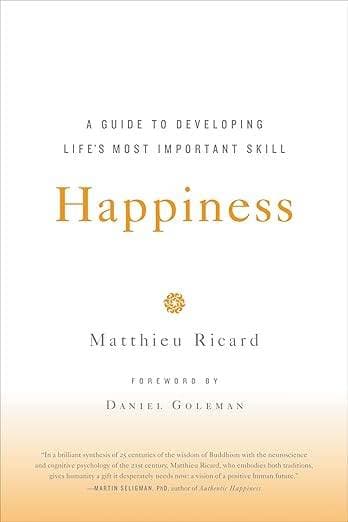
Happiness: A Guide to Developing Life’s Most Important Skill
Matthieu Ricard (Author), Jesse Browner (Translator), Daniel Goleman (Foreword)
English
Book
Little, Brown and Company, New York
2006
296 pages
2.8 MB
Introduction
The book opens with a Foreword by Daniel Goleman, who presents Matthieu Ricard as a rare figure combining scientific education, Buddhist monastic training, contemplative practice, and active participation in scientific research on meditation. Goleman emphasizes Ricard’s role in the Mind and Life dialogues and his involvement in research on how meditation may reshape the brain and strengthen emotional balance, compassion, and well-being.
The Introduction is autobiographical and philosophical. Ricard recounts his early life in France, his scientific training at the Pasteur Institute, his encounter with Tibetan Buddhist masters, his decision to live in the Himalayas, and his eventual collaboration with scientists studying meditation and emotions. He explains that happiness should be understood not as a fleeting feeling, but as a cultivated way of being grounded in inner freedom, mindfulness, and altruistic love.
Chapter 1: Talking About Happiness
Ricard begins by asking what happiness really means. He distinguishes genuine happiness from vague, temporary, or superficial forms of satisfaction. The chapter introduces happiness as a state that shapes the quality of every moment of life.
Chapter 2: Is Happiness the Purpose of Life?
This chapter examines whether happiness is the central aim of human existence. Ricard argues that the search for happiness is universal, but must be clarified so that it does not collapse into pleasure-seeking or self-centered comfort.
Chapter 3: A Two-Way Mirror: Looking Within, Looking Without
Ricard explores the relationship between inner experience and outer circumstances. He argues that external conditions matter, but the decisive factor is the way the mind interprets, processes, and responds to experience.
Chapter 4: False Friends
This chapter identifies misleading substitutes for happiness, such as pleasure, wealth, fame, distraction, power, and sensory gratification. These may provide temporary satisfaction but cannot produce durable well-being.
Chapter 5: Is Happiness Possible?
Ricard argues that lasting happiness is possible because the mind can be trained. This chapter challenges fatalistic assumptions that one’s temperament or circumstances permanently determine one’s happiness.
Chapter 6: The Alchemy of Suffering
This chapter addresses suffering not as something to deny, but as something that can be understood and transformed. Ricard draws from Buddhist practice to show how suffering can become a path toward compassion, wisdom, and inner strength.
Chapter 7: The Veils of the Ego
Ricard analyzes the ego as a major source of dissatisfaction. The chapter explains how self-centered attachment, defensiveness, pride, and insecurity create mental suffering and obstruct genuine happiness.
Chapter 8: When Our Thoughts Become Our Worst Enemies
This chapter examines the destructive power of uncontrolled thought patterns. Ricard shows how rumination, anxiety, resentment, and mental proliferation can imprison the mind, even when external circumstances are favorable.
Chapter 9: The River of Emotion
Ricard presents emotions as dynamic processes rather than fixed identities. The chapter explains that emotions arise, flow, and pass away; therefore, they can be observed, understood, and transformed.
Chapter 10: Disturbing Emotions: The Remedies
This chapter provides practical methods for working with destructive emotions. Ricard discusses awareness, antidotes, mindfulness, compassion, and insight as tools for weakening anger, craving, jealousy, and confusion.
Chapter 11: Desire
Ricard distinguishes between wholesome aspiration and compulsive desire. Desire becomes problematic when it binds the mind to dissatisfaction, craving, comparison, and endless pursuit.
Chapter 12: Hatred
This chapter analyzes hatred as one of the most destructive mental states. Ricard argues that hatred harms both the person who feels it and the person toward whom it is directed, and he proposes patience and compassion as remedies.
Chapter 13: Envy
Ricard examines envy as a painful comparison-based emotion. The chapter shows how rejoicing in others’ happiness can transform envy into appreciation and sympathetic joy.
Chapter 14: The Great Leap to Freedom
This chapter focuses on liberation from mental habits. Ricard presents inner freedom as the capacity not to be enslaved by impulses, emotions, and ego-centered reactions.
Chapter 15: A Sociology of Happiness
Ricard broadens the discussion from individual well-being to social conditions. He considers how culture, relationships, social comparison, materialism, and collective values influence happiness.
Chapter 16: Happiness in the Lab
This chapter introduces scientific research on meditation, emotion, and well-being. Ricard discusses collaboration between contemplatives and scientists, especially in the context of neuroscience and the study of trained meditators.
Chapter 17: Happiness and Altruism: Does Happiness Make Us Kind or Does Being Kind Make Us Happy?
Ricard argues that happiness and altruism mutually reinforce one another. Genuine happiness naturally expresses itself as kindness, while altruistic love deepens inner joy and reduces self-centered suffering.
Chapter 18: Happiness and Humility
This chapter presents humility not as weakness, but as freedom from egoic inflation. Humility allows openness, learning, gratitude, and more authentic relationships with others.
Chapter 19: Optimism, Pessimism, and Naïveté
Ricard distinguishes wise optimism from naïve denial. Genuine optimism is grounded in courage, realism, and confidence in transformation, not in ignoring suffering or difficulty.
Chapter 20: Golden Time, Leaden Time, Wasted Time
This chapter reflects on how human beings experience time. Ricard contrasts meaningful time with wasted or burdensome time and encourages a more mindful relationship with daily life.
Chapter 21: One with the Flow of Time
Ricard deepens the reflection on time by showing how presence, acceptance, and awareness allow one to live more harmoniously with change.
Chapter 22: Ethics as the Science of Happiness
This chapter connects ethics directly with well-being. Ricard argues that ethical conduct is not merely social duty; it is a practical science of happiness because harmful actions disturb the mind, while compassion, honesty, and non-harming support inner peace.
Chapter 23: Happiness in the Presence of Death
Ricard examines death as a decisive test of one’s understanding of happiness. Instead of avoiding mortality, he encourages reflection on death as a way to clarify priorities, reduce attachment, and live more fully.
Chapter 24: A Path
The final chapter presents happiness as a path of training. Ricard concludes that durable happiness requires sustained practice, inner transformation, wisdom, compassion, and the gradual cultivation of mental qualities.
The book ends with Acknowledgments and Notes, providing sources and references for Ricard’s philosophical, Buddhist, psychological, and scientific discussions.
Copyright Notice
This material is provided solely for academic research, study, and religious practice purposes under Article 25 of Vietnam's Intellectual Property Law. Reproduction, distribution, or commercial use is strictly prohibited.
If you are the author, translator, publisher, or rights holder and believe this content has been posted without proper authorization, please contact us and we will promptly review and remove or restrict access.
Documents
Happiness: A Guide to Developing Life’s Most Important Skill
2.8 MB
Keywords
HappinessMatthieu RicardBuddhist PsychologyMind TrainingAltruism.
Sách đọc nhiều nhất

The Buddha’s Ancient Path
Piyadassi Thera
Book·10.7 MB
229 pages1979223

The Questions of King Milinda, Part II
F. Max Müller (Editor)
Book·20.8 MB
427 pages1894208

A Taste of Freedom
Venerable Ajahn Chah / Phra Bodhinyana Thera
Book·1.2 MB
104 pages1980207

Buddhist Meditation: An Anthology of Texts from the Pāli Canon
Sarah Shaw (General Editors: Charles S. Prebish and Damien Keown)
Book·17.5 MB
253 pages2006204