
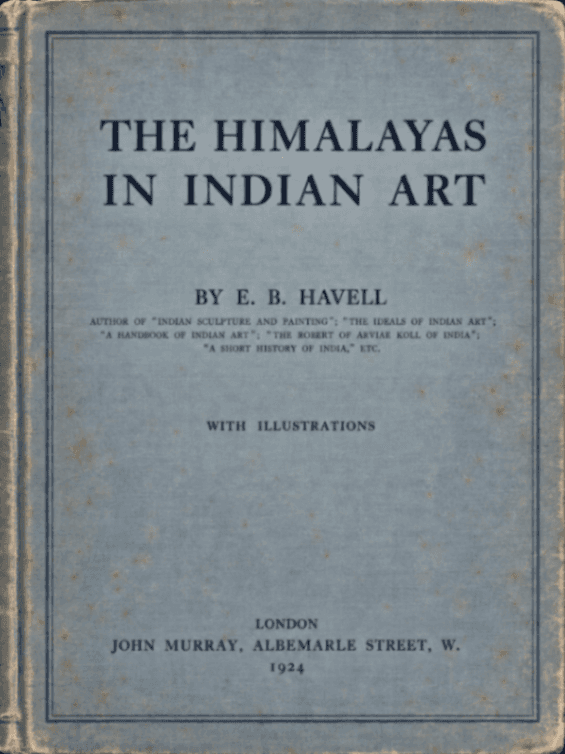
English
Himalayas in Indian Art
E. B. Havell
English
Book
John Murray; London
1924
156 pages
9.0 MB
Introduction
The Himalayas in Indian Art by E. B. Havell, published in London by John Murray in 1924, is an interpretive study of the religious, symbolic, and architectural significance of the Himalayas within the history of Indian art. The work developed from Havell’s Forlong Bequest Lectures and was conceived as a continuation and synthesis of themes he had explored in his earlier writings on Indian sculpture, painting, architecture, and aesthetics.
Rather than treating the Himalayas merely as a geographical region, Havell presents them as a major source of Indian religious imagination and artistic symbolism. He examines the sacred landscape of Mount Kailāsa and Lake Mānasarovara, pilgrimage traditions, the symbolism of mountains, rivers, lotus forms, and cosmic pillars, and the manner in which these ideas became embodied in Indian temple architecture and sculptural design. His discussion repeatedly connects natural forms in the Himalayan landscape with religious concepts associated with Śiva, Viṣṇu, Brahmā, Buddhism, and wider Indian cosmology.
The book is organized into five principal chapters: “The Indian Order of Architecture,” “Indian Pilgrimages,” “The Mountain Divided,” “The Sacred Dance,” and “The Livingness of Indian Art.” These chapters move from the symbolic foundations of Indian architecture to pilgrimage and sacred geography, Buddhist and Hindu artistic traditions, the imagery of Śiva’s cosmic dance, and finally the continuing vitality of Indian artistic principles in modern times.
A particularly important feature of the volume is Havell’s discussion of the World Lotus and World Pillar, especially in relation to the Aśokan pillar at Sārnāth, Bharhut, Sāñcī, Ajantā, and Ellora. He interprets architectural and decorative forms not simply as borrowed ornament, but as expressions of indigenous religious ideas linking the earthly world with cosmic and spiritual realities. The book also contains numerous plates and illustrations of temples, pillars, Buddhist images, sculptural reliefs, Himalayan landscapes, and sacred monuments.
Although some of Havell’s interpretations reflect the intellectual climate of early twentieth-century scholarship and should therefore be read critically alongside later archaeological and art-historical research, the book remains valuable for the history of Indian art studies. It is especially useful for readers interested in Indian aesthetics, sacred geography, temple symbolism, Buddhist and Hindu iconography, architectural symbolism, and early modern interpretations of Indian artistic traditions.
Copyright Notice
This material is provided solely for academic research, study, and religious practice purposes under Article 25 of Vietnam's Intellectual Property Law. Reproduction, distribution, or commercial use is strictly prohibited.
If you are the author, translator, publisher, or rights holder and believe this content has been posted without proper authorization, please contact us and we will promptly review and remove or restrict access.
Documents
Himalayas in Indian Art
9.0 MB
Keywords
The Himalayas in Indian ArtE. B. HavellIndian ArtIndian Art HistoryHimalayan ArtHimalayasSacred GeographyIndian AestheticsIndian ArchitectureTemple ArchitectureIndian Temple ArchitectureBuddhist ArtHindu ArtBuddhist IconographyHindu IconographyIndian SymbolismReligious SymbolismSacred LandscapeMount KailasaKailāsaLake ManasarovarMānasarovaraIndian PilgrimagePilgrimage ArtWorld LotusLotus SymbolismWorld PillarCosmic PillarAshokan PillarsSarnath PillarSanchiBharhutAjantaElloraKailasa TempleShivaŚivaVishnuViṣṇuBrahmaBrahmāNatarajaSacred DanceBuddhist SculptureHindu SculptureIndian CosmologyVedic SymbolismPuranic SymbolismIndian Religious ArtIndian Visual CultureSacred ArchitectureArt and ReligionEarly Indian Art StudiesForlong Bequest Lectures.
Sách đọc nhiều nhất
The Buddha’s Ancient Path
Piyadassi Thera
Book·10.7 MB
229 pages1979223
The Questions of King Milinda, Part II
F. Max Müller (Editor)
Book·20.8 MB
427 pages1894208
A Taste of Freedom
Venerable Ajahn Chah / Phra Bodhinyana Thera
Book·1.2 MB
104 pages1980207
Buddhist Meditation: An Anthology of Texts from the Pāli Canon
Sarah Shaw (General Editors: Charles S. Prebish and Damien Keown)
Book·17.5 MB
253 pages2006204