
English
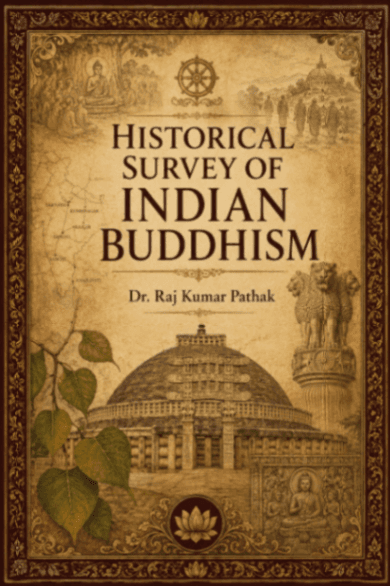
Historical Survey of Indian Buddhism
Raj Kumar Pathak
English
Book
Ramanand Vidya Bhawan, New Delhi
1989
86 pages
147.9 MB
Introduction
The book opens by explaining that Buddhism arose within a wider Indian religious context marked by Vedic sacrifice, Brahmanical authority, caste-based privilege, and the emerging inward speculation of the Upaniṣads. The author emphasizes that the Buddha’s teaching challenged ritualism, priestly monopoly, caste exclusiveness, animal sacrifice, extreme asceticism, and speculative dogmatism. The early chapters present Buddhism as a humanitarian and ethical movement that offered moral discipline, the Middle Path, and liberation to all people regardless of caste or social status.
A substantial portion of the work is devoted to Buddhism during the Buddha’s lifetime. The discussion highlights the importance of royal and lay support, especially in Magadha and Kosala. Bimbisāra, Ajātaśatru, Pasenadi, Anāthapiṇḍika, and the early disciples are treated as crucial figures in establishing the Saṅgha and spreading the Dhamma. This section shows that Buddhism’s early success depended not only on doctrine, but also on the Buddha’s personality, the quality of his disciples, the institutional strength of the Saṅgha, and strategic support from ruling elites.
The central historical section focuses on Aśoka. The author presents Aśoka’s conversion after the Kalinga war as a turning point in Indian Buddhist history. His Dhamma is discussed through the edicts, pilgrimages, concern for the Saṅgha, animal welfare, public works, missionary activity, and religious tolerance. Aśoka is portrayed as a Buddhist emperor whose policies helped Buddhism move beyond India and become a transregional religion.
The chapter on Kaniṣka examines the transformation of Buddhism in the Kushan period. The author connects Kaniṣka with the Fourth Buddhist Council, Sarvāstivāda scholasticism, the rise of Sanskrit Buddhist literature, the growth of Mahāyāna tendencies, and the development of Gandhāra art. This part is important because it shows how Buddhism adapted to new cultural, linguistic, artistic, and philosophical environments.
The section on Buddhist councils summarizes their role in preserving doctrine, Vinaya, and textual transmission. The First Council is linked with the preservation of Dhamma and Vinaya; the Second with the Vinaya dispute at Vaiśālī; the Third with Aśoka, Moggaliputta Tissa, purification of the Saṅgha, and missionary expansion; and the Fourth with Kaniṣka, commentarial activity, and northern Buddhist scholastic developments.
The chapter on Harṣavardhana presents a later revival of Buddhism in North India, especially through royal patronage, Mahāyāna support, public assemblies, charity, and the influence of Xuanzang. The final chapter analyzes the decline of Buddhism in India through multiple causes: political instability, loss of royal support, internal corruption of the Saṅgha, ritual and Tantric developments, Brahmanical resurgence, persecution by certain rulers, Muslim invasions, and gradual assimilation into Hindu traditions.
Copyright Notice
This material is provided solely for academic research, study, and religious practice purposes under Article 25 of Vietnam's Intellectual Property Law. Reproduction, distribution, or commercial use is strictly prohibited.
If you are the author, translator, publisher, or rights holder and believe this content has been posted without proper authorization, please contact us and we will promptly review and remove or restrict access.
Documents
Historical Survey of Indian Buddhism
147.9 MB
Keywords
Indian BuddhismAśokaKaniṣkaBuddhist councilsMahāyānaBuddhist declineBuddhist history.
Sách đọc nhiều nhất
The Buddha’s Ancient Path
Piyadassi Thera
Book·10.7 MB
229 pages1979223
The Questions of King Milinda, Part II
F. Max Müller (Editor)
Book·20.8 MB
427 pages1894208

A Taste of Freedom
Venerable Ajahn Chah / Phra Bodhinyana Thera
Book·1.2 MB
104 pages1980207
Buddhist Meditation: An Anthology of Texts from the Pāli Canon
Sarah Shaw (General Editors: Charles S. Prebish and Damien Keown)
Book·17.5 MB
253 pages2006204