English
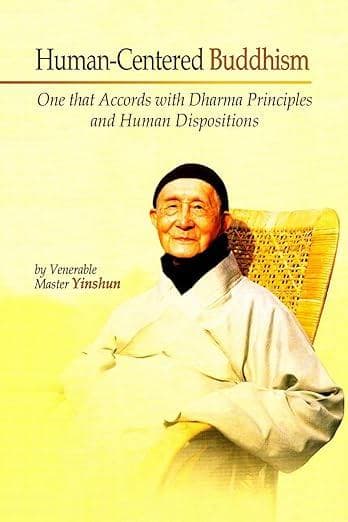
Human-Centered Buddhism - One that Accords with Dharma Principles and Human Dispositions
Venerable Master Yinshun (Author), Dharma Translation Team (Translator), Franz Li (Translator)
English
Book
Dharma Translation Team
2009
99 pages
971 KB
Introduction
The book opens with a Translation Team Preface, which compares the historical transmission of Buddhism to China with the contemporary transmission of Buddhism to the West. The translators explain that modern Western readers encounter many Buddhist traditions, doctrines, and practices that developed across different Asian contexts over 2,500 years. Against this background, Master Yinshun’s work provides a framework for identifying the essential principles of Buddhism and adapting them to modern life without losing their doctrinal integrity. The preface also introduces Yinshun as a major Chinese Buddhist scholar-monk, a disciple of Master Taixu, and a reformer who sought a down-to-earth Buddhism centered on human life.
Chapter One: Conviction and Attitude in the Study of Buddhism
This chapter presents Yinshun’s basic research conviction and Buddhist standpoint. He explains that his lifelong project was to investigate the whole body of Buddhist teachings in order to identify which Dharma methods should be promoted in the modern age. His guiding statement is that one should be grounded in Original Buddhism, promote Early Mahāyāna, and selectively incorporate appropriate teachings from Late Mahāyāna.
Yinshun stresses that he is neither a revivalist of ancient forms nor an inventor of new doctrines. His aim is to invigorate the pure Dharma by adapting to present conditions without departing from the Buddha’s essential teaching. The chapter also explains his methodology: Buddhist study must be guided by the principles of impermanence, non-self, and nirvāṇa. This means that Buddhist doctrine should be studied historically, without personal bias, and with attention to interdependent causes and conditions.
Chapter Two: Classification of the History of Indian Buddhist Thought
This chapter gives Yinshun’s major classification of Indian Buddhist history. He divides Indian Buddhism into five periods: the śrāvaka-centered liberation period, the transition toward bodhisattva thought, the Mahāyāna period centered on the bodhisattva doctrine, the transition toward tathāgata doctrine, and the final esoteric period characterized by the “oneness of deities and the Buddha.”
He also offers a three-period classification: Early Buddhism, Mahāyāna Buddhism, and Esoteric Mahāyāna Buddhism. Within Mahāyāna, he further distinguishes three doctrinal systems: empty nature mere name, delusive discernment mere consciousness, and true permanence mere mind. This classification becomes the intellectual basis for his later argument that Buddhism must be judged according to both Dharma principles and human dispositions.
Chapter Three: A Discussion of the Tiantai and Xianshou Classifications of Buddhist Doctrines from the Historic Perspective of Indian Buddhism
This chapter is relocated to the appendix in the English translation. It addresses Chinese Buddhist doctrinal classification systems, especially those associated with Tiantai and Xianshou/Huayan traditions, from the standpoint of Indian Buddhist historical development. Its function is to show how Chinese Buddhist classification systems can be reexamined in light of the chronological evolution of Buddhism in India.
Chapter Four: Indian Buddhism’s Evolutionary Journey
This chapter presents Indian Buddhism as a historical process of emergence, growth, maturity, decline, and disappearance. Yinshun compares the evolution of Indian Buddhism to the life cycle of a human being: childhood, youth, adulthood, old age, and death. He rejects two simplistic assumptions: that the oldest form of Buddhism is automatically the most authentic, and that later forms are automatically more complete or superior.
The chapter discusses Early Buddhism’s emphasis on conditioned origination and nirvāṇa, Early Mahāyāna’s teaching of emptiness, Late Mahāyāna’s tathāgatagarbha and buddha-nature teachings, and Esoteric Mahāyāna’s incorporation of deities, mantras, visualization, and ritual elements. Yinshun’s central concern is to distinguish doctrinal development from doctrinal degeneration. He is especially cautious toward the increasing deification and ritualization of Buddhism.
Chapter Five: Criteria for Classification of Buddhist Doctrines
This chapter explains the criteria Yinshun uses to classify Buddhist teachings. He draws on the four siddhāntas, or teaching approaches: worldly siddhānta, therapeutic siddhānta, individually adapted siddhānta, and supreme-meaning siddhānta. He connects these with the early Buddhist Nikāya/Āgama tradition and argues that Buddhist scriptures developed with different teaching objectives.
Yinshun uses this framework to classify Indian Buddhist history. Early Buddhism corresponds mainly to the supreme-meaning siddhānta; Early Mahāyāna emptiness teachings correspond to therapeutic siddhānta; Late Mahāyāna tathāgatagarbha teachings correspond to individually adapted siddhānta; and Esoteric Mahāyāna corresponds to worldly siddhānta. This chapter is important because it provides the hermeneutical basis for evaluating Buddhist doctrines without treating all scriptures as having the same doctrinal status.
Chapter Six: Buddhism that Accords with Dharma Principles and Also Accommodates the Needs of the World
This chapter directly develops the idea of Buddhism that is faithful to Dharma principles while also responsive to changing human conditions. Yinshun argues that Buddhism must avoid two errors: rigid attachment to inherited forms and careless adaptation that loses the Dharma’s essence.
He emphasizes that Buddhist teaching should be adapted according to human dispositions, but adaptation must not become secularized dilution or deification. Buddhism should remain rooted in conditioned origination, non-self, compassion, ethical conduct, and the path of liberation. The chapter establishes the practical and doctrinal foundation for human-centered Buddhism as a modern Buddhist orientation.
Chapter Seven: The Youthful and Strong Human-Centered Buddhism
This chapter clarifies Yinshun’s relationship to Master Taixu’s thought. Yinshun acknowledges Taixu’s influence but also distinguishes his own view. Taixu emphasized human-life Buddhism as a response to the modern age, while Yinshun seeks deeper scriptural and historical grounding for human-centered Buddhism through Indian Buddhist development.
Yinshun criticizes forms of Chinese Buddhism that emphasize the easiest method, fastest realization, or most perfect theory, such as instant buddhahood, rebirth in the Pure Land at death, or immediate realization of one’s nature. Instead, he argues that modern Buddhism should cultivate youthful, strong, socially engaged bodhisattva practice. Human-centered Buddhism should especially encourage human beings to develop right understanding, compassion, moral discipline, and active service in society.
Chapter Eight: The Path of Liberation and the Practice of Loving-Kindness and Compassion
This chapter explains how human-centered Buddhism is grounded in the path of liberation while also extending into loving-kindness and compassion. Yinshun argues that human-centered Buddhism does not abandon Original Buddhism. Rather, it takes the Buddha’s original teaching as its foundation.
He notes that in the Buddha’s time both monastics and lay disciples practiced the path of liberation. The Eightfold Noble Path includes right view, right intention, right speech, right action, right livelihood, right effort, right mindfulness, and right concentration. For householders, right livelihood means lawful and Dharma-consistent ways of supporting life. The chapter emphasizes that the Buddha rejected caste ideology, supplication to gods, divination, ritual sacrifice, and improper livelihood. Instead, Buddhism teaches moral causality, wholesome action, and responsibility for human destiny.
Chapter Nine: A True Picture of Human Bodhisattva Deeds
This chapter presents human bodhisattva practice as the heart of human-centered Buddhism. Yinshun explains that the bodhisattva path is not a supernatural or otherworldly ideal removed from ordinary life. It begins with human beings who recognize their defilements, cultivate correct confidence and understanding, and practice compassion through concrete beneficial action.
He describes human-centered Buddhism as revolving around humans, bodhisattvas, and buddhas: a human being arouses the bodhisattva aspiration, practices bodhisattva deeds, and eventually perfects buddhahood. This path requires avoiding pretension, rejecting displays of supernatural power, undertaking the higher training of compassion, practicing the ten wholesome actions, benefiting sentient beings, and preserving the Dharma.
Chapter Ten: Advancing Towards the Right Goal
The final chapter gathers the book’s central message and points toward the proper direction for Buddhism in the modern world. Yinshun warns that those who support human-centered Buddhism may fall into shallow secularization if they neglect Dharma principles. At the same time, he insists that Buddhism must not be confined to deified, ritualized, or otherworldly forms that fail to address human life.
The chapter concludes that human-centered Buddhism should focus on human bodhisattva deeds, connect Original Buddhism with Mahāyāna compassion, and return Buddhism to the human realm here and now. Its objective is not merely social service, nor merely personal liberation, but the integration of self-cultivation, benefit to others, Dharma preservation, and the gradual path toward buddhahood.
Appendix: A Discussion of the Tiantai and Xianshou Classifications of Buddhist Doctrines from the Historic Perspective of Indian Buddhism
The appendix examines Chinese Buddhist doctrinal classification in light of Indian Buddhist history. It helps readers understand how Tiantai and Xianshou systems relate to broader Buddhist development. Its inclusion reinforces Yinshun’s major methodological point: doctrinal systems should be studied historically, critically, and in relation to the actual evolution of Buddhist thought.
Copyright Notice
This material is provided solely for academic research, study, and religious practice purposes under Article 25 of Vietnam's Intellectual Property Law. Reproduction, distribution, or commercial use is strictly prohibited.
If you are the author, translator, publisher, or rights holder and believe this content has been posted without proper authorization, please contact us and we will promptly review and remove or restrict access.
Documents
Human-Centered Buddhism - One that Accords with Dharma Principles and Human Dispositions
971 KB
Keywords
Human-Centered BuddhismYinshunBuddhist ReformIndian Buddhist ThoughtBodhisattva Practice.
Sách đọc nhiều nhất
The Buddha’s Ancient Path
Piyadassi Thera
Book·10.7 MB
229 pages1979223
The Questions of King Milinda, Part II
F. Max Müller (Editor)
Book·20.8 MB
427 pages1894208

A Taste of Freedom
Venerable Ajahn Chah / Phra Bodhinyana Thera
Book·1.2 MB
104 pages1980207
Buddhist Meditation: An Anthology of Texts from the Pāli Canon
Sarah Shaw (General Editors: Charles S. Prebish and Damien Keown)
Book·17.5 MB
253 pages2006204