English
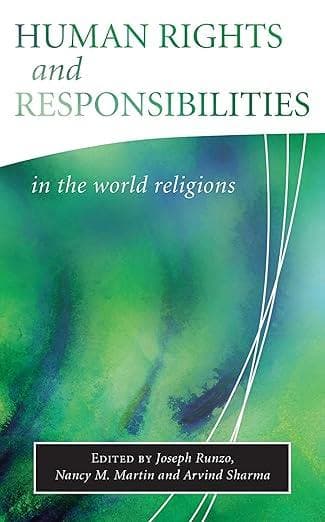
Human Rights and Responsibilities in the World Religions (Library of Global Ethics & Religion)
Joseph Runzo (Author), Nancy M Martin (Author), Arvind Sharma (Author)
English
Book
Oneworld Publications, Oxford
2003
401 pages
2.6 MB
Introduction
The volume opens with introductory materials, including a list of illustrations, contributors, acknowledgments, and an introduction. The cover and front matter identify the work as part of The Library of Global Ethics and Religion, a series devoted to pluralistic and global perspectives on major ethical questions. The volume is dedicated to Ninian Smart and Vasudha Narayanan, two scholars associated with interreligious understanding.
Introduction
The introduction frames the main problem of the book: religions have often been used to justify violations of human rights, but they have also served as powerful voices of critique against injustice. The editors ask what the world religions can contribute to the understanding and fulfillment of human rights and responsibilities. They emphasize that religion can provide moral motivation, spiritual depth, and communal resources that secular legal discourse alone may not fully supply.
The introduction also explains the structure of the book. It highlights the tension between universality and particularity: human rights must be universal enough to protect all persons, but also sensitive enough to engage different religious and cultural traditions. The volume therefore combines theoretical essays, legal analysis, interreligious responses, and tradition-specific studies.
Part I: Secular and Religious Ethics
Chapter 1: “Secular Rights and Religious Responsibilities” — Joseph Runzo
Runzo examines the modern history of rights discourse and argues that religion should not be viewed simply as an enemy of human rights. He presents the “religious point of view” as a source of relationality, moral responsibility, and human interdependence. The chapter argues that rights must be balanced by responsibilities and that religious traditions can help correct the ego-centered tendencies of purely individualistic rights discourse.
Chapter 2: “The Synergy and Interdependence of Human Rights, Religion, and Secularism” — Abdullahi A. An-Na‘im
An-Na‘im argues that human rights, religion, and secularism are mutually interdependent. Religion can provide moral grounding and motivation for rights, while secularism provides a political framework in which diverse religious and non-religious communities can coexist. He emphasizes that human rights must be embraced internally by communities, not merely imposed externally.
Chapter 3: “Faith, Faiths, and the Future: The First Two Limbs of Yoga” — Arindam Chakrabarti
Chakrabarti explores the possibility of global ethical cooperation across religious traditions. Drawing on Indian philosophical and yogic resources, he addresses the problem of religious violence and argues for a form of faith that can support pluralism, self-discipline, and respect for difference.
Chapter 4: “The Religious Perspective: Dignity as a Foundation for Human Rights Discourse” — Arvind Sharma
Sharma argues that human dignity can serve as a foundation for human rights. He suggests that religious traditions can deepen rights discourse by grounding dignity in a transcendent or ultimate dimension. This chapter provides an important bridge between legal rights language and religious anthropology.
Part II: Being Human and Having Rights
Chapter 5: “Rats, Cockroaches, and People Like Us: Views of Humanity and Human Rights” — Gerrie ter Haar
This chapter examines what it means to be human and why being human should generate rights. Ter Haar addresses cultural relativism, dehumanization, multiculturalism, globalization, and the constructive or destructive role religion can play in defining human identity.
Chapter 6: “Humanitarian Intervention, International Law, and the World Religions” — Brian D. Lepard
Lepard studies humanitarian intervention from the standpoint of international law and world religions. He asks when intervention may be justified to stop human rights violations. The chapter emphasizes the unity of the human family, ethical responsibility to help those in need, open consultation, and the use of force only as a last resort.
Chapter 7: “Human Rights, Environmental Rights, and Religion” — James Kellenberger
Kellenberger analyzes the nature of rights in the United Nations Universal Declaration of Human Rights and argues that such rights are moral, not merely legal. He also considers whether person–environment relationships can ground environmental rights, especially within Christian and Jewish traditions.
Part III: A Declaration of Human Rights by the World’s Religions
Chapter 8: “Towards a Declaration of Human Rights by the World’s Religions” — Arvind Sharma
Sharma introduces the project of developing a religiously grounded declaration of human rights. The chapter explains the need for a document that does not replace the United Nations Declaration, but enriches it through the moral and spiritual resources of the world religions.
Chapter 9: “A Universal Declaration of Human Rights by the World’s Religions”
This chapter presents the working declaration itself. The declaration seeks to articulate rights and responsibilities in a way that can be discussed, revised, and evaluated by scholars, religious leaders, and religious communities across the world.
Chapter 10: “A Universal Declaration of Human Rights by the World’s Religions: A Jewish Perspective” — Charlotte Elisheva Fonrobert
Fonrobert responds to the declaration from a Jewish perspective, considering how Jewish legal, ethical, and communal traditions engage human rights language.
Chapter 11: “A Christian Response to the Universal Declaration of Human Rights by the World’s Religions” — Jerry Irish
Irish evaluates the declaration from a Christian ethical perspective, examining how Christian theology and moral responsibility can support and critique rights discourse.
Chapter 12: “‘This Tremor of Western Wisdom’: A Muslim Response to Human Rights and the Declaration” — Amir Hussain
Hussain responds from an Islamic perspective, addressing the relationship between human rights, Western discourse, Muslim communities, and the possibility of religiously grounded universal ethics.
Chapter 13: “Can One Size Fit All? Indic Perspectives on the Declaration of Human Rights by the World’s Religions” — Christopher Key Chapple
Chapple examines the declaration from Indic religious perspectives, including Hindu, Buddhist, and Jain concerns. The chapter addresses nonviolence, duty, diversity, and the challenge of universal rights language.
Chapter 14: “Interreligious Dialogue, Globalization, and Human Rights: Buddhist Reflections on Interdependence and the Declaration” — David W. Chappell
Chappell offers Buddhist reflections on human rights through the lens of interdependence. He considers how Buddhist thought can contribute to global dialogue, responsibility, compassion, and the transformation of rights discourse.
Chapter 15: “Human Rights and Responsibilities: A Confucian Perspective on the Universal Declaration of Human Rights” — John Berthrong
Berthrong examines the declaration from a Confucian perspective. He emphasizes relational ethics, social roles, responsibility, harmony, and the Confucian contribution to balancing rights with duties.
Part IV: Rights and Religious Traditions
Chapter 16: “A Jewish Perspective on Human Rights” — Elliot N. Dorff
Dorff grounds human rights in Jewish understandings of the human being as created in the image of God. He argues that commandments in the Torah guarantee rights and make the protection of rights a religious responsibility. The chapter also gives special attention to the right to privacy.
Chapter 17: “Christian Ethics and Human Rights” — Philip Quinn
Quinn analyzes Christianity and human rights, especially in relation to critical assessments of religion’s role in rights discourse. He argues that Christian ethics can provide strong support for human rights when properly understood.
Chapter 18: “Buddhism and Human Rights: The Recent Buddhist Discussion and Its Implications for Christianity” — James Fredericks
Fredericks examines the Buddhist debate over human rights. He notes that Buddhist thinkers often criticize rights discourse for being too individualistic, adversarial, anthropocentric, and symptom-focused. The chapter explores how Buddhist concepts of compassion, interdependence, and the reduction of suffering may reshape rights discourse and offer insights for Christianity.
Chapter 19: “Rights, Roles, and Reciprocity in Hindu Dharma” — Nancy M. Martin
Martin studies human rights through the Hindu concept of dharma. She explains that Hindu traditions often emphasize role-based duties rather than abstract individual rights. The chapter argues that Hinduism can contribute an alternative model of egalitarian complementarity, preserving difference while affirming dignity and responsibility.
Chapter 20: “Confucian Values and Human Rights” — Sumner B. Twiss
Twiss challenges the assumption that Confucianism is necessarily authoritarian or hostile to human rights. He traces developments in Confucian thought and identifies analogues to rights within Confucian moral and political traditions.
Chapter 21: “The Human Rights Commitment in Modern Islam” — Khaled Abou El Fadl
Abou El Fadl offers an extensive analysis of Islam and human rights. He addresses colonialism, cultural imperialism, Islamic law, Shari‘a, authority, interpretation, and contemporary Muslim debates. He argues that support for human rights is not foreign to Islam, but can be understood as a fulfillment of Islamic moral and legal commitments.
Supplementary Materials
The book concludes with a Select Bibliography and an Index. It also includes a list of illustrations, many of which depict religious, ethical, and human rights symbols from different global contexts, including Gandhi’s statue in Pietermaritzburg, human rights murals in South Africa, Buddhist images, Confucian temples, Christian stained-glass windows, Muslim worship sites, and Jewish synagogues.
Copyright Notice
This material is provided solely for academic research, study, and religious practice purposes under Article 25 of Vietnam's Intellectual Property Law. Reproduction, distribution, or commercial use is strictly prohibited.
If you are the author, translator, publisher, or rights holder and believe this content has been posted without proper authorization, please contact us and we will promptly review and remove or restrict access.
Documents
Human Rights and Responsibilities in the World Religions
2.6 MB
Keywords
Human RightsHuman ResponsibilitiesWorld ReligionsGlobal EthicsInterreligious Dialogue.
Sách đọc nhiều nhất
The Buddha’s Ancient Path
Piyadassi Thera
Book·10.7 MB
229 pages1979223
The Questions of King Milinda, Part II
F. Max Müller (Editor)
Book·20.8 MB
427 pages1894208

A Taste of Freedom
Venerable Ajahn Chah / Phra Bodhinyana Thera
Book·1.2 MB
104 pages1980207
Buddhist Meditation: An Anthology of Texts from the Pāli Canon
Sarah Shaw (General Editors: Charles S. Prebish and Damien Keown)
Book·17.5 MB
253 pages2006204