
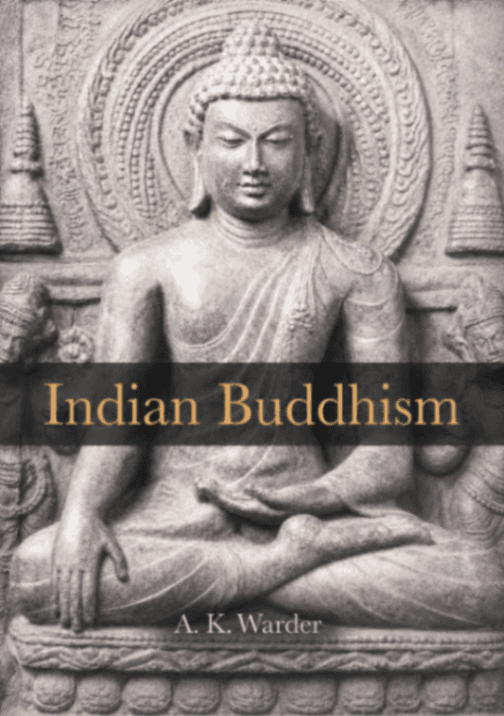
English
Indian Buddhism
A. K. Warder
English
Book
Motilal Banarsidass Publishers Pvt. Ltd., Delhi
1991
599 pages
127.6 MB
Introduction
The book is organized as a comprehensive historical progression of Indian Buddhism. It first discusses Indian civilisation before the Buddha, the religious and philosophical environment of the Buddha’s time, and the life of the Buddha from birth to parinirvāṇa. It then presents the Buddha’s doctrine, especially the principles connected with enlightenment, the Eightfold Path, causation, conditioned origination, consciousness, impermanence, freedom, and knowledge. The following chapters explore Buddhism’s social dimension, including the lay disciple, good government, class, priesthood, and the relation between Buddhist practice and society. Warder then studies the collection of the Tripiṭaka, the early councils, schisms, Abhidharma, and the popularisation of Buddhism through pagodas, pilgrimage, poetry, storytelling, and Aśoka’s religious policy. The later sections examine the eighteen schools, Theravāda/Sthaviravāda, Sarvāstivāda, Sautrāntika, Mahāyāna, Madhyamaka, Nāgārjuna, Yogācāra idealism, Asaṅga, Vasubandhu, Dignāga, Dharmakīrti, the Buddhist universities, medieval scholastic developments, and Mantrayāna.
Copyright Notice
This material is provided solely for academic research, study, and religious practice purposes under Article 25 of Vietnam's Intellectual Property Law. Reproduction, distribution, or commercial use is strictly prohibited.
If you are the author, translator, publisher, or rights holder and believe this content has been posted without proper authorization, please contact us and we will promptly review and remove or restrict access.
Documents
Indian Buddhism
127.6 MB
Keywords
Indian BuddhismEarly BuddhismTripiṭakaBuddhist schoolsMadhyamakaYogācāraBuddhist philosophy.
Sách đọc nhiều nhất
The Buddha’s Ancient Path
Piyadassi Thera
Book·10.7 MB
229 pages1979223
The Questions of King Milinda, Part II
F. Max Müller (Editor)
Book·20.8 MB
427 pages1894208

A Taste of Freedom
Venerable Ajahn Chah / Phra Bodhinyana Thera
Book·1.2 MB
104 pages1980207
Buddhist Meditation: An Anthology of Texts from the Pāli Canon
Sarah Shaw (General Editors: Charles S. Prebish and Damien Keown)
Book·17.5 MB
253 pages2006204