English
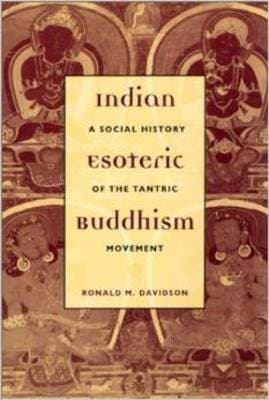
Indian Esoteric Buddhism: A Social History of the Tantric Movement
Ronald M. Davidson
English
Book
Columbia University Press, New York
2002
497 pages
4.1 MB
Introduction
The book begins with front matter including Maps and Illustrations, Preface, Acknowledgments, and a Pronunciation and Orthographic Guide. The list of maps and figures shows the book’s strong historical and material orientation, including maps of early medieval India, major Indian powers between c. 750–950 CE, Orissa, and probable sites of Buddhist siddha activity. The illustrations include images from Nālandā, Kashmir, Orissa, Ratnagiri, Hirapur, and other major sites connected with tantric and siddha traditions.
Chapter 1: Introduction: A Plethora of Premises
The introduction establishes the methodological and historical foundation of the book. Davidson begins with passages from the Mañjuśrīmūlakalpa to show the close relationship between esoteric Buddhist practitioners and political power. He argues that early medieval Buddhist figures were not isolated contemplatives only concerned with private liberation; many were involved in courts, royal service, debate, ritual performance, and statecraft.
The chapter presents the book’s main thesis: esoteric Buddhism arose as a Buddhist response to the feudal and political structures of early medieval India. Davidson proposes that the ritual world of Buddhist Tantra sacralized the social world around it. Mandalas, consecrations, divine hierarchies, ritual power, and tantric kingship cannot be understood apart from the political vocabulary of the period.
The chapter also discusses historiographical problems: the tendency of Buddhist studies to privilege origins, early texts, and doctrinal purity; the danger of treating Tantra as a degeneration of Buddhism; and the need to study esoteric Buddhism through history, institutions, and social context.
Chapter 2: Prayers in the Palace, Swords in the Temple: Early Medieval India
This chapter reconstructs the political and military background of early medieval India. Davidson challenges the tendency to treat the post-Gupta period as merely a time of decline. Instead, he describes it as a period of regional vitality, military opportunism, political fragmentation, and new forms of kingship.
The chapter examines the fall of earlier imperial structures, the rise of regional powers, the militarization of political culture, and the increasing divinization of kingship. Davidson argues that early medieval Indian political culture increasingly imagined kings as divine or semi-divine figures. At the same time, religious literature began to organize divinities in feudal and royal patterns.
Major sections include: The Occlusion of the Medieval, Early Medieval Political and Military Events, The Culture of Military Opportunism, Aesthetics and the Apotheosis of Kingship, and Feudalization of Divinity.
Chapter 3: The Medieval Buddhist Experience
This chapter examines how Buddhist institutions responded to early medieval social and political transformations. Davidson argues that Buddhist communities experienced both pressure and adaptation. The loss of older patronage systems, especially guild-based support, weakened some Buddhist institutions, while large monasteries became increasingly important centers of administration, learning, and ritual authority.
The chapter also discusses the decline of women’s visible participation in Buddhist institutional life, the loss of important Buddhist regions such as Kuntala and Andhrapatha, the turn toward epistemology, and the rise of large monastic establishments. Davidson portrays medieval Buddhism as a tradition under pressure but also creatively transforming itself.
Major sections include: Guilds, Commerce, and Political Legitimacy, Politics, Patronage, and Ethics, Medieval Women’s Buddhism, A Loss of Footing, The Turn to Epistemology, and Big Important Monasteries—Administrators in Maroon Robes.
Chapter 4: The Victory of Esoterism and the Imperial Metaphor
This is one of the core chapters of the book. Davidson argues that esoteric Buddhism became successful because it adopted and sacralized the political logic of early medieval kingship. The practitioner’s ritual identity is modeled on becoming a rājādhirāja, or supreme overlord, within a mandala.
The chapter analyzes consecration rites, mandalas, ritual access, institutional authority, monastic ritual activity, and the sacralization of territory. Davidson presents the mandala not merely as a mystical diagram but as a symbolic political field, reflecting the hierarchical organization of kings, vassals, domains, and ritual authority.
Major sections include: Chronology: The Seventh-Century Beginning, Becoming the Rājādhirāja, Mandalas and Fields of Plenty, Becoming the Institution, Monks and Their Rituals, and Sacralization of the Domain.
Chapter 5: Siddhas and the Religious Landscape
This chapter turns from monastic esoterism to the world of the siddhas, the charismatic Buddhist perfected beings associated with tantric practice, wandering lifestyles, ritual power, and transgressive religious identity. Davidson examines siddha models in relation to Śaiva, Śākta, Kāpālika, Kaula, and Pāśupata traditions.
The chapter emphasizes that Buddhist siddhas emerged within a competitive religious landscape. They interacted with non-Buddhist ascetic orders, tribal communities, cremation-ground symbolism, marginal spaces, and local sacred geographies. Davidson does not present siddhas as purely literary fantasy; rather, he treats them as complex figures shaped by social imagination, ritual practice, and historical religious competition.
Major sections include: Some Siddha Social Models, First Moments in Siddha Identity, Śaiva and Śākta Ascetic Orders, Marginal Siddha Topography, Buddhist Siddhas and the Vidyādharas, Indian Sacred Geography, Bhairava and Heruka, and Siddhas in the Tribal Landscape.
Chapter 6: Siddhas, Literature, and Language
This chapter analyzes tantric literature, revelation, coded language, secrecy, and the social production of siddha scriptures. Davidson studies the rise of Mahāyoga and Yoginī Tantra literature, paying attention to sexual imagery, extreme language, symbolic reversal, and the coded forms of tantric discourse.
The chapter argues that siddha scriptural production should not be imagined simply as individual mystical authorship. Instead, Davidson emphasizes interactive, social, and performative models of authorship and reception. The chapter also discusses secret language, ritual codes, bilingualism, diglossia, humor, and the role of vernacular and non-elite linguistic registers.
Major sections include: Regional Towns and the Lay Siddha, The Hidden Scriptures, From Transmission to Reception, The Magic Decoder, Coded Language as Secret Ritual Words, Secret Sacred Sociolinguistics, and Extreme Language and Comedy in the Tantras.
Chapter 7: Siddhas, Monks, and Communities
This chapter studies siddha communities, ritual circles, mandalas, tantric feasts, lineage imagination, and actual social formations. Davidson examines how siddhas were imagined both as isolated charismatic figures and as members of networks, circles, lineages, and ritual communities.
The chapter discusses goddess circles, siddha mandalas, the number eighty-four in siddha traditions, hagiographical communities, Buddhajñānapāda’s travels, gaṇacakra rituals, rules of order, self-criticism, and correction within tantric communities. Davidson also revisits the imperial metaphor and argues that the siddha ideal reframes power as mastery over vidyādharas, deities, and ritual domains.
Major sections include: Siddha Mandalas, Circles of Goddesses, Siddhas in a Circle, Siddhas in a Line, Siddhas in a Mob, Hagiographical Communities, Gatherings and Gaṇacakras, Rules of Order, Self-Criticism and Correction, and Becoming the Vidyādhara-Cakravartin.
Chapter 8: Conclusion: The Esoteric Conundrum
The conclusion synthesizes the book’s major argument: esoteric Buddhism cannot be understood apart from the political, social, institutional, and religious transformations of early medieval India. Davidson argues that Buddhist Tantra was neither a mere decline from earlier Buddhism nor a purely mystical innovation. It was a complex historical formation that drew from monastic institutions, royal ideology, siddha culture, Śaiva-Śākta competition, ritual technologies, sacred geography, coded language, and new social worlds.
Copyright Notice
This material is provided solely for academic research, study, and religious practice purposes under Article 25 of Vietnam's Intellectual Property Law. Reproduction, distribution, or commercial use is strictly prohibited.
If you are the author, translator, publisher, or rights holder and believe this content has been posted without proper authorization, please contact us and we will promptly review and remove or restrict access.
Documents
Indian Esoteric Buddhism A Social History of the Tantric Movement
4.1 MB
Keywords
Indian Esoteric BuddhismVajrayānaBuddhist TantraSiddhasMedieval India.
Sách đọc nhiều nhất
The Buddha’s Ancient Path
Piyadassi Thera
Book·10.7 MB
229 pages1979223
The Questions of King Milinda, Part II
F. Max Müller (Editor)
Book·20.8 MB
427 pages1894208

A Taste of Freedom
Venerable Ajahn Chah / Phra Bodhinyana Thera
Book·1.2 MB
104 pages1980207
Buddhist Meditation: An Anthology of Texts from the Pāli Canon
Sarah Shaw (General Editors: Charles S. Prebish and Damien Keown)
Book·17.5 MB
253 pages2006204