English
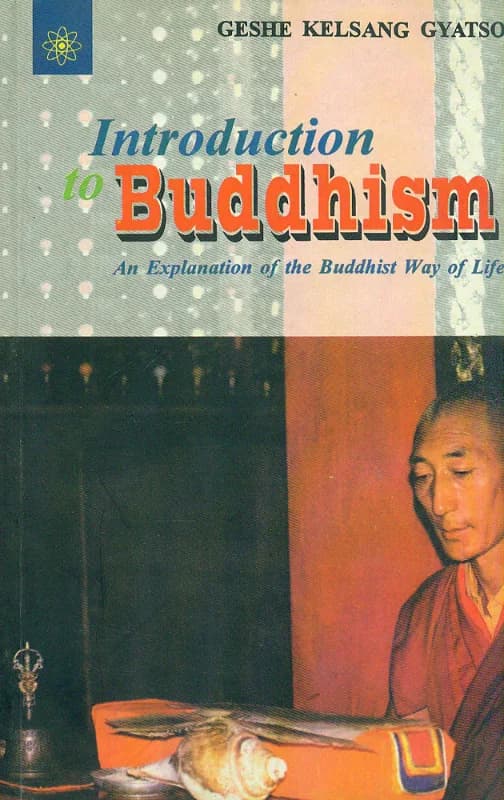
Introduction to Buddhism: An Explanation of the Buddhist Way of Life
Geshe Kelsang Gyatso
English
Book
Tharpa Publications, Ulverston, UK
2008
213 pages
3.8 MB
Introduction
The book begins with front matter including Dedication, Contents, Illustrations, Acknowledgements, and an Editorial Note. The dedication states that the book was written with the intention that all living beings may be released from the prison of saṃsāra and attain supreme happiness.
Part One: Basic Buddhism
Chapter 1: Who was Buddha?
This chapter introduces Buddha Śākyamuni as the historical founder of Buddhism and explains the meaning of “Buddha” as an awakened or enlightened being. It presents Siddhartha’s life story: royal birth, sheltered palace life, encounter with suffering, renunciation, meditation, awakening under the Bodhi Tree, and teaching career. The chapter establishes Buddha as a spiritual guide who discovered the path to liberation through direct realization.
Chapter 2: Understanding the Mind
This chapter explains the Buddhist view that the mind is the foundation of human experience. Happiness and suffering are not determined only by external circumstances; they depend deeply on states of mind. The chapter introduces meditation as the method for understanding and transforming the mind. It also distinguishes peaceful, virtuous mental states from disturbed and deluded states.
Chapter 3: Past and Future Lives
This chapter presents the Buddhist doctrine of rebirth. It explains that consciousness is not reduced to the physical body and that present life is connected to past and future existences. The doctrine of rebirth gives a wider ethical horizon to human life: actions performed now shape future experience.
Chapter 4: What is Karma?
This chapter explains karma as intentional action and its consequences. Karma is presented not as fate, but as a moral law of cause and effect. Positive actions create causes for happiness, while negative actions create causes for suffering. The chapter links karma directly with responsibility, ethical discipline, and the possibility of spiritual transformation.
Chapter 5: Our Precious Human Life
This chapter emphasizes the rarity and value of human birth. A human life is precious because it provides the conditions needed to understand Dharma, practice meditation, cultivate virtue, and move toward liberation. The chapter encourages readers not to waste human life in distraction, attachment, or merely worldly pursuits.
Chapter 6: Death
This chapter reflects on death as an unavoidable reality and a powerful object of contemplation. Awareness of death helps the practitioner overcome complacency and clarify what is truly important. The chapter teaches that preparation for death is inseparable from preparation for future lives and spiritual freedom.
Chapter 7: The Buddhist Way of Life
This chapter gathers the practical implications of the previous chapters. Buddhist life is presented as a disciplined path of ethical conduct, meditation, wisdom, compassion, and reliance on Dharma. The chapter shows how Buddhist teachings are meant to be practiced in daily life, not merely studied intellectually.
Part Two: The Path to Liberation
Chapter 8: What is Liberation?
This chapter defines liberation as permanent freedom from suffering and its causes. Liberation is not merely temporary relief from pain or difficulty; it is freedom from the cycle of uncontrolled rebirth and from the delusions that bind beings to saṃsāra.
Chapter 9: Developing Renunciation
This chapter explains renunciation as the sincere wish to be free from saṃsāra. Renunciation does not mean rejecting life or becoming pessimistic. It means recognizing the unsatisfactory nature of cyclic existence and developing the determination to seek genuine freedom.
Chapter 10: The Three Higher Trainings
This chapter presents the three core trainings of the Buddhist path: higher moral discipline, higher concentration, and higher wisdom. Moral discipline restrains harmful actions; concentration stabilizes the mind; wisdom realizes the true nature of reality. Together, these three trainings form the practical method for attaining liberation.
Part Three: The Path to Enlightenment
Chapter 11: Becoming a Bodhisattva
This chapter introduces the Mahāyāna ideal of the bodhisattva. A bodhisattva is one who generates bodhicitta, the altruistic wish to attain enlightenment for the benefit of all living beings. The chapter shifts the focus from personal liberation to universal compassion.
Chapter 12: The Bodhisattva’s Way of Life
This chapter explains how bodhisattvas train in compassion, generosity, patience, joyful effort, concentration, and wisdom. It presents the bodhisattva path as an active life of benefiting others while cultivating the qualities necessary for enlightenment.
Chapter 13: Ultimate Truth
This chapter presents the Buddhist teaching on ultimate truth, especially emptiness. It explains that ordinary beings grasp at persons and phenomena as if they existed independently and inherently. Wisdom realizes that phenomena are empty of inherent existence. This insight is essential for removing ignorance, the root of saṃsāra.
Chapter 14: Enlightenment
This chapter describes enlightenment as the complete purification of all faults and the full development of all good qualities. Enlightenment is the final goal of the Mahāyāna path because only a fully enlightened being can benefit all living beings perfectly.
Appendices and Reference Material
Appendix I: The Commitments of Going for Refuge
This appendix explains the practical commitments connected with taking refuge in Buddha, Dharma, and Sangha.
Appendix II: Mahāyāna Sutra of the Three Superior Heaps
This appendix provides a Mahāyāna liturgical or practice text associated with purification, confession, and spiritual accumulation.
Glossary and Index
The glossary explains key Buddhist terms, and the index supports study and reference use.
Copyright Notice
This material is provided solely for academic research, study, and religious practice purposes under Article 25 of Vietnam's Intellectual Property Law. Reproduction, distribution, or commercial use is strictly prohibited.
If you are the author, translator, publisher, or rights holder and believe this content has been posted without proper authorization, please contact us and we will promptly review and remove or restrict access.
Documents
Introduction to Buddhism: An Explanation of the Buddhist Way of Life
3.8 MB
Keywords
Introduction to BuddhismGeshe Kelsang GyatsoKarmaLiberationBodhisattva Path.
Sách đọc nhiều nhất
The Buddha’s Ancient Path
Piyadassi Thera
Book·10.7 MB
229 pages1979223
The Questions of King Milinda, Part II
F. Max Müller (Editor)
Book·20.8 MB
427 pages1894208

A Taste of Freedom
Venerable Ajahn Chah / Phra Bodhinyana Thera
Book·1.2 MB
104 pages1980207
Buddhist Meditation: An Anthology of Texts from the Pāli Canon
Sarah Shaw (General Editors: Charles S. Prebish and Damien Keown)
Book·17.5 MB
253 pages2006204