English
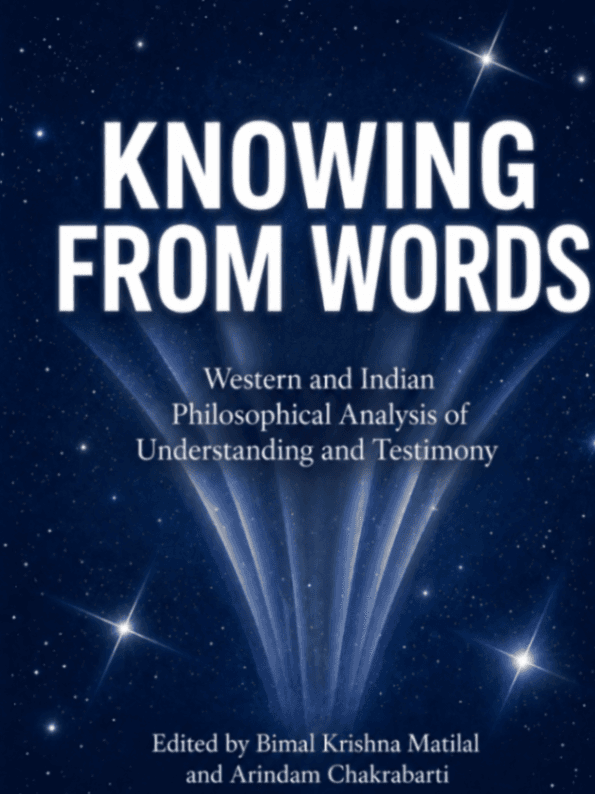
Knowing from Words: Western and Indian Philosophical Analysis of Understanding and Testimony
Bimal Krishna Matilal and Arindam Chakrabarti
English
Book
Kluwer Academic Publishers, Dordrecht / Boston / London
1994
402 pages
5.6 MB
Introduction
Knowing from Words is a comparative philosophical anthology devoted to testimony, linguistic understanding, and the epistemic role of communication. Edited by Bimal Krishna Matilal and Arindam Chakrabarti, the volume brings together scholars from Western analytic philosophy and classical Indian philosophy to examine how spoken and written words generate, transmit, preserve, and justify knowledge. Its central concern is the long-neglected distinction between knowing the meanings of words and acquiring knowledge from words.
The contributors investigate whether testimony constitutes an irreducible source of knowledge or whether testimonial knowledge must ultimately be reduced to perception, memory, inference, or coherence. The essays address the authority of speakers, the conditions under which trust is rational, the relationship between testimony and observation, the danger of gullibility, the role of comprehension, and the epistemology of hearsay. Further discussions consider whether knowledge derived from others can remain autonomous, how testimony relates to historical knowledge and scepticism, and whether belief based on linguistic communication requires independent justification.
A distinctive feature of the collection is its sustained comparison between Western theories and Indian debates concerning śabda, or word-generated knowledge. Nyāya, Mīmāṃsā, and Buddhist approaches are examined alongside the work of modern philosophers concerned with language, authority, meaning, propositions, and proper names. The volume also includes studies of the Naiyāyika response to Russellian theories, the relation between understanding and justification, and Gaṅgeśa’s treatment of self-mentioning words.
By integrating these traditions, the book challenges epistemological individualism and demonstrates that much human knowledge depends upon rational reliance on competent and trustworthy communicators. It therefore offers a significant contribution to comparative philosophy, social epistemology, philosophy of language, and theories of testimony.
Copyright Notice
This material is provided solely for academic research, study, and religious practice purposes under Article 25 of Vietnam's Intellectual Property Law. Reproduction, distribution, or commercial use is strictly prohibited.
If you are the author, translator, publisher, or rights holder and believe this content has been posted without proper authorization, please contact us and we will promptly review and remove or restrict access.
Documents
Knowing from Words: Western and Indian Philosophical Analysis of Understanding and Testimony
5.6 MB
Sách đọc nhiều nhất
The Buddha’s Ancient Path
Piyadassi Thera
Book·10.7 MB
229 pages1979223
The Questions of King Milinda, Part II
F. Max Müller (Editor)
Book·20.8 MB
427 pages1894208

A Taste of Freedom
Venerable Ajahn Chah / Phra Bodhinyana Thera
Book·1.2 MB
104 pages1980207
Buddhist Meditation: An Anthology of Texts from the Pāli Canon
Sarah Shaw (General Editors: Charles S. Prebish and Damien Keown)
Book·17.5 MB
253 pages2006204