English
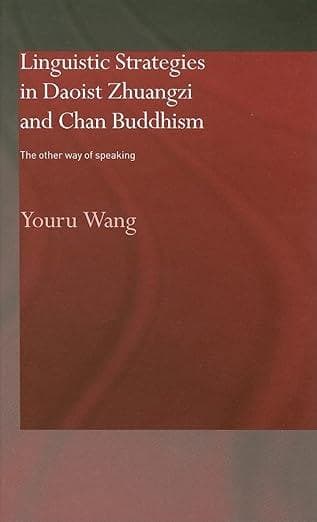
Linguistic Strategies in Daoist Zhuangzi and Chan Buddhism: The Other Way of Speaking
Youru Wang
English
Book
RoutledgeCurzon, London and New York.
2003
264 pages
1.6 MB
Introduction
The book opens by presenting itself as the first systematic study of the linguistic strategies of Daoist Zhuangzi and Chan Buddhism. Wang identifies three central fields of investigation: deconstructive strategy, liminology of language, and indirect communication. The study is grounded in original texts and places their language use within practical and soteriological contexts rather than treating language as an abstract theoretical issue.
Chapter 1: Introduction
The introduction establishes the book’s twofold task. First, Wang seeks to reinterpret Daoist and Chan Buddhist thought in light of contemporary postmodern discourse. Second, he asks how Daoist and Chan Buddhist thought can participate constructively in that discourse. The chapter responds to critiques that have accused Daoism and Chan Buddhism of logocentrism, especially in relation to the Zhuangzi and Chan figures such as Linji. Wang argues that the issue should not be reduced to whether these traditions are simply “logocentric” or “anti-logocentric.” Instead, their linguistic strategies must be studied in context.
The chapter also explains the structure of the book. The study is divided into three parts. Part I investigates deconstruction in the Zhuangzi and Chan Buddhism. Part II examines the liminology of language, meaning the study of language at its limits. Part III analyzes the pragmatics of indirect communication, including Zhuangzi’s “goblet words” and Chan’s preference for not speaking too plainly.
Part I: Deconstruction in the Zhuangzi and in Chan Buddhism
Chapter 2: Understanding Deconstruction through the Zhuangzi and Chan
This chapter clarifies the meaning of “deconstruction” for the purposes of the book. Wang does not use the term merely in a Derridean sense. Rather, he defines deconstruction as a contextual and situational strategy that overturns oppositional hierarchies while also remaining self-subverting. This definition allows him to compare Western deconstruction with Daoist and Chan strategies without collapsing them into one another.
The chapter argues that Zhuangzian and Chan deconstruction differs from Derridean deconstruction because it is inseparable from practical liberation. In the Zhuangzi and Chan, deconstructive language is not only textual or philosophical; it functions to free the practitioner from fixation, conceptual rigidity, and attachment to linguistic reification.
Chapter 3: Zhuangzi’s Dao Deconstructs . . . and Zhuangzi Deconstructs His Dao
This chapter examines the Zhuangzi as a text that deconstructs fixed conceptual systems, including fixed understandings of Dao itself. Wang analyzes Zhuangzi’s philosophy of change, including the infinite transformation of things, the self-transforming character of things, and the dynamic interrelationship of all things. This worldview supports Zhuangzi’s linguistic strategy: one must accommodate the mind to endless transformation rather than cling to rigid distinctions.
The chapter pays special attention to Zhuangzi’s deconstruction of the self. Zhuangzi does not simply replace “self” with “non-self.” Instead, he moves toward a third position: forgetting self. Wang also explores how Zhuangzi deconstructs early Daoist notions of Dao as a fixed One or as nonbeing, showing that Zhuangzi’s Dao cannot be reduced to a metaphysical foundation.
Chapter 4: The Deconstruction of Buddha Nature in Chan Buddhism
This chapter examines Chan Buddhist treatment of Buddha nature. Wang situates the discussion within broader debates on tathāgatagarbha thought and modern critiques of Buddha-nature discourse. He argues that Chan contains both reifying and deconstructive tendencies, but its strongest voices work to prevent Buddha nature from becoming a fixed metaphysical essence.
The chapter discusses The Platform Sūtra, especially Huineng’s critique of Shenxiu’s tendency to reify the pure mind. Huineng’s teaching of no-thought does not mean absence of thought, but freedom from attachment to thought. Wang then turns to Hongzhou Chan, showing how its language of ordinary activity, following circumstances, and flexible response deconstructs fixed notions of Buddha nature while preserving its practical function.
Part II: The Liminology of Language in the Zhuangzi and in Chan Buddhism
Chapter 5: What Is a Liminology of Language?
This chapter introduces the concept of liminology, the study of limits, boundaries, and thresholds of language. Wang develops the concept to examine how Daoist and Chan texts operate at the border between speech and silence, saying and not-saying, language and what exceeds language.
He identifies three major aspects of liminology: radical problematization of the limits of language; insight into the mutual relation between speaking and non-speaking; and play at the boundary of language. The chapter argues that the goal is not to absolutize silence over speech, but to loosen fixed boundaries and discover alternative modes of speaking.
Chapter 6: Zhuangzi’s Liminology of “Speaking Non-Speaking”
This chapter addresses the old problem of Zhuangzi’s apparent contradiction: he criticizes language but uses language with extraordinary creativity. Wang argues that Zhuangzi does not reject language altogether. He rejects conventional, descriptive, entitative, and metaphysical language. In place of such language, he develops a marginal and transformative speech.
The key phrase is “speaking non-speaking.” This does not mean total silence. It means a kind of speech that does not freeze reality into fixed concepts. Zhuangzi crosses the boundary between speech and silence through irony, paradox, playful narration, perspectival shifts, and destabilizing language. His language works by loosening attachment to rigid distinctions.
Chapter 7: The Chan Contribution to the Liminology of Language
This chapter argues that Chan’s famous claim of “not relying on words and letters” should not be misunderstood as simple anti-language rhetoric. Wang traces Chan’s concern with the inadequacy of language back to Indian Mahāyāna Buddhism, where referential and conceptual language is seen as inadequate for ultimate realization.
Chan masters do not abandon language; they transform its function. Their concern is not whether language should be used, but how language can be used differently. Chan discourse therefore includes shouting, silence, paradox, poetic language, unexpected replies, gestures, and non-conventional utterances. These are ways of breaking dependence on ordinary referential language while still using words skillfully for awakening.
Part III: Pragmatics of Indirect Communication in the Zhuangzi and in Chan Buddhism
Chapter 8: The Displacement of Indirect Communication
This chapter surveys Western philosophical discussions of indirect communication, including Kierkegaard and contemporary theories of communication. Wang defines indirect communication as listener- or reader-oriented, open-ended, non-teleological, interactive, and concerned with existential-practical transformation rather than simple transfer of information.
The chapter prepares the ground for understanding Zhuangzi and Chan as traditions in which communication is not a matter of transmitting a fixed message from speaker to listener. Instead, communication becomes a process of provoking insight, participation, and self-realization.
Chapter 9: The Pragmatics of “Goblet Words”: Indirect Communication in the Zhuangzi
This chapter studies Zhuangzi’s “goblet words” — words that shift, respond, and adapt like a vessel that tips and rights itself. Wang argues that Zhuangzi’s indirect communication is rooted in his philosophical aim: helping the mind accommodate itself to endless transformation.
Zhuangzi’s communication is open-ended and reader-oriented. It does not deliver a fixed doctrine. Instead, it invites participation, perspective-shifting, and transformation. Wang discusses strategies such as denegation, paradox, irony, and the disappearance of the determinate authorial voice. The reader must actively engage rather than passively receive.
Chapter 10: The Pragmatics of “Never Tell Too Plainly”: Indirect Communication in Chan
This chapter examines Chan’s distinctive use of indirect language. Wang critiques modern interpretations that portray Chan as anti-linguistic or as relying on direct mind-to-mind communication without linguistic strategy. He argues instead that Chan “mind-to-mind transmission” relies heavily on indirect communication.
The Chan master does not give the student a ready-made truth. Because awakening must be realized by the student directly and situationally, the master speaks in ways that evoke, disrupt, provoke, and open. Wang analyzes three major forms of Chan “living words”: paradoxical language, tautological language, and poetic language. These strategies prevent the student from clinging to conceptual formulations and instead push the student toward existential realization.
Concluding Remarks
The conclusion emphasizes that linguistic strategy in the Zhuangzi and Chan Buddhism is never merely linguistic. It is always connected to practice, liberation, transformation, and the undoing of conceptual fixation. Wang also stresses both continuity and discontinuity between Zhuangzi and Chan. Chan inherited much from Zhuangzian language strategy, but transformed it through Buddhist soteriology, especially the concern with enlightenment and liberation.
The book concludes with Notes, Glossary, Bibliography, and Index, making it a valuable resource for advanced research in Chinese philosophy, Daoism, Chan Buddhism, Buddhist hermeneutics, philosophy of language, and comparative religious thought.
Overall, Linguistic Strategies in Daoist Zhuangzi and Chan Buddhism is a significant contribution to the study of how religious-philosophical traditions use language to undo attachment to language. Its central insight is that Zhuangzi and Chan do not simply negate words; they develop another way of speaking — indirect, playful, paradoxical, deconstructive, and liberative.
Copyright Notice
This material is provided solely for academic research, study, and religious practice purposes under Article 25 of Vietnam's Intellectual Property Law. Reproduction, distribution, or commercial use is strictly prohibited.
If you are the author, translator, publisher, or rights holder and believe this content has been posted without proper authorization, please contact us and we will promptly review and remove or restrict access.
Documents
Linguistic Strategies in Daoist Zhuangzi and Chan Buddhism: The Other Way of Speaking
1.6 MB
Keywords
ZhuangziChan BuddhismLinguistic StrategiesDeconstructionIndirect Communication.
Sách đọc nhiều nhất
The Buddha’s Ancient Path
Piyadassi Thera
Book·10.7 MB
229 pages1979223
The Questions of King Milinda, Part II
F. Max Müller (Editor)
Book·20.8 MB
427 pages1894208

A Taste of Freedom
Venerable Ajahn Chah / Phra Bodhinyana Thera
Book·1.2 MB
104 pages1980207
Buddhist Meditation: An Anthology of Texts from the Pāli Canon
Sarah Shaw (General Editors: Charles S. Prebish and Damien Keown)
Book·17.5 MB
253 pages2006204