
English
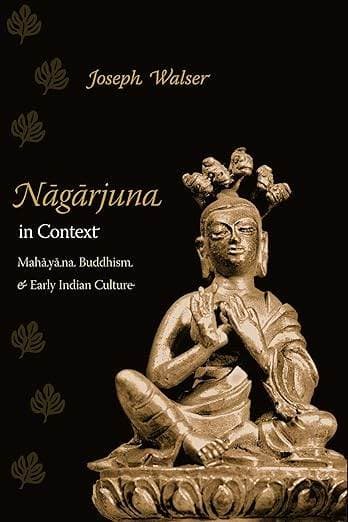
Nāgārjuna in Context: Mahāyāna Buddhism and Early Indian Culture
Joseph Walser
English
Book
Columbia University Press, New York.
2005
384 pages
6.4 MB
Introduction
The book opens with maps of India and surrounding regions and the Takla Makan Desert / Central Asian routes, situating early Mahāyāna and Buddhist transmission within a wide geographic network extending across India, Central Asia, and routes toward China. These visual materials support the book’s concern with the spatial and institutional movement of Buddhist texts, communities, and ideas.
Introduction
The introduction states the central project of the book: to recover Nāgārjuna’s social and institutional context. Walser argues that previous scholarship has focused heavily on Nāgārjuna’s philosophical arguments, especially emptiness, causality, and Madhyamaka logic, but has paid less attention to the institutional world in which those arguments were written.
Walser proposes that Nāgārjuna’s writings should be read as strategies for securing the survival of Mahāyāna Buddhism. His arguments were not directed only toward philosophical opponents such as Sarvāstivādins or other doctrinal schools, but also toward a third audience: monks and lay patrons who controlled the resources needed for textual reproduction, monastic recognition, and institutional survival.
The introduction also applies concepts from social movement theory, especially resource mobilization and opportunity structure. Mahāyāna is treated as a marginal or minority movement that required access to legitimacy, labor, money, manuscripts, and monastic facilities. Nāgārjuna’s writings are therefore interpreted as textual strategies designed to make Mahāyāna appear continuous with already authorized Buddhist traditions.
Chapter 1: Locating Mahāyāna
This chapter examines the institutional and geographic location of Mahāyāna in India during the first centuries of the Common Era. Walser surveys inscriptions, Mahāyāna sūtras, translator records, Chinese pilgrims’ accounts, and Buddhist histories.
The chapter argues that early Mahāyāna was likely a relatively small and sometimes embattled movement within Buddhism. It did not yet possess strong independent institutional structures. Instead, Mahāyānists often lived within monasteries belonging to established Buddhist sects. This means that early Mahāyāna had to negotiate its place inside institutions that were not necessarily Mahāyāna in identity.
Walser also reviews major theories about the social location of early Mahāyāna: Mahāyāna as a movement within established nikāyas, Mahāyāna as a lay-centered movement linked to stūpa worship, and Mahāyāna as a movement associated with forest-dwelling ascetics. The chapter does not reduce Mahāyāna to one single origin, but stresses its diversity and institutional fragility.
Chapter 2: Locating Nāgārjuna
This chapter narrows the historical focus to Nāgārjuna himself. Walser evaluates evidence concerning Nāgārjuna’s date, location, and institutional affiliation. He considers the possibility that Nāgārjuna lived during the second century and was connected with the Eastern Deccan, especially the Lower Krishna River Valley in present-day Andhra Pradesh.
The chapter also explores the possibility that Nāgārjuna lived in or near a Mahāsāṃghika monastery and may later have served as an adviser to a king. Rather than accepting hagiographic legends uncritically, Walser reconstructs a plausible historical setting in which Nāgārjuna could have written works such as the Ratnāvalī.
The goal of this chapter is to move Nāgārjuna from mythic abstraction into a concrete institutional and geographic setting.
Chapter 3: Mahāyāna and the Constraints of Monastic Law
This chapter studies how monastic law shaped the possibilities and dangers facing early Mahāyāna monks. Walser argues that a monk teaching Mahāyāna doctrines in a non-Mahāyāna monastery could potentially be accused of causing schism or introducing unauthorized teachings.
The chapter analyzes how Nāgārjuna’s writings may have been designed to minimize this legal risk. If Mahāyāna could be shown to be consistent with accepted Buddhist doctrine, then Mahāyāna monks could avoid disciplinary sanctions. In this sense, Nāgārjuna’s arguments function not only as philosophy but also as institutional defense.
Chapter 4: Mahāyāna Sūtras as Monastic Property
This chapter examines the legal and economic implications of Mahāyāna texts within monasteries. Walser argues that textual reproduction was not merely an intellectual activity; it required material resources, scribal labor, monastic authorization, and preservation systems.
Because Mahāyāna communities often lacked independent institutions, they needed their texts to be copied and preserved within existing monasteries. This meant that Mahāyāna sūtras had to be presented as texts worthy of monastic reproduction. Walser suggests that Nāgārjuna and other Mahāyānists attempted to show that Mahāyāna texts belonged within the category of legitimate Buddhist scripture.
This chapter is important because it connects the survival of Mahāyāna doctrine to the concrete economics of manuscript production and monastic property law.
Chapter 5: On the Parasitic Strategies of Mahāyāna
This chapter develops Walser’s argument that early Mahāyāna texts often used strategies of camouflage, adaptation, and textual dependence. The term “parasitic” does not simply mean negative dependence; it refers to the way Mahāyāna inserted itself into already existing Buddhist textual and institutional frameworks.
Walser argues that Mahāyāna texts often presented new teachings as extensions, clarifications, or deeper meanings of already accepted Buddhist doctrines. This allowed Mahāyāna to maximize innovation while minimizing apparent deviation. Nāgārjuna’s Mūlamadhyamakakārikā is examined in this light as a work that advances Mahāyāna philosophical positions while remaining deeply connected to earlier Buddhist textual authority.
Chapter 6: Abhidharma and Sectarian Identity
This chapter studies Abhidharma as a site of sectarian identity in early Buddhism. Walser examines the Abhidharma materials that may have been available to Nāgārjuna and asks what Mahāsāṃghika Abhidharma might have looked like.
The chapter’s broader argument is that Abhidharma was not merely doctrinal analysis; it was also tied to institutional identity. Different Buddhist sects used Abhidharma to define their doctrinal boundaries and interpretive authority. If Nāgārjuna wanted Mahāyāna to gain acceptance, he had to engage these sectarian frameworks carefully.
Chapter 7: Nāgārjuna and the Abhidharma
This chapter examines Nāgārjuna’s engagement with Abhidharma in greater detail. Walser argues that Nāgārjuna’s critiques of Abhidharma categories should not be read only as abstract philosophical refutations. They also functioned as strategic interventions within debates among Buddhist sects.
Nāgārjuna’s arguments against intrinsic nature, fixed categories, and reified dharmas allowed Mahāyāna to challenge certain Abhidharma positions while still presenting itself as loyal to the deeper meaning of Buddhist teaching. In this way, Nāgārjuna could form alliances with certain sectarian interests while undermining others.
Conclusion: Toward the Outline of a Career
The conclusion brings together the book’s reconstruction of Nāgārjuna’s historical role. Walser presents Nāgārjuna as a monk, thinker, and Mahāyāna advocate whose writings helped secure space for Mahāyāna in an environment where it lacked full institutional power.
Nāgārjuna’s philosophical writings are therefore interpreted as part of a broader career: defending Mahāyāna, negotiating with monastic law, aligning Mahāyāna with accepted scripture, engaging Abhidharma debates, and helping ensure the reproduction and preservation of Mahāyāna texts.
Copyright Notice
This material is provided solely for academic research, study, and religious practice purposes under Article 25 of Vietnam's Intellectual Property Law. Reproduction, distribution, or commercial use is strictly prohibited.
If you are the author, translator, publisher, or rights holder and believe this content has been posted without proper authorization, please contact us and we will promptly review and remove or restrict access.
Documents
Nāgārjuna in Context: Mahāyāna Buddhism and Early Indian Culture
6.4 MB
Sách đọc nhiều nhất
The Buddha’s Ancient Path
Piyadassi Thera
Book·10.7 MB
229 pages1979223
The Questions of King Milinda, Part II
F. Max Müller (Editor)
Book·20.8 MB
427 pages1894208

A Taste of Freedom
Venerable Ajahn Chah / Phra Bodhinyana Thera
Book·1.2 MB
104 pages1980207
Buddhist Meditation: An Anthology of Texts from the Pāli Canon
Sarah Shaw (General Editors: Charles S. Prebish and Damien Keown)
Book·17.5 MB
253 pages2006204