English
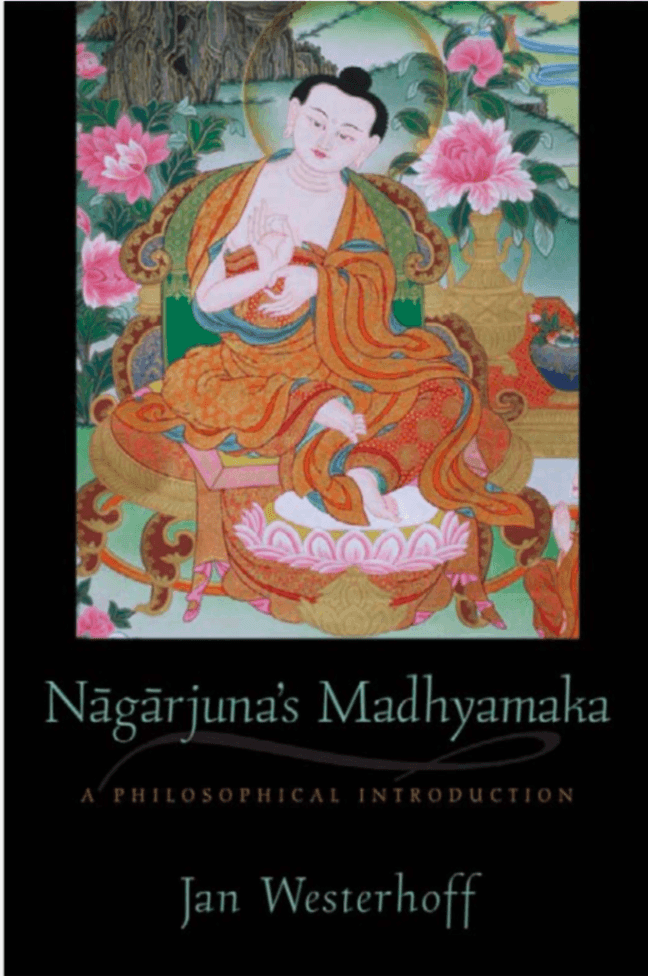
Nāgārjuna’s Madhyamaka: A Philosophical Introduction
Jan Westerhoff
English
Book
Oxford University Press
2009
257 pages
22.4 MB
Introduction
The introduction presents Nāgārjuna as one of the most important philosophers in Asian thought, while acknowledging the historical uncertainty surrounding his life, date, location, and authorship. Westerhoff explains his methodology: rather than offering a line-by-line commentary, the book provides a synoptic and analytical reconstruction of Nāgārjuna’s philosophical arguments. It also reviews major Western interpretations of Nāgārjuna, including Kantian, analytic, and post-Wittgensteinian approaches.
The main chapters examine key Madhyamaka problems. Chapter 2 analyzes different meanings of svabhāva, including ontological and cognitive dimensions. Chapters 3 and 4 study negation and the catuṣkoṭi, or tetralemma. Chapters 5 and 6 examine causation and motion, showing how Nāgārjuna deconstructs assumptions about cause, effect, time, movement, mover, and motion. Chapter 7 studies the self, rejecting a substance-self and explaining the Madhyamaka view of personal identity. Chapter 8 examines epistemology and the means of knowledge. Chapter 9 discusses language and Nāgārjuna’s “no-thesis” position.
Copyright Notice
This material is provided solely for academic research, study, and religious practice purposes under Article 25 of Vietnam's Intellectual Property Law. Reproduction, distribution, or commercial use is strictly prohibited.
If you are the author, translator, publisher, or rights holder and believe this content has been posted without proper authorization, please contact us and we will promptly review and remove or restrict access.
Documents
Nāgārjuna’s Madhyamaka: A Philosophical Introduction
22.4 MB
Keywords
NāgārjunaMadhyamakaJan WesterhoffMūlamadhyamakakārikāSvabhāvaEmptinessŚūnyatāCatuṣkoṭiCausationMotionSelfEpistemologyBuddhist philosophyLanguage and truth.
Sách đọc nhiều nhất
The Buddha’s Ancient Path
Piyadassi Thera
Book·10.7 MB
229 pages1979223
The Questions of King Milinda, Part II
F. Max Müller (Editor)
Book·20.8 MB
427 pages1894208

A Taste of Freedom
Venerable Ajahn Chah / Phra Bodhinyana Thera
Book·1.2 MB
104 pages1980207
Buddhist Meditation: An Anthology of Texts from the Pāli Canon
Sarah Shaw (General Editors: Charles S. Prebish and Damien Keown)
Book·17.5 MB
253 pages2006204