English
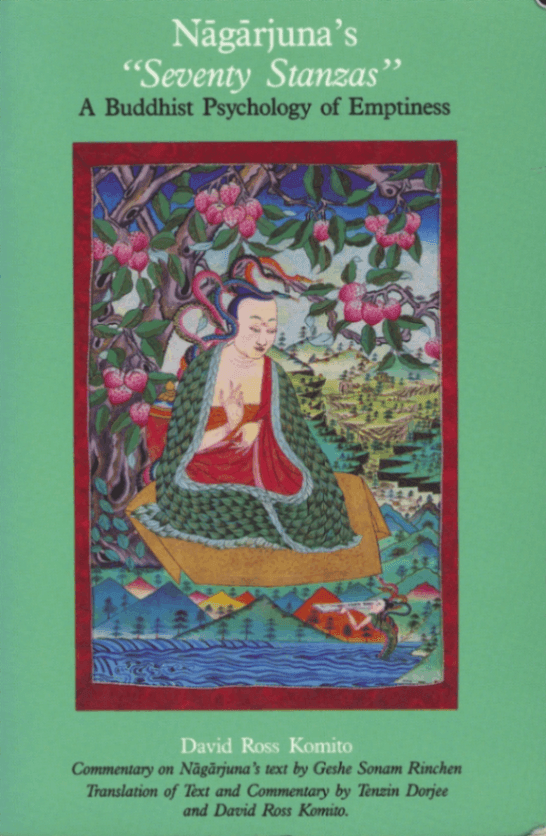
Nāgārjuna’s “Seventy Stanzas”: A Buddhist Psychology of Emptiness
David Ross Komito
English
Book
Snow Lion Publications, Ithaca, New York.
1987
226 pages
7.3 MB
Introduction
The work opens with a preface explaining the background of the project: Komito’s study of Nāgārjuna’s Madhyamaka system in Dharamsala with Geshe Sonam Rinchen, and the decision to produce a readable contemporary commentary rather than a purely literal or technical translation. The foreword presents the traditional legend of Nāgārjuna’s encounter with the nāgas, linking Nāgārjuna to the transmission of the Perfection of Wisdom teachings and the Madhyamaka doctrine of emptiness.
The book is divided into three main chapters. Chapter 1, “Buddhist Psychology,” introduces Buddhadharma, perception and conception, subject, attention, meditation, and object. Chapter 2, “The Seventy Stanzas on Emptiness,” gives the translation of Nāgārjuna’s verses and includes the Tibetan text and commentary by Geshe Sonam Rinchen. Chapter 3, “The Seventy Stanzas on Emptiness and its Transmission,” discusses Nāgārjuna’s treatises, the transmission of the Seventy Stanzas during the first and second introductions of Buddhism to Tibet, and modern translation activities. The volume concludes with footnotes, bibliography, and index.
Copyright Notice
This material is provided solely for academic research, study, and religious practice purposes under Article 25 of Vietnam's Intellectual Property Law. Reproduction, distribution, or commercial use is strictly prohibited.
If you are the author, translator, publisher, or rights holder and believe this content has been posted without proper authorization, please contact us and we will promptly review and remove or restrict access.
Documents
Nāgārjuna’s “Seventy Stanzas”: A Buddhist Psychology of Emptiness
7.3 MB
Keywords
NāgārjunaSeventy Stanzas on EmptinessŚūnyatāsaptatiDavid Ross KomitoGeshe Sonam RinchenTenzin DorjeeMadhyamakaEmptinessBuddhist psychologyDependent originationPerceptionConceptionNo-selfTibetan Buddhism.
Sách đọc nhiều nhất
The Buddha’s Ancient Path
Piyadassi Thera
Book·10.7 MB
229 pages1979223
The Questions of King Milinda, Part II
F. Max Müller (Editor)
Book·20.8 MB
427 pages1894208

A Taste of Freedom
Venerable Ajahn Chah / Phra Bodhinyana Thera
Book·1.2 MB
104 pages1980207
Buddhist Meditation: An Anthology of Texts from the Pāli Canon
Sarah Shaw (General Editors: Charles S. Prebish and Damien Keown)
Book·17.5 MB
253 pages2006204