English
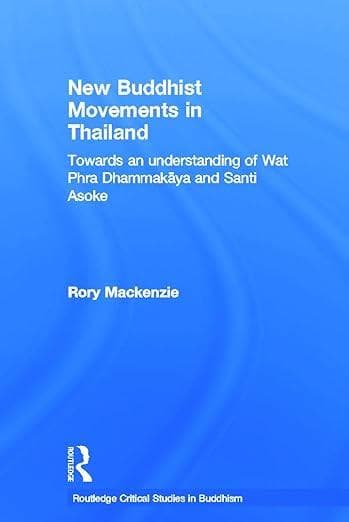
New Buddhist Movements in Thailand: Towards an Understanding of Wat Phra Dhammakaya and Santi Asoke
Rory Mackenzie
English
Book
Routledge
2007
268 pages
1.4 MB
Introduction
The book opens with a Preface, where Mackenzie explains that the study examines two Buddhist movements that emerged during a period of political uncertainty, social change, and dissatisfaction with the Thai Saṅgha and its leadership. He states that both movements regard their leaders as possessing amnat or power, ittiphon or influence, and parami or moral stature. The preface also introduces the core contrast between the two movements: Wat Phra Dhammakaya is modern, expansive, and organizationally efficient, while Santi Asoke is ascetic, communal, and morally rigorous.
The book also includes an Acknowledgements section, a Note on the Use of Thai Words and Referencing, and a Map of Thailand. The map situates the study geographically, showing major Thai regions and cities such as Bangkok, Chiang Mai, Khon Kaen, Nakhon Ratchasima, Ubon Ratchathani, Surat Thani, Phuket, and Hat Yai. This geographical framing is relevant because the movements are studied not merely as doctrines but as Thai social and institutional phenomena.
Introduction
The introduction sets out the book’s five research questions:
How did Wat Phra Dhammakaya and Santi Asoke begin and develop?
What are their distinctive features, and why do they appeal to their members?
How accurate are outsider descriptions and analyses of the two movements?
How do members pursue spiritual development?
What do these findings suggest about the future of state-regulated Buddhism in Thailand?
Mackenzie discusses terms such as sect, cult, New Religious Movement, and New Buddhist Movement. He argues that both movements are thoroughly Buddhist in orientation and are more accurately described as New Buddhist Movements than as cults. The introduction also explains the research model, including phenomenological, insider-oriented, sociological, and typological approaches.
Review of Scholarly Literature on Wat Phra Dhammakaya and Santi Asoke
This section reviews major scholarly studies of the two movements. Mackenzie discusses Peter Jackson, Donald Swearer, Phra Rajyanvisith, Apinya Feungfusakul, Marja-Leena Heikkilä-Horn, Jeffrey Bowers, and Phra Dhammapitaka / Prayudh Payutto.
The literature review shows that previous scholars have interpreted the two movements through frameworks such as political legitimation, Thai social change, Buddhist fundamentalism, merit-making, urban religiosity, millenarianism, meditation reform, and criticism of mainstream Saṅgha authority. Mackenzie positions his own study as a contribution that combines insider accounts, fieldwork, typology, and analysis of Thai cultural leadership concepts such as amnat, ittiphon, and parami.
Chapter 1: Setting the Scene: The Religious and Socio-Political Context of the Development of the Two Movements
This chapter places Wat Phra Dhammakaya and Santi Asoke within the wider history of Thai Buddhism and Thai society. Mackenzie examines the reforms associated with King Mongkut, the development of the Thammayut and Mahanikai fraternities, and the Saṅgha Acts of 1902, 1941, and 1962.
The chapter also discusses the proposed Fourth Saṅgha Act, military rule, the emergence of the Thai middle class, student activism, the impact of the Vietnam War, anti-communist politics, and the weakening credibility of the state-regulated Saṅgha. Mackenzie argues that both movements emerged within a context where traditional Buddhist authority was being challenged by modern social needs, political change, and dissatisfaction with mainstream monastic leadership.
Chapter 2: The Inception and Development of the Wat Phra Dhammakaya Movement
This chapter traces the origins of Wat Phra Dhammakaya through Luang Phaw Sot and the alleged discovery of Dhammakaya meditation. Mackenzie discusses Luang Phaw Sot’s career as abbot of Wat Paknam, his meditative practice, and the later role of Khun Yai Chan as a meditation teacher and formative influence on young disciples.
The chapter then describes the founding and growth of Wat Phra Dhammakaya and the associated Dhammakaya Foundation. It also discusses the development of Wat Luang Phaw Sot Dhammakayaram as a separate movement within the broader Dhammakaya meditation lineage. Mackenzie includes discussion of controversies involving land ownership, allegations against the abbot, and legal proceedings, as well as observations from his own field visits.
Chapter 3: An Analysis of the Wat Phra Dhammakaya Movement
This chapter analyzes Wat Phra Dhammakaya from both insider and outsider perspectives. From the insider view, the movement is attractive because it offers disciplined meditation, strong leadership, organizational efficiency, modern facilities, large-scale religious events, and a sense of participation in a global Buddhist mission.
Mackenzie compares Wat Phra Dhammakaya with Sōka Gakkai, noting similarities such as modern organizational methods, lay mobilization, global ambition, strong leadership, and public religious visibility. The chapter also examines outsider interpretations, including Wat Phra Dhammakaya as a fundamentalist movement, a millenarian movement, a neo-galactic structure, and a Buddhist prosperity movement.
A key theme is the movement’s ability to combine traditional merit-making with modern management, marketing, media, and middle-class aspirations.
Chapter 4: The Approach of Wat Phra Dhammakaya to Spiritual Development
This chapter focuses on Wat Phra Dhammakaya’s spiritual practice and doctrinal distinctiveness. Mackenzie examines its understanding of nibbāna, ayatananibbāna, and Dhammakaya meditation. The chapter also considers debates over whether the movement’s teachings on nibbāna as atta or “self” depart from mainstream Theravāda orthodoxy.
The chapter explores possible influences on Luang Phaw Sot’s meditation system, including comparisons with Tibetan and Yogavacara practices. Wat Phra Dhammakaya’s path of spiritual development is presented as meditation-centered, highly structured, and closely linked to ideas of purity, merit, cosmic struggle, and access to higher spiritual realities.
Chapter 5: The History of the Santi Asoke Movement and a Description of Its Various Communities
This chapter traces the life of Rak Rakphong, later known as Bodhirak, and the founding of Santi Asoke. It discusses Bodhirak’s break from mainstream Thai Buddhism, the formation of Asoke communities, and the legal conflict with the Thai Saṅgha that eventually led to Santi Asoke’s excommunication.
Mackenzie also examines the political career of Chamlong Srimuang and his relationship with Santi Asoke. The chapter describes various Asoke communities, including their organizational structures, schools, adult education programs, and annual festivals. Santi Asoke is presented as a community-based reform movement that seeks to embody Buddhist morality in everyday social and economic life.
Chapter 6: The Distinctives of Santi Asoke and an Analysis of the Movement
This chapter provides a detailed analysis of Santi Asoke’s distinctive identity. Mackenzie first presents insider understandings of the movement, then examines its major features: strict ethical discipline, simplicity, vegetarianism, communal life, criticism of consumerism, critique of mainstream monastic laxity, and commitment to moral purification.
The chapter evaluates several outsider interpretations of Santi Asoke, including whether it should be understood as fundamentalist, millenarian, similar to Christian base communities, or part of Thailand’s community culture movement. Mackenzie concludes that Santi Asoke is best described as an ascetic-prophetic utopian movement with strong legalistic tendencies.
Chapter 7: The Approach of Santi Asoke to Spiritual Purification
This chapter examines Santi Asoke’s understanding of spiritual development. Unlike Wat Phra Dhammakaya, which strongly emphasizes meditation, Santi Asoke focuses on ethical discipline, daily conduct, communal accountability, simplicity, and rigorous observance of the precepts.
Mackenzie discusses Santi Asoke’s understanding of nibbāna, meditation, the Eightfold Path, and spiritual purification. The movement presents liberation as something to be pursued through morally disciplined daily life rather than through ritual merit-making or abstract doctrine. The chapter shows that Santi Asoke’s model of practice is practical, ascetic, ethical, and community-centered.
Chapter 8: Conclusion
The conclusion summarizes the answers to the book’s research questions. Mackenzie argues that both movements reveal significant dissatisfaction with mainstream, state-regulated Thai Buddhism. Wat Phra Dhammakaya and Santi Asoke represent two very different Buddhist responses to modern Thai society: one modernizing, expansive, media-driven, and meditation-centered; the other ascetic, prophetic, communal, and morally reformist.
The conclusion also reflects on the future of state-regulated Buddhism in Thailand. Mackenzie suggests that the continuing vitality of both movements indicates that the Thai Saṅgha no longer possesses the same unquestioned credibility and legitimating authority it once had. Thai Buddhism remains influential, but its institutional future may become more plural, contested, and movement-based.
Copyright Notice
This material is provided solely for academic research, study, and religious practice purposes under Article 25 of Vietnam's Intellectual Property Law. Reproduction, distribution, or commercial use is strictly prohibited.
If you are the author, translator, publisher, or rights holder and believe this content has been posted without proper authorization, please contact us and we will promptly review and remove or restrict access.
Documents
New Buddhist Movements in Thailand
1.4 MB
Keywords
hai BuddhismWat Phra DhammakayaSanti AsokeNew Buddhist MovementsBuddhist Modernity.
Sách đọc nhiều nhất
The Buddha’s Ancient Path
Piyadassi Thera
Book·10.7 MB
229 pages1979223
The Questions of King Milinda, Part II
F. Max Müller (Editor)
Book·20.8 MB
427 pages1894208

A Taste of Freedom
Venerable Ajahn Chah / Phra Bodhinyana Thera
Book·1.2 MB
104 pages1980207
Buddhist Meditation: An Anthology of Texts from the Pāli Canon
Sarah Shaw (General Editors: Charles S. Prebish and Damien Keown)
Book·17.5 MB
253 pages2006204