
English
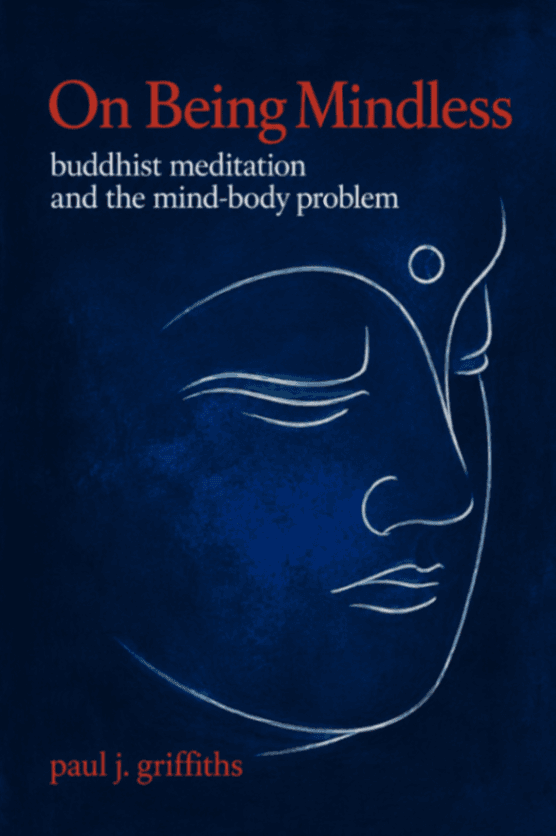
On Being Mindless: Buddhist Meditation and the Mind-Body Problem
Paul J. Griffiths
English
Book
Open Court Publishing Company
1986
193 pages
15.1 MB
Introduction
On Being Mindless: Buddhist Meditation and the Mind-Body Problem examines a highly specialized issue in Indian Buddhist thought: the attainment of cessation, or nirodhasamāpatti, a meditative state in which sensation and conceptualization are said to come temporarily to a halt while bodily life continues. Through this problem, Paul J. Griffiths explores the relationship between meditation, soteriology, consciousness, and the mind-body question in Buddhist philosophy. The book shows that Buddhist reflection on meditation was not merely practical or experiential, but also deeply analytical, producing sophisticated arguments about mental continuity, physical processes, and the conditions under which consciousness can cease and later arise again.
The study compares how three major Buddhist traditions understood this unusual state. In the Theravāda tradition, the attainment of cessation is examined in relation to the path of practice, meditative absorption, liberation, and the distinction between temporary cessation and final release. In the Vaibhāṣika and Sautrāntika traditions, the central problem becomes more explicitly philosophical: if all mental events stop during cessation, how can consciousness re-emerge afterward? The Yogācāra tradition offers a different solution through the doctrine of store-consciousness, presenting ālayavijñāna as the underlying basis that preserves continuity when ordinary forms of consciousness are inactive.
By focusing on these debates, the book demonstrates that nirodhasamāpatti is not only a topic in Buddhist meditation theory, but also a crucial point of entry into Buddhist discussions of mind, body, memory, karma, personal continuity, and liberation. It raises fundamental questions: Can a living person exist without active consciousness? What sustains continuity when mental activity ceases? Is liberation best understood as knowledge, detachment, or the complete stilling of mental processes? Through these questions, Griffiths presents Buddhist scholastic thought as a rigorous philosophical tradition capable of engaging some of the deepest problems in comparative philosophy of mind.
Copyright Notice
This material is provided solely for academic research, study, and religious practice purposes under Article 25 of Vietnam's Intellectual Property Law. Reproduction, distribution, or commercial use is strictly prohibited.
If you are the author, translator, publisher, or rights holder and believe this content has been posted without proper authorization, please contact us and we will promptly review and remove or restrict access.
Documents
On Being Mindless: Buddhist Meditation and the Mind-Body Problem
15.1 MB
Keywords
NirodhasamāpattiBuddhist MeditationMind-Body ProblemTheravādaVaibhāṣikaYogācāraStore-Consciousness.
Sách đọc nhiều nhất
The Buddha’s Ancient Path
Piyadassi Thera
Book·10.7 MB
229 pages1979223
The Questions of King Milinda, Part II
F. Max Müller (Editor)
Book·20.8 MB
427 pages1894208

A Taste of Freedom
Venerable Ajahn Chah / Phra Bodhinyana Thera
Book·1.2 MB
104 pages1980207
Buddhist Meditation: An Anthology of Texts from the Pāli Canon
Sarah Shaw (General Editors: Charles S. Prebish and Damien Keown)
Book·17.5 MB
253 pages2006204