English
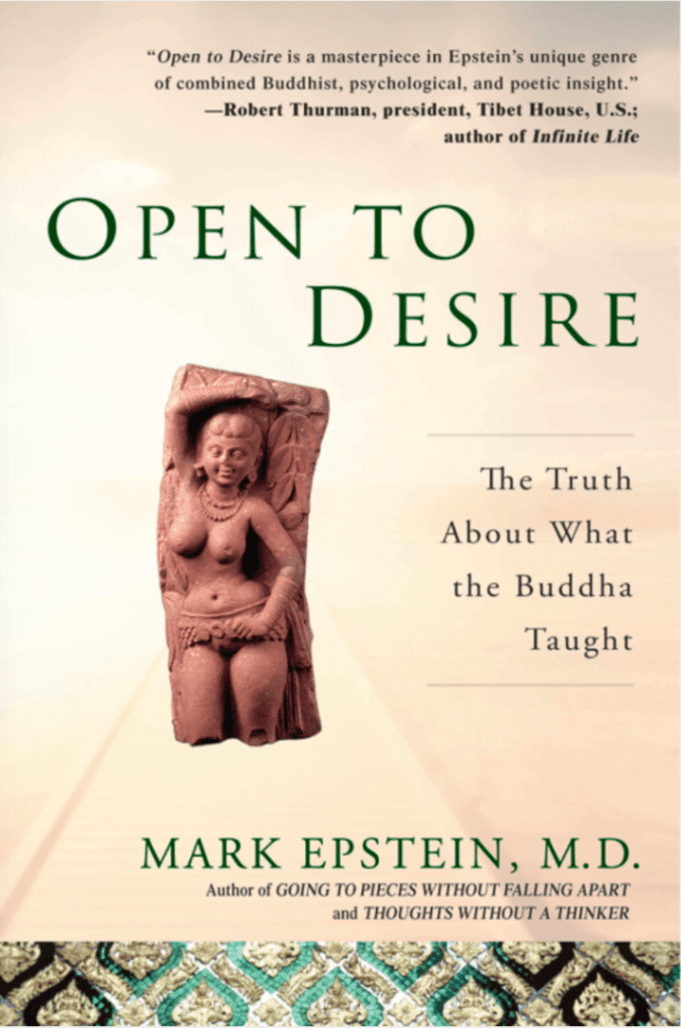
Open to Desire: The Truth About What the Buddha Taught
Mark Epstein, M.D.
English
Book
Gotham Books, Penguin Group (USA) Inc.
2005
227 pages
1.3 MB
Introduction
The book begins with “The Baby and the Bathwater,” where Epstein challenges the common idea that Buddhism requires the rejection of desire. He explains that the Buddha identified taṇhā, or craving, as the cause of suffering, not desire itself. The book is organized into four main parts modeled on the Four Noble Truths: “For Want of Desire,” “Clinging,” “The End of Clinging,” and “A Path for Desire.” The early chapters use the Ramayana and the idea of the left-handed or tantric path to show how desire can be misunderstood, repressed, or transformed. The middle sections analyze clinging, renunciation, separation, and the movement from objectification to deeper subjectivity. The final chapters present a practical path for working with desire without being dominated by it. In general, the book integrates Buddhist psychology and psychotherapy to show how desire, when held with awareness rather than grasping, can become a vehicle for growth and awakening.
Copyright Notice
This material is provided solely for academic research, study, and religious practice purposes under Article 25 of Vietnam's Intellectual Property Law. Reproduction, distribution, or commercial use is strictly prohibited.
If you are the author, translator, publisher, or rights holder and believe this content has been posted without proper authorization, please contact us and we will promptly review and remove or restrict access.
Documents
Open to Desire: The Truth About What the Buddha Taught
1.3 MB
Keywords
DesireBuddhismPsychotherapyCravingClingingTantric PathMark Epstein.
Sách đọc nhiều nhất
The Buddha’s Ancient Path
Piyadassi Thera
Book·10.7 MB
229 pages1979223
The Questions of King Milinda, Part II
F. Max Müller (Editor)
Book·20.8 MB
427 pages1894208

A Taste of Freedom
Venerable Ajahn Chah / Phra Bodhinyana Thera
Book·1.2 MB
104 pages1980207
Buddhist Meditation: An Anthology of Texts from the Pāli Canon
Sarah Shaw (General Editors: Charles S. Prebish and Damien Keown)
Book·17.5 MB
253 pages2006204