
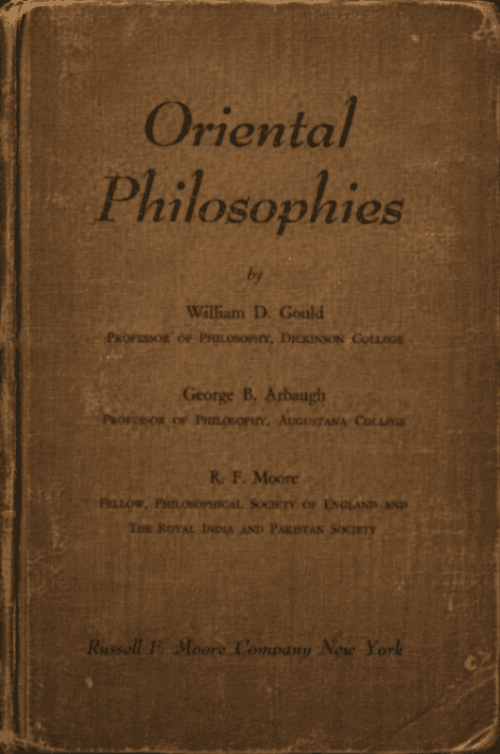
Oriental Philosophies
Introduction
Oriental Philosophies, by William D. Gould, George B. Arbaugh, and R. F. Moore, is a broad introductory survey of the major philosophical and religious traditions of Asia. Written primarily for readers approaching Eastern thought from a Western philosophical background, the book seeks to present the principal ideas, historical developments, and representative texts of Indian, Buddhist, Chinese, and Japanese philosophy in a clear and comparative framework. The title page identifies Gould and Arbaugh as professors of philosophy and R. F. Moore as a fellow of the Philosophical Society of England and the Royal India and Pakistan Society; the volume is presented as a revised third edition.
The first major section is devoted to Indian thought. It surveys early Vedic religion and philosophy, the Rig Veda, the Upanishads, the development of Hindu philosophical systems, Jainism, Buddhism, and modern or contemporary Indian philosophy. The authors discuss such central themes as Brahman and Ātman, karma and rebirth, liberation, the nature of reality, knowledge, ethics, and the relationship between religious experience and philosophical speculation. The work also introduces major Hindu schools and thinkers and includes substantial selections from classical sources such as the Rig Veda, Katha Upanishad, Bhagavad-gītā, and writings associated with Śaṅkara and Rāmānuja. The table of contents shows this progression from Indian philosophy and Hinduism through Jainism, contemporary Indian philosophy, Buddhism, and Tibetan Buddhism.
The chapters on Buddhism provide an overview of the Buddha’s teaching, including the Four Noble Truths, the Middle Way, karma, rebirth, Nirvāṇa, Buddhist ethics, monastic ideals, and the development of Buddhist philosophical traditions. The book distinguishes early Buddhist teachings from later Mahāyāna developments and discusses figures and schools associated with Nāgārjuna, Vasubandhu, Madhyamaka, and Yogācāra-related thought. It also contains an extended selection from the Dhammapada, while the chapter on Tibetan Buddhism introduces Tibetan religious philosophy through selections from the Tibetan Book of the Dead.
The latter part of the volume turns to Chinese philosophy. It examines Confucius and Confucian ethics, the Analects, Mencius and his teaching on human nature, followed by Lao Tzu, Taoism, and Chuang Tzu. The book then proceeds to Japanese philosophy before concluding with a broader reflection on the significance of Eastern philosophical traditions. Its structure is especially useful for comparative study because explanatory chapters are repeatedly supplemented by translated passages from primary texts, allowing readers to encounter both the authors’ historical interpretation and representative materials from the traditions themselves.
Although the terminology and some interpretations reflect the mid-twentieth-century scholarly context in which the book was written, Oriental Philosophies remains valuable as a historical introduction to the comparative study of Asian philosophy and religion. Its wide scope, combination of exposition and primary-source readings, and treatment of Indian, Buddhist, Chinese, and Japanese intellectual traditions make it particularly useful for students and researchers interested in the history of philosophy, comparative religion, Buddhist studies, Hindu studies, and East Asian thought.
Copyright Notice
This material is provided solely for academic research, study, and religious practice purposes under Article 25 of Vietnam's Intellectual Property Law. Reproduction, distribution, or commercial use is strictly prohibited.
If you are the author, translator, publisher, or rights holder and believe this content has been posted without proper authorization, please contact us and we will promptly review and remove or restrict access.
Documents
Oriental Philosophies
17.0 MB
Keywords
Sách đọc nhiều nhất
The Buddha’s Ancient Path
Piyadassi Thera
The Questions of King Milinda, Part II
F. Max Müller (Editor)

A Taste of Freedom
Venerable Ajahn Chah / Phra Bodhinyana Thera
Buddhist Meditation: An Anthology of Texts from the Pāli Canon
Sarah Shaw (General Editors: Charles S. Prebish and Damien Keown)