English
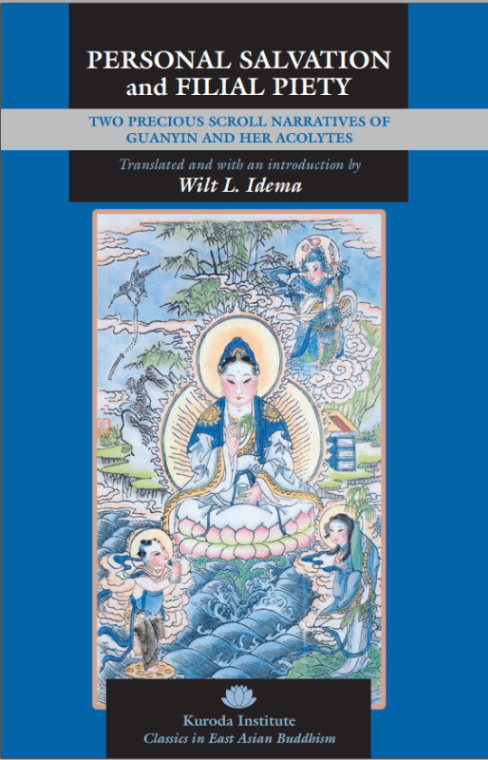
Personal Salvation and Filial Piety: Two Precious Scroll Narratives of Guanyin and Her Acolytes
Wilt L. Idema
English
Book
University of Hawai‘i Press, Honolulu.
2008
281 pages
1.8 MB
Introduction
The book opens with a substantial Introduction by Wilt L. Idema. The introduction situates Guanyin within the wider history of Avalokiteśvara devotion in East Asia. It explains that Avalokiteśvara entered China as a male bodhisattva, often depicted as a handsome prince, but from around the tenth century onward Guanyin was increasingly venerated in female form. This transformation produced a rich body of legends, rituals, images, and vernacular narratives, especially stories centered on Guanyin as a compassionate savior who responds to those in distress.
The introduction explains the importance of the Princess Miaoshan legend. Miaoshan is the youngest daughter of King Miaozhuang. Unlike her sisters, she refuses marriage because she seeks liberation from saṃsāra. Her refusal creates a direct conflict with her father, who represents royal authority, patriarchal control, and conventional family morality. The narrative develops this conflict through debates over marriage, filial duty, monastic life, religious aspiration, and the proper role of women.
A major theme of the introduction is the relationship between religious salvation and filial piety. Chinese family ethics require children to obey parents, marry, continue the lineage, and repay parental care. Miaoshan’s religious aspiration appears antisocial and unfilial because she refuses marriage and rejects the family line. However, the story reverses this judgment. When her father becomes gravely ill, Miaoshan gives her own eyes and arms to heal him. In this way, the narrative transforms renunciation into the highest form of filial devotion.
The introduction also discusses Avalokiteśvara and Guanyin. Idema explains different Chinese renderings of Avalokiteśvara, including Guanyin, Guanshiyin, and Guanzizai. He also traces Guanyin’s connection with the Lotus Sūtra, especially the chapter celebrating Avalokiteśvara’s saving powers. This scriptural background is important because the Lotus Sūtra presents Avalokiteśvara as a bodhisattva who can assume many forms, male or female, to rescue beings.
Another important section of the introduction concerns The Precious Scroll of Incense Mountain: Authorship and Editions. Idema explains that the earliest external reference to the text may date from the early sixteenth century, while the earliest preserved printed edition dates to 1773. The text circulated in both a more elaborate version and a later shorter version. The translation in this volume is based on the shorter version, which circulated widely in the nineteenth and early twentieth centuries among Guanyin devotees.
The introduction also compares Miaoshan with female saints in medieval Europe. Idema highlights striking parallels between Buddhist female sanctity and Christian hagiographic romance: noble birth, refusal of marriage, paternal persecution, bodily suffering, public humiliation, miraculous endurance, and final sanctification. At the same time, Miaoshan differs from many Christian virgin saints because she becomes not merely a martyr but a universal savior identified with Guanyin.
The Precious Scroll of Incense Mountain, Part 1
The first main translated section narrates the early life and conflict of Princess Miaoshan. The story begins with the royal household of King Miaozhuang and the birth of his three daughters. Because the king has no son, he expects his daughters to marry and produce descendants. Miaoshan, however, is spiritually inclined from birth and refuses worldly marriage. She declares her wish to cultivate the Buddhist path and escape the cycle of rebirth.
Part 1 develops the long conflict between Miaoshan and her family. Her father, mother, sisters, palace women, officials, and the abbess of the White Sparrow Convent all try to persuade her to abandon religious life. They appeal to social duty, parental affection, political order, bodily comfort, and the supposed hardship of monastic existence. Miaoshan answers these arguments by stressing impermanence, karmic retribution, the inevitability of death, and the superiority of liberation.
The first part also narrates Miaoshan’s trials. She is confined, sent to the convent, forced to perform impossible tasks, aided by divine beings and animals, and eventually condemned by her father. Her suffering becomes a narrative demonstration of spiritual determination. The text is not merely a devotional story; it dramatizes the clash between Buddhist renunciation and Chinese familial-social obligation.
The Precious Scroll of Incense Mountain, Part 2
The second part narrates Miaoshan’s execution, journey through the underworld, resurrection, cultivation on Incense Mountain, and final transformation into Guanyin. After being condemned, Miaoshan is publicly humiliated and taken to execution. Yet her death does not end the story. She visits the underworld, where her presence brings relief to suffering beings and reveals the tension between karmic justice and saving compassion.
After returning from death, Miaoshan continues her cultivation on Incense Mountain. Later, King Miaozhuang falls into a terrible disease that no ordinary medicine can cure. He is told that only the eyes and arms of a person without anger can heal him. Miaoshan, still unknown to him as his daughter, gives her own eyes and arms. The king is cured, visits Incense Mountain, and discovers that the mutilated savior is his own daughter. This recognition leads to remorse, revelation, and Miaoshan’s manifestation as Guanyin.
This part is doctrinally significant because it turns the entire narrative around the body as sacrifice. Miaoshan’s renunciation is no longer merely personal salvation; it becomes compassionate self-giving for the salvation of others, including the very father who persecuted her. The text thereby integrates Buddhist compassion, bodily sacrifice, karmic justice, and filial piety.
The Precious Scroll of Good-in-Talent and Dragon Girl
The second translated text is shorter and more humorous. It explains how Guanyin acquired three acolytes frequently shown in popular iconography: Good-in-Talent / Shancai / Sudhana, Dragon Girl / Longnü / Nāgakanyā, and the white parrot. These figures commonly appear around Guanyin in popular prints and devotional imagery.
This scroll draws from popular lore and Buddhist legend. It is less solemn than The Precious Scroll of Incense Mountain and often satirizes ordinary human motives, especially people’s tendency to forget received favors and to seek personal gain rather than religious salvation. Nevertheless, it remains important because it explains the devotional ensemble surrounding Guanyin and shows how Buddhist narrative absorbed humor, folklore, local imagination, and popular visual culture.
The volume concludes with Notes, Glossary, and Bibliography. These scholarly apparatuses make the book useful for advanced research on Chinese Buddhist literature, Guanyin devotion, baojuan performance, Buddhist gender studies, popular religion, and comparative hagiography.
Overall, Personal Salvation and Filial Piety is a major contribution to the study of Chinese popular Buddhism. Its key value lies in showing how Guanyin devotion developed not only through canonical scriptures and temple cults, but also through performative vernacular literature. For research on Buddhist compassion, filial piety, female religiosity, religious renunciation, and bodhisattva self-sacrifice, this volume is especially important.
Copyright Notice
This material is provided solely for academic research, study, and religious practice purposes under Article 25 of Vietnam's Intellectual Property Law. Reproduction, distribution, or commercial use is strictly prohibited.
If you are the author, translator, publisher, or rights holder and believe this content has been posted without proper authorization, please contact us and we will promptly review and remove or restrict access.
Documents
Personal Salvation and Filial Piety: Two Precious Scroll Narratives of Guanyin and Her Acolytes
1.8 MB
Keywords
GuanyinMiaoshanPrecious ScrollsFilial PietyChinese Popular Buddhism.
Sách đọc nhiều nhất
The Buddha’s Ancient Path
Piyadassi Thera
Book·10.7 MB
229 pages1979223
The Questions of King Milinda, Part II
F. Max Müller (Editor)
Book·20.8 MB
427 pages1894208

A Taste of Freedom
Venerable Ajahn Chah / Phra Bodhinyana Thera
Book·1.2 MB
104 pages1980207
Buddhist Meditation: An Anthology of Texts from the Pāli Canon
Sarah Shaw (General Editors: Charles S. Prebish and Damien Keown)
Book·17.5 MB
253 pages2006204