
English
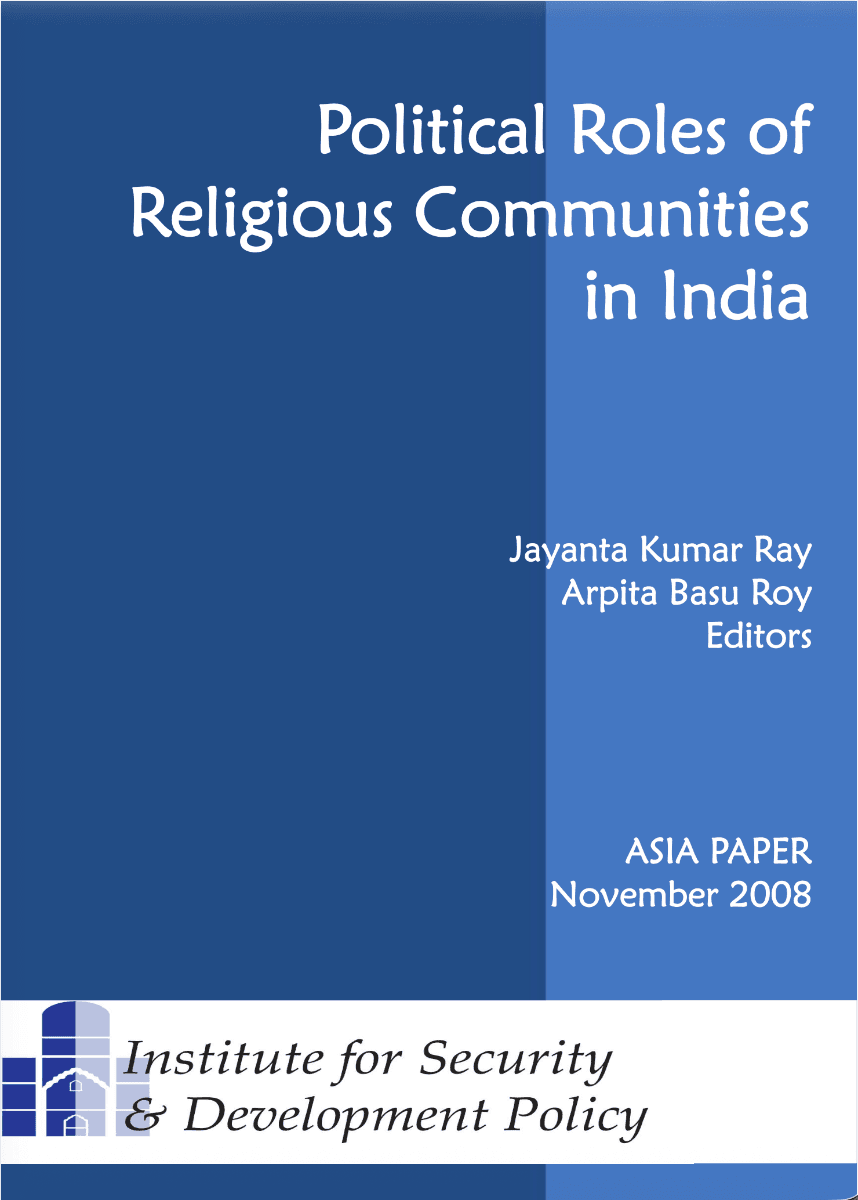
Political Roles of Religious Communities in India
Jayanta Kumar Ray & Arpita Basu Roy
English
Book
Institute for Security and Development Policy (ISDP), Stockholm-Nacka, Sweden
2008
139 pages
802 KB
Introduction
The volume is organized into three thematic sections. The first examines the theoretical relationship between individuals, religious communities, the state, and globalization, addressing historiography, jurisdiction, secularism, Muslim personal law, and the Kashmir dispute. The second section presents case studies of major religious communities and movements in India, including Hindu-Muslim relations, Buddhism in Ladakh and eastern India, Christian missionary activity among tribal populations in Arunachal Pradesh, Sikh political activism in India and the diaspora, and the historical development of the Matak movement in Assam. The final section offers a comparative perspective by examining European and Indian experiences of nation-building, citizenship, secularism, and the political position of religious communities. Throughout the collection, the contributors investigate how religion shapes identity, law, conflict, governance, peacebuilding, and democratic politics within the diverse social and constitutional landscape of modern India.
Copyright Notice
This material is provided solely for academic research, study, and religious practice purposes under Article 25 of Vietnam's Intellectual Property Law. Reproduction, distribution, or commercial use is strictly prohibited.
If you are the author, translator, publisher, or rights holder and believe this content has been posted without proper authorization, please contact us and we will promptly review and remove or restrict access.
Documents
Political Roles of Religious Communities in India
802 KB
Keywords
IndiaReligion and PoliticsReligious CommunitiesSecularismHinduismBuddhismNation-Building.
Sách đọc nhiều nhất
The Buddha’s Ancient Path
Piyadassi Thera
Book·10.7 MB
229 pages1979223
The Questions of King Milinda, Part II
F. Max Müller (Editor)
Book·20.8 MB
427 pages1894208

A Taste of Freedom
Venerable Ajahn Chah / Phra Bodhinyana Thera
Book·1.2 MB
104 pages1980207
Buddhist Meditation: An Anthology of Texts from the Pāli Canon
Sarah Shaw (General Editors: Charles S. Prebish and Damien Keown)
Book·17.5 MB
253 pages2006204