
English
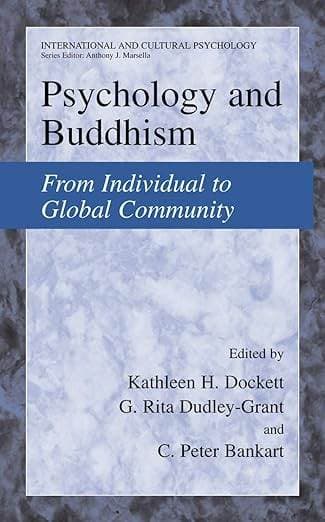
Psychology and Buddhism: From Individual to Global Community
Kathleen H. Dockett (Editor), G. Rita Dudley-Grant (Editor), C. Peter Bankart (Editor)
English
Book
Kluwer Academic Publishers
2004
308 pages
5.1 MB
Introduction
The book begins with an Introduction by G. Rita Dudley-Grant, C. Peter Bankart, and Kathleen H. Dockett. The editors argue that Buddhism and psychology are both committed to understanding human suffering, human potential, personal transformation, and the cultivation of more humane communities. They also explain that much previous work on Buddhism and psychology has focused on individual therapy, while this volume deliberately broadens the conversation toward community and global concerns.
The introduction also situates the book in the post-September 11 context. Buddhist responses to violence, especially those emphasizing compassion, interdependence, nonviolence, and dialogue, are presented as relevant to psychology’s responsibility in a world marked by ethnic conflict, social suffering, and global insecurity.
Part I: Foundations
Chapter 1: “On the Path of the Buddha: A Psychologists’ Guide to the History of Buddhism” — C. Peter Bankart, Kathleen H. Dockett, and G. Rita Dudley-Grant
This chapter gives a broad historical introduction to Buddhism for psychologists. It presents the life of Siddhartha Gautama, his encounter with suffering, renunciation, ascetic practice, enlightenment, and teaching career. The chapter explains core Buddhist doctrines such as dukkha, craving, dependent origination, the Four Noble Truths, the Noble Eightfold Path, compassion, karma, and mindfulness.
The chapter’s purpose is not only historical. It also shows why Buddhist ideas are relevant to psychology: Buddhism offers a disciplined account of suffering, desire, consciousness, selfhood, attachment, and transformation. The authors emphasize that Buddhism is grounded in practice and experiential insight rather than mere dogma.
Chapter 2: “Five Manifestations of the Buddha in the West: A Brief History” — C. Peter Bankart
This chapter examines how Buddhism has been received, interpreted, and sometimes misunderstood in the West. Bankart discusses the difficulties psychologists and Western intellectuals have had in translating Buddhist philosophy into psychological theory and practice.
The chapter is especially concerned with Western ethnocentrism and Orientalist distortion. It asks whether contemporary efforts to integrate Buddhism and psychology can avoid earlier errors and retain the depth of Buddhist philosophical insight.
Chapter 3: “Value and Meaning in Gestalt Psychology and Mahayana Buddhism” — Edward S. Ragsdale
This chapter compares Gestalt psychology with Mahāyāna Buddhism. Ragsdale explores questions of value, meaning, subjectivity, perception, and relational existence. A major theme is that both Gestalt psychology and Mahāyāna Buddhism challenge overly rigid or atomistic views of reality.
The chapter gives special attention to dependent origination and compassion. It argues that Buddhist thought can help psychology move beyond both nihilism and absolutism by emphasizing relational meaning and interdependence.
Part II: Healing and Psychotherapy: Alternatives in Psychotherapy
Chapter 4: “Buddhism, Psychology, and Addiction Theory in Psychotherapy” — G. Rita Dudley-Grant
This chapter applies Buddhist principles to addiction theory and psychotherapy. Dudley-Grant compares Buddhist and psychological approaches to suffering, self-control, craving, habit, recovery, and community support.
The chapter discusses addiction through Buddhist concepts such as attachment, desire, selfhood, and delusion. It also compares Buddhist practice with recovery models such as the Twelve-Step approach, suggesting that community, responsibility, and transformation are shared points of contact.
Chapter 5: “Suffering from Biobabble: Searching for a Science of Subjectivity” — Polly Young-Eisendrath
This chapter critiques the reduction of human suffering to biological explanation alone. Young-Eisendrath argues that Western psychology often lacks an adequate science of subjective experience, especially when it reduces behavior to genetics or biological determinism.
Buddhism is presented as a resource for understanding suffering, karma, responsibility, and transformation without falling into rigid mind–body dualism. The chapter suggests that Buddhist practice and psychodynamic inquiry can both help people become accountable for their patterns of suffering and change.
Chapter 6: “Role of Responsibility in Daseinanalysis and Buddhism” — Belinda Siew Luan Khong
This chapter compares Buddhism with Daseinanalysis and Heideggerian existential thought. Khong focuses on responsibility, freedom, self-understanding, and dependent origination.
The chapter argues that both Buddhism and existential analysis ask individuals to take responsibility for their lives and experience. Buddhism extends this responsibility through the doctrine of dependent origination, showing that one’s actions, perceptions, and relationships are embedded in a wider field of causes and conditions.
Chapter 7: “Classical Buddhist Model of a Healthy Mind” — Richard P. Hayes
This chapter presents a Buddhist model of mental health. Hayes emphasizes the Middle Way: avoiding both self-denial and self-indulgence. A healthy mind is not withdrawn from the world, but ethically engaged, balanced, compassionate, and wise.
The chapter explains that Buddhist mental health involves ethics, contemplation, wisdom, family life, community responsibility, and active participation in the world. The Buddhist goal is not merely symptom reduction, but the cultivation of a mind free from destructive extremes.
Part III: Empowerment, Responsibility, and the Challenges of Change
Chapter 8: “Buddhist Empowerment: Individual, Organizational, and Societal Transformation” — Kathleen H. Dockett
This chapter connects Buddhism with empowerment theory in community psychology. Dockett discusses how Buddhist practice can support individual empowerment, organizational transformation, and wider social change.
Drawing especially on Nichiren Buddhism and Soka Gakkai International-USA, the chapter analyzes how Buddhist philosophy and practice may promote stress resistance, personal agency, collective support, and social responsibility.
Chapter 9: “The Role of Religion and Spirituality in Community Building” — Leonard A. Jason and John Moritsugu
This chapter studies how religion and spirituality can support community psychology. Jason and Moritsugu argue that community psychology needs deeper values to guide intervention, especially in contexts involving social suffering, ethnic conflict, and collective trauma.
Buddhist traditions are presented as a possible source of foundational values such as compassion, interdependence, non-harming, and responsibility. The chapter suggests that Buddhist thought can strengthen community-level approaches to healing and social change.
Chapter 10: “Transcending Self and Other: Mahayana Principles of Integration” — Kathleen H. Dockett and Doris North-Schulte
This chapter applies Mahāyāna Buddhist principles to ethnic conflict and social division. The authors argue that many conflicts are rooted in rigid identity boundaries between self and other.
The chapter proposes that Mahāyāna teachings on interdependence, non-duality, compassion, and the transformation of self-understanding can help prevent conflict and support integration across ethnic, cultural, and social boundaries.
Chapter 11: “Environmental Problems and Buddhist Ethics: From the Perspective of the Consciousness-Only Doctrine” — Shuichi Yamamoto
This chapter addresses environmental crisis through Buddhist ethics, especially from the perspective of the Consciousness-Only tradition. Yamamoto argues that environmental destruction is not only a technical problem, but a problem of consciousness.
The chapter emphasizes that ecological healing requires transformation in human perception, values, and conduct. Buddhist ideas of interdependence, compassion, and the continuity of life provide an ethical foundation for environmental responsibility.
Chapter 12: “Buddhist Social Principles” — David W. Chappell
This chapter develops the concept of social mindfulness. Chappell argues that Buddhist mindfulness should not be restricted to inner observation; it should also be extended into social dialogue, structural violence, oppression, and environmental responsibility.
The chapter presents the Buddha as socially active rather than merely contemplative. Chappell emphasizes that meditation and wisdom require a third dimension: social action. Buddhist practice therefore includes responsibility for social transformation, justice, dialogue, and compassionate engagement.
Part IV: Future Directions: Global Impact
Chapter 13: “On the Path to Peace and Wholeness: Conclusion to Psychology and Buddhism” — G. Rita Dudley-Grant, C. Peter Bankart, and Kathleen H. Dockett
The concluding chapter gathers the book’s central argument: psychology can be enriched by Buddhism when it takes seriously interdependence, compassion, consciousness, empowerment, and social responsibility.
The editors argue that the integration of Buddhism and psychology should not remain limited to psychotherapy or individual well-being. Its broader promise lies in helping individuals and communities build sustainable, peaceful, and ethically responsible ways of life.
Copyright Notice
This material is provided solely for academic research, study, and religious practice purposes under Article 25 of Vietnam's Intellectual Property Law. Reproduction, distribution, or commercial use is strictly prohibited.
If you are the author, translator, publisher, or rights holder and believe this content has been posted without proper authorization, please contact us and we will promptly review and remove or restrict access.
Documents
Psychology and Buddhism: From Individual to Global Community
5.1 MB
Keywords
Buddhist PsychologyPsychotherapyCommunity PsychologyEngaged BuddhismGlobal Peace.
Sách đọc nhiều nhất

The Buddha’s Ancient Path
Piyadassi Thera
Book·10.7 MB
229 pages1979223

The Questions of King Milinda, Part II
F. Max Müller (Editor)
Book·20.8 MB
427 pages1894208

A Taste of Freedom
Venerable Ajahn Chah / Phra Bodhinyana Thera
Book·1.2 MB
104 pages1980207

Buddhist Meditation: An Anthology of Texts from the Pāli Canon
Sarah Shaw (General Editors: Charles S. Prebish and Damien Keown)
Book·17.5 MB
253 pages2006204