
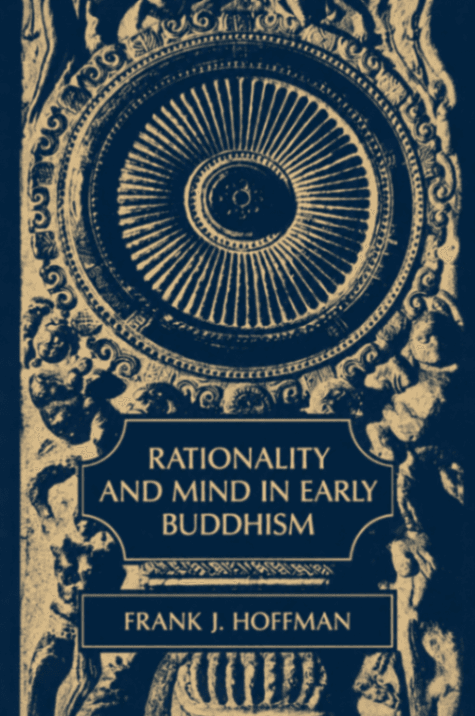
English
Rationality and Mind in Early Buddhism
Frank J. Hoffman
English
Book
Motilal Banarsidass, Delhi
1987
126 pages
79.1 MB
Introduction
The book is organized into six chapters. “Understanding Early Buddhism” establishes the methodological framework by treating early Buddhism as the Buddhism of the five Nikāyas and by advocating a careful dialogue between Pāli textual study and philosophy of religion. “Rationality and Logic” examines the charge that early Buddhist fourfold logic is self-contradictory, arguing instead that it functions as a heuristic principle for debate rather than as a formal logical system. “Rationality and Pessimism” analyzes the concept of dukkha and rejects the view that early Buddhism is fundamentally pessimistic. “Mind and Rebirth” studies the relation between mind, consciousness, no-self, rebirth, and the problem of personal reidentification across lives. “Mind and Verification” discusses faith, special knowledge, and the limits of Buddhist empiricism in relation to rebirth. “The Deathless (Amata)” examines nibbāna, parinibbāna, and the problem of final liberation, proposing that early Buddhist liberation can be understood without positing a permanent soul or reducing the tradition to nihilism.
Copyright Notice
This material is provided solely for academic research, study, and religious practice purposes under Article 25 of Vietnam's Intellectual Property Law. Reproduction, distribution, or commercial use is strictly prohibited.
If you are the author, translator, publisher, or rights holder and believe this content has been posted without proper authorization, please contact us and we will promptly review and remove or restrict access.
Documents
Rationality and Mind in Early Buddhism
79.1 MB
Keywords
Early BuddhismrationalitymindPāli Nikāyasno-selfrebirthNibbāna.
Sách đọc nhiều nhất
The Buddha’s Ancient Path
Piyadassi Thera
Book·10.7 MB
229 pages1979223
The Questions of King Milinda, Part II
F. Max Müller (Editor)
Book·20.8 MB
427 pages1894208

A Taste of Freedom
Venerable Ajahn Chah / Phra Bodhinyana Thera
Book·1.2 MB
104 pages1980207
Buddhist Meditation: An Anthology of Texts from the Pāli Canon
Sarah Shaw (General Editors: Charles S. Prebish and Damien Keown)
Book·17.5 MB
253 pages2006204