English
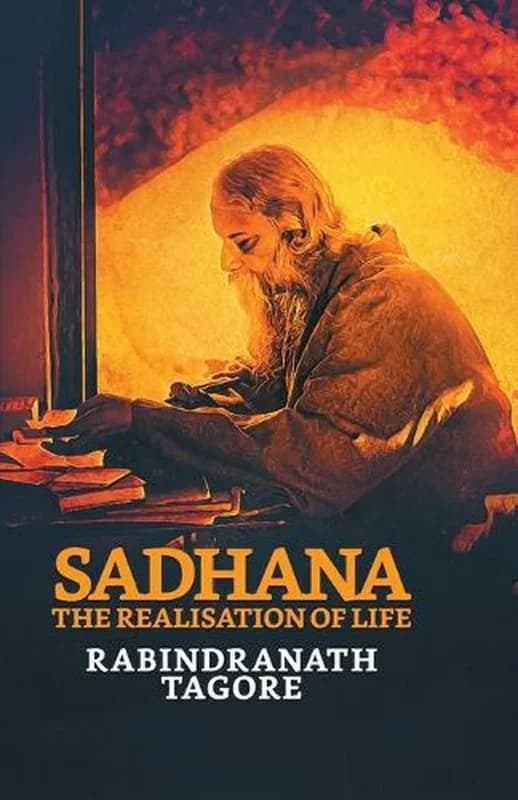
Sādhana: The Realisation of Life
Rabindranath Tagore
English
Book
Bernhard Tauchnitz
1921
278 pages
12.5 MB
Introduction
Author’s Preface
Tagore explains that the book is not written from a purely scholarly or systematic philosophical standpoint. Its ideas arise from his upbringing in a family where the Upanishads were used in daily worship, and from his own religious and educational work. He states that the Upanishads and the teachings of Buddha are living spiritual realities, not merely historical texts.
I. The Relation of the Individual to the Universe
This chapter presents one of the book’s central ideas: the individual cannot be understood apart from the universe. Tagore contrasts the Western tendency to divide man and nature with the Indian vision of harmony between the human spirit and the spirit of the world.
II. Soul Consciousness
This section develops the idea that human beings must awaken to a deeper consciousness beyond the narrow ego. True consciousness is not limited to personal desire or external knowledge, but opens toward unity, inner freedom, and spiritual awareness.
III. The Problem of Evil
Tagore examines evil not merely as an external force, but as a condition arising from separation, ignorance, selfishness, and failure to realise unity. Evil is overcome through spiritual expansion, love, and harmony with the larger truth of life.
IV. The Problem of Self
This chapter reflects on the nature of selfhood. Tagore distinguishes the limited ego from the deeper self that finds fulfilment in relation, love, and universality. The self becomes complete not through isolation, but through union with the Infinite.
V. Realisation in Love
Love is presented as a principal path of realisation. Through love, the individual transcends the boundaries of ego and participates in the life of others. Love reveals the unity between self and world.
VI. Realisation in Action
This chapter, connected with Tagore’s Bengali discourse on Karma-yoga, presents action as a spiritual path. True action is not driven by egoistic possession, but by service, duty, freedom, and participation in universal life.
VII. The Realisation of Beauty
Beauty is treated as a mode of spiritual perception. It reveals harmony, joy, and the deeper unity of existence. For Tagore, beauty is not merely aesthetic pleasure, but a doorway into the truth of life.
VIII. The Realisation of the Infinite
The final chapter gathers the book’s central vision. Human life reaches fulfilment when it realises the Infinite, not as an abstract metaphysical idea, but as a living spiritual presence experienced through love, beauty, action, and unity.
Copyright Notice
This material is provided solely for academic research, study, and religious practice purposes under Article 25 of Vietnam's Intellectual Property Law. Reproduction, distribution, or commercial use is strictly prohibited.
If you are the author, translator, publisher, or rights holder and believe this content has been posted without proper authorization, please contact us and we will promptly review and remove or restrict access.
Documents
Sādhana: The Realisation of Life
12.5 MB
Keywords
SādhanaRabindranath TagoreUpanishadsSelf-RealisationInfinite.
Sách đọc nhiều nhất
The Buddha’s Ancient Path
Piyadassi Thera
Book·10.7 MB
229 pages1979223
The Questions of King Milinda, Part II
F. Max Müller (Editor)
Book·20.8 MB
427 pages1894208
A Taste of Freedom
Venerable Ajahn Chah / Phra Bodhinyana Thera
Book·1.2 MB
104 pages1980207
Buddhist Meditation: An Anthology of Texts from the Pāli Canon
Sarah Shaw (General Editors: Charles S. Prebish and Damien Keown)
Book·17.5 MB
253 pages2006204