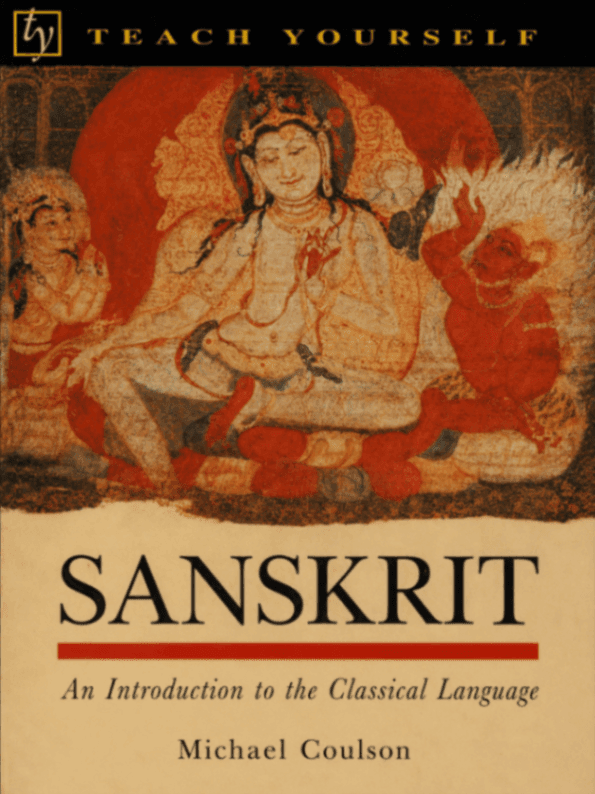
Sanskrit: An Introduction to the Classical Language
Introduction
The book is intended primarily to give students practical access to straightforward Classical Sanskrit as rapidly as possible. Coulson deliberately gives greater attention to syntax, idiom, nominal constructions, and compounds than many traditional Sanskrit primers, which he considers overly concentrated on exhaustive morphological paradigms. Although the work introduces the major systems of declension and conjugation, grammatical forms are progressively reinforced through authentic examples and exercises rather than treated principally as isolated paradigms.
The introductory discussion also situates Sanskrit historically within the Indo-European and Indo-Iranian language families and distinguishes Vedic, Classical, and Middle Indo-Aryan developments. Particular importance is given to Pāṇini and the stabilization of Classical Sanskrit, while Coulson stresses that Pāṇinian codification did not prevent significant developments in syntax and literary style. His treatment of long compounds, case relationships, participial constructions, and the evolution of learned Sanskrit provides a linguistic framework for understanding why Classical Sanskrit differs markedly from both Vedic Sanskrit and other Indo-European languages.
Table of Contents
Preface
Introduction
Using This Book
Chapter 1: The Nāgarī Script
Chapter 2: Roots and Verb Classes
Chapter 3: Nouns and Pronouns
Chapter 4: Past Participle and Instrumental Case
Chapter 5: The Cases: Dative, Ablative, Genitive, Locative
Chapter 6: Feminine Gender and Determinative Compounds
Chapter 7: Consonant Stems and Causatives
Chapter 8: Changeable Consonant Stems and Bahuvrīhi Compounds
Chapter 9: Stems in i and u; Ātmanepada
Chapter 10: Stems in ī and ū; Present Participle and Imperative
Chapter 11: Stems in ṛ; Periphrastic Future and Passive
Chapter 12: Athematic Presents and Gerundives
Chapter 13: Reduplication, Infinitive and Future
Chapter 14: Imperfect and Optative
Chapter 15: Perfect, Aorist, Injunctive and Precative
Appendix 1: Further Sanskrit Study
Appendix 2: Grammatical Paradigms
Appendix 3: Classical Metres
Sanskrit-English Exercises: Transcription
Sanskrit-English Exercises: Key
English-Sanskrit Exercises: Roman Key
English-Sanskrit Exercises: Nāgarī Key
General Vocabulary
Sanskrit-English
English-Sanskrit
Supplementary English-Sanskrit Exercises
English Index
Sanskrit Index
Copyright Notice
This material is provided solely for academic research, study, and religious practice purposes under Article 25 of Vietnam's Intellectual Property Law. Reproduction, distribution, or commercial use is strictly prohibited.
If you are the author, translator, publisher, or rights holder and believe this content has been posted without proper authorization, please contact us and we will promptly review and remove or restrict access.
Documents
Sanskrit: An Introduction to the Classical Language
7.7 MB
Keywords
Sách đọc nhiều nhất
The Buddha’s Ancient Path
Piyadassi Thera
The Questions of King Milinda, Part II
F. Max Müller (Editor)
A Taste of Freedom
Venerable Ajahn Chah / Phra Bodhinyana Thera
Buddhist Meditation: An Anthology of Texts from the Pāli Canon
Sarah Shaw (General Editors: Charles S. Prebish and Damien Keown)