
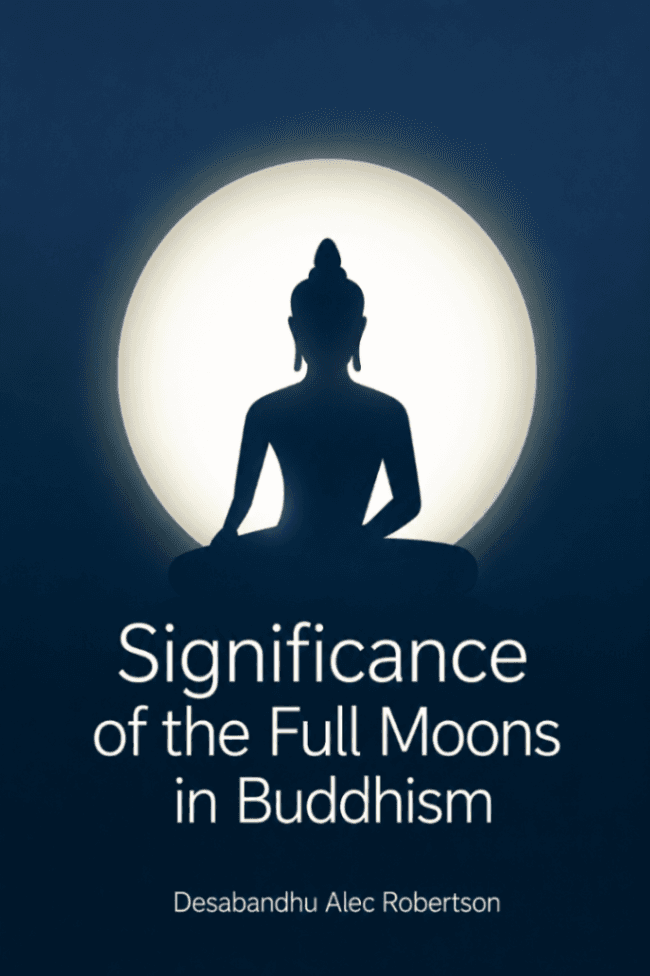
English
Significance of the Full Moons in Buddhism
Desabandhu Alec Robertson
English
Book
Buddhist Cultural Centre; Nedimala, Dehiwala, Sri Lanka.
1971
269 pages
41.8 MB
Introduction
The book is organized into fifteen chapters. The opening chapters establish the doctrinal foundation of Poya or Uposatha observance, explaining its religious significance, the discipline of the observance day, and the Uposatha as preached by the Buddha. The following chapters examine the major full-moon days in sequence: Vesak Poya, Poson Poya, Esala Poya, Nikini Poya, Binara Poya, Vap Poya, Il Poya, Unduvap Poya, Duruthu Poya, Navam Poya, Medin Poya, and Bak Poya. Through these chapters, the author connects lunar observances with key moments in Buddhist sacred history, including events in the Buddha’s life, the spread of Buddhism to Sri Lanka, monastic ceremonies, devotional observances, doctrinal reflection, and the continuing role of the Triple Gem in Buddhist practice. Overall, the volume presents the full-moon calendar as a structured religious framework through which Buddhist laypeople and monastics renew ethical discipline, deepen devotion, remember sacred history, and reaffirm commitment to the Dhamma.
Copyright Notice
This material is provided solely for academic research, study, and religious practice purposes under Article 25 of Vietnam's Intellectual Property Law. Reproduction, distribution, or commercial use is strictly prohibited.
If you are the author, translator, publisher, or rights holder and believe this content has been posted without proper authorization, please contact us and we will promptly review and remove or restrict access.
Documents
Significance of the Full Moons in Buddhism
41.8 MB
Keywords
Full MoonPoyaUposathaVesakPosonTheravāda BuddhismSri Lankan Buddhism.
Sách đọc nhiều nhất
The Buddha’s Ancient Path
Piyadassi Thera
Book·10.7 MB
229 pages1979223
The Questions of King Milinda, Part II
F. Max Müller (Editor)
Book·20.8 MB
427 pages1894208

A Taste of Freedom
Venerable Ajahn Chah / Phra Bodhinyana Thera
Book·1.2 MB
104 pages1980207
Buddhist Meditation: An Anthology of Texts from the Pāli Canon
Sarah Shaw (General Editors: Charles S. Prebish and Damien Keown)
Book·17.5 MB
253 pages2006204