English
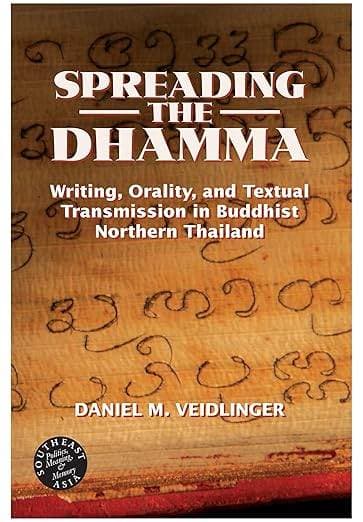
Spreading the Dhamma: Writing, Orality, and Textual Transmission in Buddhist Northern Thailand
Daniel M. Veidlinger
English
Book
University of Hawai‘i Press, Honolulu, Hawai‘i
2007
280 pages
2.7 MB
Introduction
The book opens with a methodological concern: Buddhist textual history should not be studied only through the semantic content of texts. Veidlinger argues that the vessels of transmission—oral memory, recitation, writing, manuscripts, inscriptions, and later print—are essential to understanding how Buddhism functioned in actual communities. Drawing on media theory, especially the insight that communication technologies shape culture, he treats writing and mnemonic systems as technologies that affected religious authority, monastic identity, ritual life, and the regional formation of Lan Na Buddhism.
The opening visual material includes a map of Mainland Southeast Asia, helping situate Lan Na within a wider regional network including Burma, Laos, Siam, Cambodia, Vietnam, and Malaysia. This geographical framing is important because the book repeatedly compares Lan Na with the broader Theravāda world, especially Sri Lanka and Burma.
Introduction
The introduction presents the book’s core research problem: how did Buddhists in northern Thailand encounter Pāli texts, and what roles did oral and written transmission play in religious life? Veidlinger explains that the Pāli Tipiṭaka was transmitted orally for centuries before being written down, and that oral recitation continued to matter even after manuscripts existed. He then introduces the history of Lan Na, beginning with the rise of Chiang Mai under King Mangrai in the thirteenth century, the arrival of Sinhalese forest-dwelling monastic lineages, and the Golden Age of Lan Na in the fifteenth and early sixteenth centuries.
The introduction also develops an important distinction between cultic and discursive uses of manuscripts. In cultic use, a manuscript may be honored, offered flowers, carried in procession, installed in a stūpa, or treated as a physical embodiment of the Buddha’s teaching. In discursive use, the words of the text are read, recited, studied, copied, or stored for later transmission. This framework is central to the whole book because it shows that manuscripts were not merely information containers; they were ritual, social, economic, and symbolic objects.
Chapter 1: Monks and Memory: The Oral World
This chapter reconstructs the oral world of Buddhist textual transmission. Veidlinger examines the importance of memorization, recitation, and the role of monks who preserved and transmitted texts through oral discipline. The chapter discusses the older bhāṇaka tradition, in which specialist reciters were responsible for maintaining different sections of the canon. It also shows that oral transmission did not simply disappear after texts were written down. Rather, memory and recitation continued to function as marks of monastic learning and religious authority.
Chapter 2: Early Thai Encounters with Orality and Literacy
This chapter explores the early interaction between oral and written modes of communication in Thai Buddhist contexts. Veidlinger studies how writing entered Buddhist practice gradually and unevenly. Literacy did not immediately replace oral authority. Instead, oral and written practices coexisted, competed, and reinforced each other. The chapter also considers how written forms began to shape religious administration, textual preservation, and the diffusion of Pāli learning.
Chapter 3: Golden Age, Golden Images, and Golden Leaves
This chapter focuses on the Lan Na Golden Age, when Buddhist cultural production flourished. Veidlinger links political consolidation, monastic reform, Sri Lankan Buddhist influence, and textual activity. The phrase “golden leaves” evokes palm-leaf manuscripts, while “golden images” points to the strong visual and cultic environment of Buddhist devotion. The chapter shows that manuscripts emerged alongside other sacred objects, especially Buddha images and relics, but did not always occupy the same religious status. Written texts became increasingly important, yet their prestige had to be negotiated within already powerful ritual cultures centered on relics, images, and oral performance.
Chapter 4: The Text in the World: Scribes, Sponsors, and Manuscript Culture
This chapter is central for understanding the material and social world of manuscripts. Veidlinger examines how palm-leaf manuscripts were produced, who sponsored them, who copied them, where they were stored, and what their colophons reveal. Manuscript colophons are especially important because they often preserve information about sponsors, scribes, merit-making intentions, dates, locations, and hopes for preserving the Buddha’s teaching.
The chapter shows that manuscript production was embedded in an economy of merit. To sponsor the copying of a text was not merely to create a book; it was to participate in the preservation of the sāsana and generate religious merit. Manuscripts could thus function as gifts, ritual objects, educational tools, and vehicles of Buddhist memory.
Chapter 5: Turning Over a New Leaf: The Advance of Writing
This chapter traces the increasing expansion of writing in Lan Na Buddhist life. Veidlinger does not present this as a simple replacement of orality by literacy. Rather, writing advanced through specific institutions, monastic groups, political patronage, manuscript copying, and regional networks. The chapter discusses the tensions between monks committed to oral traditions and those who supported the growth of written textual culture.
A major theme is that communication technology affected monastic authority. Those trained in memorized recitation had one kind of religious capital; those skilled in manuscript copying, preservation, and textual study had another. The advance of writing therefore changed not only textual transmission but also social relations within the Buddhist community.
Chapter 6: Overlooked or Looked Over? The Meaning and Uses of Written Pāli Texts
This chapter examines how written Pāli texts were actually used and valued. Veidlinger asks whether manuscripts were read, recited, worshipped, stored, copied, displayed, or simply possessed as meritorious objects. He shows that written Pāli texts could be central in ritual contexts even when many laypeople could not read them directly. A manuscript might be heard through recitation, revered as a sacred object, copied for merit, or stored as a sign of preserving the Dhamma for future generations.
This chapter also deepens the discussion of the cult of the book in Theravāda Buddhism. While book worship is often associated with Mahāyāna traditions, Veidlinger demonstrates that written texts in northern Thailand also acquired sacred, ritual, and merit-producing roles. However, the status of manuscripts must be understood within the broader religious ecology of relics, Buddha images, stūpas, recitation, and monastic authority.
Conclusion
The conclusion synthesizes the book’s argument: Buddhist textual transmission in Lan Na was shaped by a dynamic relationship between oral and written media. Writing did not simply supersede orality; instead, manuscripts entered a world already structured by memory, recitation, ritual authority, relic devotion, and monastic hierarchy. Over time, writing became increasingly important in preserving and spreading Pāli texts, but its authority was negotiated through existing Buddhist institutions and practices.
The book concludes with Notes, Bibliography, and Index, making it a strong research tool for scholars of Theravāda Buddhism, Southeast Asian Buddhism, manuscript culture, and religious communication.
Overall, Spreading the Dhamma is a major contribution to the study of Buddhist textual practice. Its key insight is that the history of Buddhism cannot be understood only by asking what texts say; one must also ask how texts were carried, heard, copied, stored, sponsored, worshipped, and transmitted across generations. For research on dāna, the work is also relevant because manuscript sponsorship emerges as a form of merit-making, religious giving, and participation in the preservation of the Buddha’s teaching.
Copyright Notice
This material is provided solely for academic research, study, and religious practice purposes under Article 25 of Vietnam's Intellectual Property Law. Reproduction, distribution, or commercial use is strictly prohibited.
If you are the author, translator, publisher, or rights holder and believe this content has been posted without proper authorization, please contact us and we will promptly review and remove or restrict access.
Documents
Spreading the Dhamma: Writing, Orality, and Textual Transmission in Buddhist Northern Thailand
2.7 MB
Keywords
Lan Na BuddhismPāli ManuscriptsOrality and LiteracyTextual TransmissionCult of the Book.
Sách đọc nhiều nhất
The Buddha’s Ancient Path
Piyadassi Thera
Book·10.7 MB
229 pages1979223
The Questions of King Milinda, Part II
F. Max Müller (Editor)
Book·20.8 MB
427 pages1894208

A Taste of Freedom
Venerable Ajahn Chah / Phra Bodhinyana Thera
Book·1.2 MB
104 pages1980207
Buddhist Meditation: An Anthology of Texts from the Pāli Canon
Sarah Shaw (General Editors: Charles S. Prebish and Damien Keown)
Book·17.5 MB
253 pages2006204