English
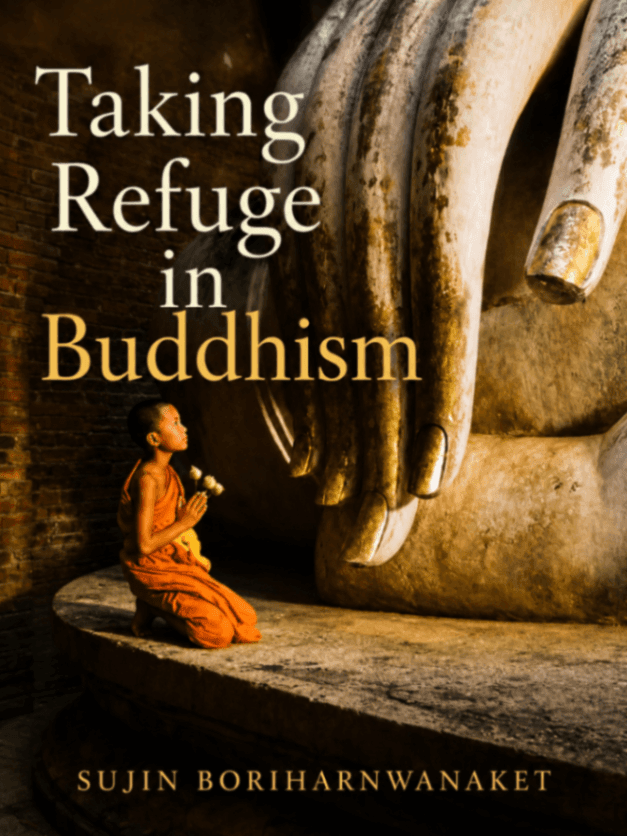
Taking Refuge in Buddhism
Sujin Boriharnwanaket
English
Book
Zolag
2000
109 pages
197 KB
Introduction
The book begins by distinguishing conventional reality from ultimate reality. What is ordinarily conceived as a person, body, animal, object, or world is understood conventionally, whereas ultimate realities possess their own characteristics and can be directly experienced. These realities include consciousness, associated mental factors, and material phenomena. By understanding their conditioned and momentary nature, practitioners gradually weaken the mistaken belief in a permanent self.
The discussions subsequently explain how theoretical understanding developed through listening and reflection provides the foundation for direct mindfulness and insight. The Eightfold Path unfolds through awareness of whatever mental or physical phenomenon appears in the present moment, rather than through forced concentration or an artificial method. As wisdom develops, practitioners discern impermanence, suffering, and non-self, penetrate the Four Noble Truths, and acquire increasingly stable confidence in the Triple Gem. The work therefore integrates Abhidhamma analysis with a practical account of Buddhist learning, mindfulness, detachment, and liberation.
Copyright Notice
This material is provided solely for academic research, study, and religious practice purposes under Article 25 of Vietnam's Intellectual Property Law. Reproduction, distribution, or commercial use is strictly prohibited.
If you are the author, translator, publisher, or rights holder and believe this content has been posted without proper authorization, please contact us and we will promptly review and remove or restrict access.
Documents
Taking Refuge in Buddhism
197 KB
Keywords
Taking refugeTheravāda BuddhismAbhidhammanāma and rūparight understandingNoble Eightfold Pathsatipaṭṭhāna.
Sách đọc nhiều nhất
The Buddha’s Ancient Path
Piyadassi Thera
Book·10.7 MB
229 pages1979223
The Questions of King Milinda, Part II
F. Max Müller (Editor)
Book·20.8 MB
427 pages1894208

A Taste of Freedom
Venerable Ajahn Chah / Phra Bodhinyana Thera
Book·1.2 MB
104 pages1980207
Buddhist Meditation: An Anthology of Texts from the Pāli Canon
Sarah Shaw (General Editors: Charles S. Prebish and Damien Keown)
Book·17.5 MB
253 pages2006204