English
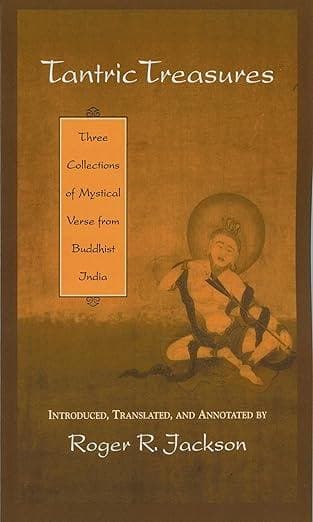
Tantric Treasures: Three Collections of Mystical Verse from Buddhist India
Roger R. Jackson
English
Book
Oxford University Press, New York, United States.
2004
182 pages
1.9 MB
Introduction
The book opens with a Preface, in which Roger R. Jackson explains his purpose: to provide an accurate, accessible, and poetically engaging translation of three classics of medieval Indian Buddhist mysticism. These are the Apabhraṃśa-language Dohākoṣas of Saraha, Kāṇha, and Tilopa. Jackson notes that all three texts had been translated before, but often with stronger emphasis on philological precision than poetic resonance. His translation seeks to preserve both doctrinal seriousness and the aphoristic, musical, paradoxical quality of the original verses.
The Introduction begins with a vivid reconstructed scene: a tantric yogin emerging from the Bengali jungle, sitting beneath a village banyan tree, beating a drum, and singing rhymed verses to villagers. This imagined scenario helps the reader understand the likely oral, performative, and public character of early dohā poetry. The verses were not merely written doctrines; they may have circulated as songs, instructions, provocations, and mystical utterances addressed to real audiences.
The section Uncertainties about Siddhas and Dohās explains the difficulties in studying the mahāsiddhas. Saraha, Kāṇha, Tilopa, and other siddhas are central to Indian, Nepalese, and Tibetan tantric traditions, but their historical identities remain elusive. The texts attributed to them are often transmitted through complex manuscript traditions, later commentaries, Tibetan translations, and hagiographic memory. Jackson cautions that the scholar cannot always determine with certainty who these figures were, when they lived, or whether each verse attributed to them is historically authentic.
The subsection Siddhas in General introduces the mahāsiddhas as “great adepts” or perfected tantric practitioners. These figures were remembered as poets, yogins, ritual masters, miracle workers, critics of orthodoxy, and transmitters of esoteric practice. Their influence extended across India, Nepal, Tibet, Mongolia, Ladakh, Sikkim, and Bhutan. In India, their songs helped shape later vernacular religious poetry and contributed to traditions such as bhakti, sant poetry, and perhaps even Sufi-inflected mystical expression. In Tibet, they became foundational ancestors of major Vajrayāna lineages.
The subsection Saraha, Kāṇha, and Tilopa gives specific attention to the three figures whose verses are translated. Saraha is presented as perhaps the greatest individual figure in Indian tantric Buddhism, associated with the arrow-maker woman, Mahāmudrā, and powerful antinomian songs. Kāṇha, also known as Kṛṣṇācārya, is linked with Yoginī Tantra traditions, Cakrasaṃvara, and skull-bearing tantric symbolism. Tilopa is especially important for Tibetan Buddhist traditions, particularly the Kagyu lineage, where he is remembered as a source of Mahāmudrā instruction and as teacher of Nāropa.
The section What We Do Know establishes the more secure scholarly ground. Jackson explains that the language of these texts is an eastern form of Apabhraṃśa, probably connected with regions such as Bihar and Bengal around the end of the first millennium CE. The poetic form is the dohā, a rhyming couplet often used for aphoristic spiritual instruction. The Dohākoṣa, or “Treasury of Couplets,” should therefore be understood as a later collection of verses that may have originated in oral performance, yogic instruction, and tantric song culture.
The subsection Content: The Yoginī Tantras as Background situates the poems in the world of late Indian Buddhist tantra. Jackson explains that the three collections show familiarity with the Yoginī Tantras, including tantric systems associated with Hevajra, Cakrasaṃvara, Vajrayoginī, and other esoteric practices. This context is important because the verses often refer to the subtle body, sexual yoga, guru devotion, ecstatic awareness, the innate nature, and practices that challenge ordinary dualistic categories of purity and impurity.
The introduction then identifies six common themes running through the three collections:
A rhetoric of paradox
The siddha poets often speak in deliberately paradoxical language. They affirm and deny, praise and criticize, reveal and conceal. This style is not mere contradiction; it is a method for pushing the listener beyond conventional conceptual thought.
Cultural critique
The poems criticize ritualism, scholastic pride, empty asceticism, social convention, and religious pretension. The siddhas challenge those who seek liberation through external forms while failing to recognize awakened awareness within direct experience.
Focus on the innate
A central term in these poems is the innate — sahaja. This refers to the natural, uncontrived, luminous reality of mind and experience. Liberation is not something fabricated from outside; it is recognized by cutting through confusion and dualistic grasping.
Affirmation of the body, senses, and sexuality
Unlike renunciant models that treat the body only as a problem, these tantric verses often use the body, desire, and sensory life as fields for realization. This does not mean ordinary indulgence; rather, tantric practice transforms embodied experience into the path.
Promotion of yogic techniques
The poems allude to subtle-body practices, breath, channels, drops, seals, and esoteric methods. However, they rarely explain these systematically, because such instructions traditionally require initiation and guidance from a qualified guru.
Celebration of the guru
The guru is indispensable. In these texts, realization depends not merely on study, ritual, or self-effort, but on direct instruction and transformative transmission from a realized teacher.
After the introduction, the book presents the three translated collections.
Saraha’s Treasury of Couplets
This is the longest and most important section of the book. Saraha’s verses express radical critique of religious convention and direct praise of the innate mind. His songs attack hollow ritual, mere textual learning, external asceticism, and conceptual elaboration. At the same time, they celebrate the guru, the immediacy of realization, the nonduality of saṃsāra and nirvāṇa, and the possibility of liberation within ordinary experience. Saraha’s Dohākoṣa is especially important for the later development of Mahāmudrā and tantric Buddhist poetry.
Kāṇha’s Treasury of Couplets
Kāṇha’s verses are shorter but doctrinally dense and symbolically rich. They reflect the world of Yoginī Tantra, cremation-ground imagery, antinomian symbolism, and esoteric practice. Kāṇha critiques conventional religious identity and points toward direct realization through the body, the guru, and nondual awareness. His poems are especially significant for understanding the interface between Buddhist tantra, vernacular song, and radical yogic practice.
Tilopa’s Treasury of Couplets
Tilopa’s collection is brief but highly influential. In Tibetan tradition, Tilopa is remembered as a foundational master of Mahāmudrā and the teacher of Nāropa. His verses point toward direct recognition of mind’s nature, release from conceptual fixation, and reliance on the guru’s instruction. The Tilopa section is particularly important for readers interested in the Indian roots of Tibetan Kagyu meditation traditions.
The book concludes with Notes, Bibliography, and Index. These sections provide research support for readers interested in philology, Buddhist tantra, Apabhraṃśa literature, Mahāmudrā, siddha traditions, and Indo-Tibetan transmission history.
Overall, Tantric Treasures is an important resource for studying the poetic, doctrinal, and historical world of Indian Buddhist tantra. It is especially valuable because it presents the siddha songs not merely as esoteric documents, but as living works of mystical poetry. The book helps show how tantric Buddhist masters used song, paradox, embodied symbolism, and cultural critique to communicate a vision of awakening beyond conventional religious boundaries.
Copyright Notice
This material is provided solely for academic research, study, and religious practice purposes under Article 25 of Vietnam's Intellectual Property Law. Reproduction, distribution, or commercial use is strictly prohibited.
If you are the author, translator, publisher, or rights holder and believe this content has been posted without proper authorization, please contact us and we will promptly review and remove or restrict access.
Documents
Tantric Treasures: Three Collections of Mystical Verse from Buddhist India
1.9 MB
Keywords
DohākoṣaMahāsiddhasSarahaMahāmudrāBuddhist Tantra.
Sách đọc nhiều nhất
The Buddha’s Ancient Path
Piyadassi Thera
Book·10.7 MB
229 pages1979223
The Questions of King Milinda, Part II
F. Max Müller (Editor)
Book·20.8 MB
427 pages1894208

A Taste of Freedom
Venerable Ajahn Chah / Phra Bodhinyana Thera
Book·1.2 MB
104 pages1980207
Buddhist Meditation: An Anthology of Texts from the Pāli Canon
Sarah Shaw (General Editors: Charles S. Prebish and Damien Keown)
Book·17.5 MB
253 pages2006204