
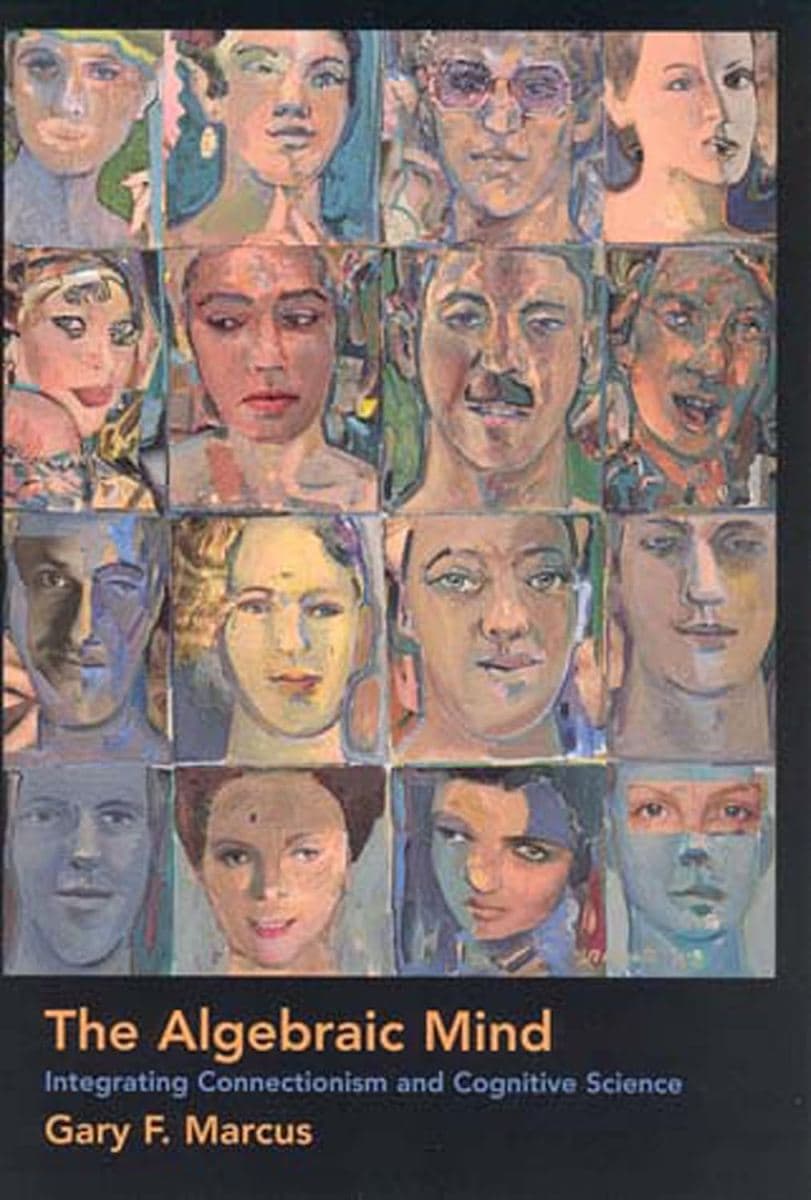
English
The Algebraic Mind: Integrating Connectionism and Cognitive Science
Gary F. Marcus
English
Book
The MIT Press, Cambridge, Massachusetts
2001
240 pages
1.1 MB
Introduction
The book consists of seven chapters. The first introduces the controversy between symbolic cognitive architectures and connectionist models and defines symbol manipulation as a family of separable hypotheses rather than a single doctrine. The second explains the structure, learning mechanisms, activation functions, and representational properties of multilayer perceptrons. Chapters Three to Five evaluate whether such networks can adequately represent abstract relations between variables, structured and recursive knowledge, and the distinction between individuals and categories. Chapter Six considers how the machinery of symbolic cognition may arise through childhood development and biological evolution. The final chapter synthesizes the argument and outlines a cognitive architecture that integrates neural implementation with algebraic and symbolic forms of mental representation.
Copyright Notice
This material is provided solely for academic research, study, and religious practice purposes under Article 25 of Vietnam's Intellectual Property Law. Reproduction, distribution, or commercial use is strictly prohibited.
If you are the author, translator, publisher, or rights holder and believe this content has been posted without proper authorization, please contact us and we will promptly review and remove or restrict access.
Documents
The Algebraic Mind: Integrating Connectionism and Cognitive Science
1.1 MB
Keywords
Cognitive ScienceConnectionismSymbol ManipulationNeural NetworksCognitive ArchitectureStructured RepresentationComputational Models
Sách đọc nhiều nhất

The Buddha’s Ancient Path
Piyadassi Thera
Book·10.7 MB
229 pages1979223
The Questions of King Milinda, Part II
F. Max Müller (Editor)
Book·20.8 MB
427 pages1894208

A Taste of Freedom
Venerable Ajahn Chah / Phra Bodhinyana Thera
Book·1.2 MB
104 pages1980207
Buddhist Meditation: An Anthology of Texts from the Pāli Canon
Sarah Shaw (General Editors: Charles S. Prebish and Damien Keown)
Book·17.5 MB
253 pages2006204