
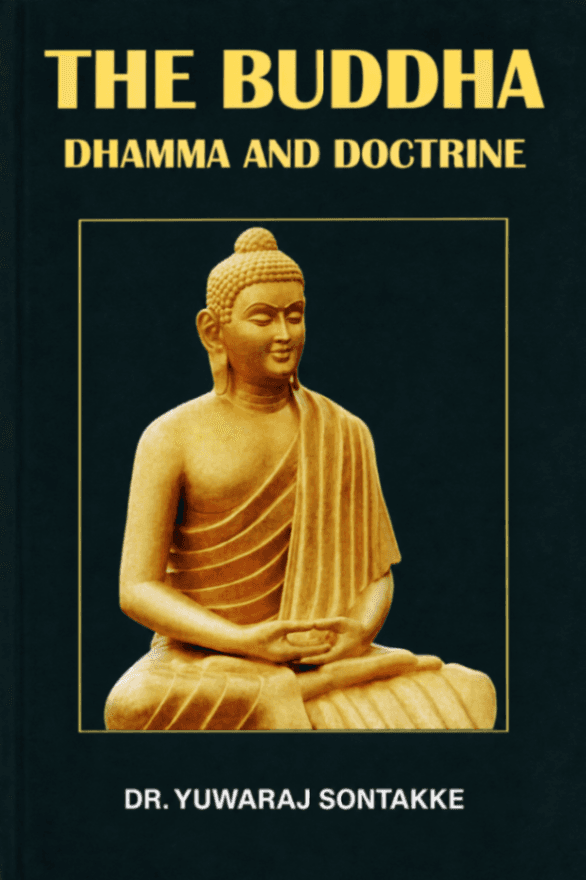
The Buddha: Dhamma and Doctrine
Introduction
The Buddha: Dhamma and Doctrine seeks to provide a comprehensive introductory account of Buddhism by integrating the Buddha’s life, historical context, philosophical teachings, monastic institutions, later doctrinal developments, and modern social interpretation. The work begins from the premise that the Buddha and his Dhamma should be understood against the political, economic, social, and religious conditions of ancient India. It subsequently moves from biography to philosophy and doctrine, then to the Saṅgha, Buddhist sectarian development, canonical literature, and finally B. R. Ambedkar’s modern reinterpretation of Buddhism. The resulting framework presents Buddhism simultaneously as a path of liberation, an ethical system, an intellectual critique of inherited religious assumptions, and a body of teachings with continuing social significance.
The first chapter, “The Background of Buddhism,” describes the political, social, economic, and religious conditions of India prior to and during the Buddha’s lifetime. Particular attention is given to the mahājanapadas, social stratification, the position of women, wandering ascetics (parivrājakas), and contemporary teachers and philosophers. The book places the Buddha’s emergence against a period of significant religious and social questioning and interprets his teaching as a response to the prevailing intellectual and social environment.
Chapter 2, “Early Life and Missionary Life of Siddhārtha Buddha,” presents the Buddha’s traditional biography from birth and education through marriage, renunciation, meditation, enlightenment, and subsequent teaching career. It also discusses the Dhammacakkappavattana, daily life of the Buddha, qualities attributed to his personality, traditional names and epithets, the bodily marks of a great man, the bodhisattva ideal, and the Buddha’s missionary activity.
Chapter 3, “Philosophy of the Buddha,” situates Buddhism within the wider landscape of Indian philosophy. The author contrasts theistic and non-theistic systems and discusses schools such as Jainism, Lokāyata/Cārvāka, Mīmāṃsā, Vedānta, Sāṃkhya, Yoga, Nyāya, and Vaiśeṣika. Buddhist philosophy is presented through principles such as karuṇā(compassion), samatā (equality), ahiṃsā (non-violence), intellectual inquiry, universality, and what the author characterizes as a scientific approach to human experience.
Chapter 4, “The Noble Doctrine of the Buddha,” concentrates on major doctrinal principles: pratītyasamutpāda(dependent origination), anātman/anattā (non-self), anitya/anicca (impermanence), atheism as interpreted by the author, karma, and the Buddha’s criticism of caste distinctions. These themes form the doctrinal core through which the work explains the Buddha’s understanding of suffering, causation, ethical responsibility, and liberation.
Chapter 5, “The Buddha’s Bhikkhu Saṅgha,” examines the formation and organization of the monastic community, including the first five monks, Yasa and his companions, Sāriputta and Moggallāna, Śuddhodana, Yaśodharā, Nanda, Rāhula, Mahāpajāpatī Gotamī, and the development of the Bhikkhunī Saṅgha. The chapter also considers questions concerning monastic discipline and the Buddha’s responses to speculative problems.
Chapter 6, “Subsequent Sects of Buddha Dhamma,” surveys the historical diversification of Buddhism after the Buddha. It discusses Theravāda/Sthaviravāda, Sarvāstivāda, Vaibhāṣika, Sautrāntika, Hīnayāna, Mahāyāna, Madhyamaka, and Yogācāra/Vijñānavāda, together with the Buddha’s final period and Mahāparinirvāṇa. The surviving portion of the uploaded scan specifically presents the division between Sthaviravāda and Mahāsāṃghika and outlines several later schools.
Chapter 7, “Buddhist Literature,” addresses the importance of Pāli, the Pāli canon, the reliability and structure of the Tipiṭaka, Buddhist Councils, and the subsequent decline and revival of Buddhism in India. Chapter 8, “Dr. Babasaheb Ambedkar’s Buddha Dhamma,” discusses Ambedkar’s conversion, his interpretation of Buddhism, morality, nirvāṇa, rebirth, karma, religion, and the social significance of Buddhist doctrine.
Copyright Notice
This material is provided solely for academic research, study, and religious practice purposes under Article 25 of Vietnam's Intellectual Property Law. Reproduction, distribution, or commercial use is strictly prohibited.
If you are the author, translator, publisher, or rights holder and believe this content has been posted without proper authorization, please contact us and we will promptly review and remove or restrict access.
Documents
The Buddha: Dhamma and Doctrine
73.1 MB
Keywords
Sách đọc nhiều nhất
The Buddha’s Ancient Path
Piyadassi Thera
The Questions of King Milinda, Part II
F. Max Müller (Editor)

A Taste of Freedom
Venerable Ajahn Chah / Phra Bodhinyana Thera
Buddhist Meditation: An Anthology of Texts from the Pāli Canon
Sarah Shaw (General Editors: Charles S. Prebish and Damien Keown)