English
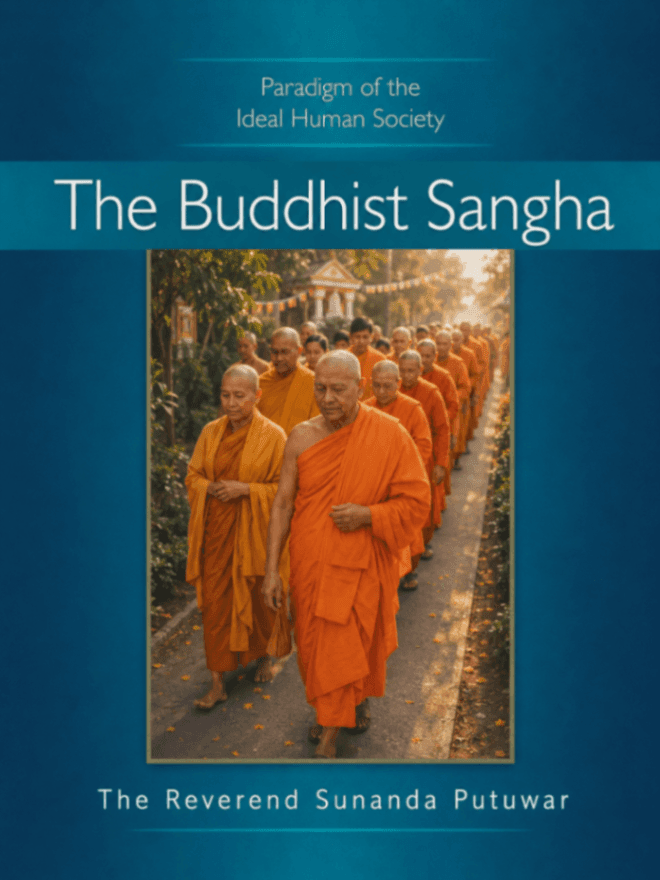
The Buddhist Sangha: Paradigm of the Ideal Human Society
The Reverend Sunanda Putuwar
English
Book
University Press of America
1991
127 pages
10.8 MB
Introduction
The study begins with the proposition that the ethical and political dimensions of early Theravāda Buddhism have received insufficient scholarly attention. Its central purpose is to demonstrate that the Buddhist Saṅgha embodies a coherent social and political ideal applicable beyond the monastery. The author identifies non-violence, patience, forgiveness, social progress, freedom of thought and speech, equality under the Dhamma, and peaceful conflict resolution as essential principles of this model. These principles are presented not as commitments to a particular political party or ideology, but as universal foundations for an orderly and humane society.
The book traces the development of the Saṅgha from the Buddha’s early disciples and simple ordination procedures to a large and formally regulated institution. As the community expanded, disciplinary rules and constitutional procedures were established to preserve moral conduct, harmonious relations, and effective interaction with the laity. Regular assemblies, Pātimokkha recitation, confession, admonition, and collective deliberation enabled the Saṅgha to resolve problems without coercive force. Buddhist moral philosophy therefore serves as both the personal foundation of spiritual training and the institutional basis of democratic communal life.
Copyright Notice
This material is provided solely for academic research, study, and religious practice purposes under Article 25 of Vietnam's Intellectual Property Law. Reproduction, distribution, or commercial use is strictly prohibited.
If you are the author, translator, publisher, or rights holder and believe this content has been posted without proper authorization, please contact us and we will promptly review and remove or restrict access.
Documents
The Buddhist Sangha: Paradigm of the Ideal Human Society
10.8 MB
Keywords
Buddhist Saṅghaideal societyBuddhist ethicsdemocratic governanceVinaya Piṭakamonastic disciplineconflict resolution.
Sách đọc nhiều nhất
The Buddha’s Ancient Path
Piyadassi Thera
Book·10.7 MB
229 pages1979223
The Questions of King Milinda, Part II
F. Max Müller (Editor)
Book·20.8 MB
427 pages1894208

A Taste of Freedom
Venerable Ajahn Chah / Phra Bodhinyana Thera
Book·1.2 MB
104 pages1980207
Buddhist Meditation: An Anthology of Texts from the Pāli Canon
Sarah Shaw (General Editors: Charles S. Prebish and Damien Keown)
Book·17.5 MB
253 pages2006204