
English
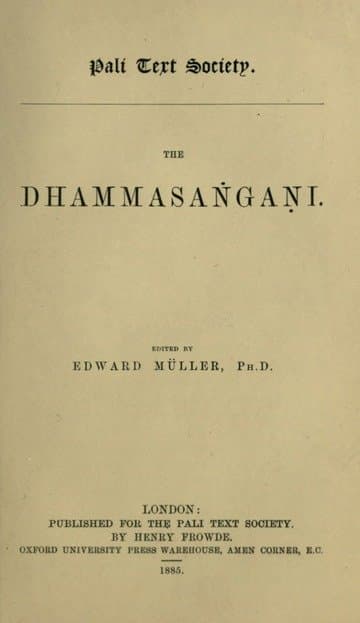
The Dhammasaṅgaṇī
Edward Müller (Editor)
English
Book
Oxford University Press Warehouse, London
1885
307 pages
19.5 MB
Introduction
The book opens with Edward Müller’s Introduction, which explains the editorial basis of the text. Müller states that he used a copy prepared for the Pali Text Society from a Burmese manuscript in the India Office, together with a Sinhalese manuscript from Vanavāsa Vihāra in Bentota, Ceylon. The introduction also explains the structure of the work, noting that the principal part comprises questions 1–1367, while the second part, questions 1368–1509, functions largely as a recapitulation of important earlier passages.
The Mātikā forms the structural foundation of the text. It lists the principal doctrinal categories by which all dhammas are later analyzed. These include triads such as wholesome, unwholesome, and indeterminate; dhammas connected with pleasant, painful, and neutral feeling; resultant and non-resultant dhammas; defiled and undefiled dhammas; worldly and supramundane dhammas. It also contains dyadic groupings related to causes, conditions, formations, outflows, fetters, knots, floods, bonds, hindrances, clinging, defilements, abandonment by seeing or cultivation, jhāna, feeling, sense-spheres, and liberation-oriented categories.
The first major section analyzes wholesome dhammas. It begins with wholesome consciousness of the sense-sphere and then breaks down the associated mental factors, including contact, feeling, perception, volition, consciousness, applied thought, sustained thought, joy, happiness, one-pointedness, faith, energy, mindfulness, concentration, wisdom, right view, right intention, right effort, right mindfulness, right concentration, moral shame, moral fear, non-greed, non-hatred, non-delusion, tranquility, lightness, pliancy, adaptability, proficiency, rectitude, calm, insight, effort, and non-distraction. This section is especially important for understanding the Abhidhamma analysis of ethical consciousness and wholesome mental cultivation.
The text then expands into classifications of aggregates, sense bases, elements, nutriments, faculties, jhāna factors, path factors, powers, and roots. It shows how a single moment of consciousness can be analyzed through multiple doctrinal frameworks. This method demonstrates the Abhidhamma strategy of mapping experience through overlapping analytical categories rather than narrative exposition.
A substantial portion is devoted to meditative and supramundane states, including rūpāvacara and arūpāvacara jhānas, kasiṇa meditations, brahmavihāras, liberation categories, and lokuttara jhāna connected with the path. These sections are important for studying how Abhidhamma organizes meditation, concentration, and liberating insight within a precise taxonomy of consciousness and mental factors.
The later sections treat unwholesome and indeterminate dhammas. The unwholesome section examines states rooted in greed, hatred, delusion, wrong view, shamelessness, recklessness, and other defilements. The indeterminate section includes resultant consciousness, functional states, and material phenomena. The discussion of rūpa analyzes materiality through great elements and derived matter, while further chapters examine fetters, taints, bonds, hindrances, clinging, defilements, wrong views, name-and-form, and dependent origination.
The edition concludes with recapitulation material, an errata list, and an alphabetical index of Pāli terms. As a whole, the text functions not as a narrative scripture but as an analytical matrix for classifying reality according to Theravāda Abhidhamma doctrine.
Copyright Notice
This material is provided solely for academic research, study, and religious practice purposes under Article 25 of Vietnam's Intellectual Property Law. Reproduction, distribution, or commercial use is strictly prohibited.
If you are the author, translator, publisher, or rights holder and believe this content has been posted without proper authorization, please contact us and we will promptly review and remove or restrict access.
Documents
The Dhammasaṅgaṇī
19.5 MB
Keywords
DhammasaṅgaṇīAbhidhammaPāli Canondhamma classificationkusalaakusalaBuddhist psychology
Sách đọc nhiều nhất
The Buddha’s Ancient Path
Piyadassi Thera
Book·10.7 MB
229 pages1979223
The Questions of King Milinda, Part II
F. Max Müller (Editor)
Book·20.8 MB
427 pages1894208

A Taste of Freedom
Venerable Ajahn Chah / Phra Bodhinyana Thera
Book·1.2 MB
104 pages1980207
Buddhist Meditation: An Anthology of Texts from the Pāli Canon
Sarah Shaw (General Editors: Charles S. Prebish and Damien Keown)
Book·17.5 MB
253 pages2006204