
English
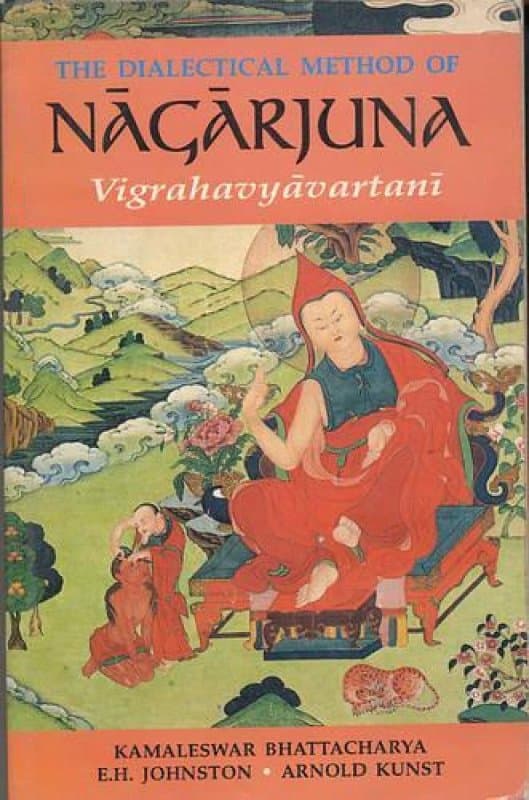
The Dialectical Method of Nāgārjuna (Vigrahavyāvartanī)
Nāgārjuna (translated and noted by Kamaleswar Bhattacharya)
English
Book
Motilal Banarsidass Publishers
1978
53 pages
4.1 MB
Introduction
The volume is organized around Nāgārjuna’s Vigrahavyāvartanī, a key Madhyamaka text devoted to philosophical debate, refutation, and clarification of emptiness. The opening prefatory material explains the publication history of the work: Bhattacharya’s English translation, introduction, and notes were originally published in the Journal of Indian Philosophy, and the present volume reproduces them together with the critically edited Sanskrit text prepared by E. H. Johnston and Arnold Kunst. This arrangement makes the book useful both for doctrinal study and for textual research.
The Introduction explains Nāgārjuna’s dialectical skill and emphasizes that he does not establish a formal philosophical system in the ordinary constructive sense. His method is primarily critical: he examines the assumptions of opponents and exposes contradictions within views that posit intrinsic nature, self-existence, or independently grounded entities. The introduction clarifies that Nāgārjuna’s philosophy should not be misread as nihilism. When he says that all things are empty, he does not deny conventional reality; he denies only the claim that things possess fixed, independent essence. Emptiness is therefore linked directly with dependent origination.
The Translation and Notes present the arguments of the Vigrahavyāvartanī in sequence. The text begins with objections against Nāgārjuna: if all things lack intrinsic nature, then Nāgārjuna’s own words and reasoning would also lack intrinsic nature and fail to refute anything. Nāgārjuna replies by showing that such objections depend on the very essentialist assumptions he rejects. The discussion then moves through problems of negation, cognition, valid knowledge, perception, inference, testimony, causality, examples, and the relation between word and object. Throughout, Nāgārjuna demonstrates that philosophical categories operate conventionally but cannot establish ultimate intrinsic being.
The section Abbreviations and Bibliographical References provides scholarly tools for tracing sources and related studies. The Indexes list significant technical terms, uncommon words, ancient authorities, and cited works. The second major component, The Vigrahavyāvartanī of Nāgārjuna with the Author’s Commentary, gives the critically edited Sanskrit text, enabling direct engagement with the original terminology and structure of Nāgārjuna’s argument.
Copyright Notice
This material is provided solely for academic research, study, and religious practice purposes under Article 25 of Vietnam's Intellectual Property Law. Reproduction, distribution, or commercial use is strictly prohibited.
If you are the author, translator, publisher, or rights holder and believe this content has been posted without proper authorization, please contact us and we will promptly review and remove or restrict access.
Documents
The Dialectical Method of Nāgārjuna (Vigrahavyāvartanī)
4.1 MB
Keywords
NāgārjunaVigrahavyāvartanīMadhyamakaŚūnyatāSvabhāvaDependent originationBuddhist logic.
Sách đọc nhiều nhất
The Buddha’s Ancient Path
Piyadassi Thera
Book·10.7 MB
229 pages1979223
The Questions of King Milinda, Part II
F. Max Müller (Editor)
Book·20.8 MB
427 pages1894208

A Taste of Freedom
Venerable Ajahn Chah / Phra Bodhinyana Thera
Book·1.2 MB
104 pages1980207
Buddhist Meditation: An Anthology of Texts from the Pāli Canon
Sarah Shaw (General Editors: Charles S. Prebish and Damien Keown)
Book·17.5 MB
253 pages2006204