English
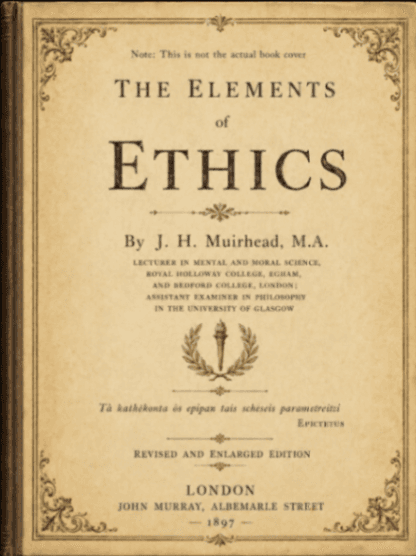
The Elements of Ethics
John H. Muirhead, LL.D.
English
Book
John Murray, London
1912
327 pages
13.2 MB
Introduction
Book I. The Science of Ethics
Chapter I. The Problem of Ethics: This opening chapter explains why ethics becomes necessary as a reflective science. Muirhead begins from Plato’s idea that philosophy arises from wonder, then asks what kind of “wonder” gives rise to ethics. He defines ethics through its Greek and Latin roots as the science of moral character, conduct, custom and habit. The chapter argues that ethical inquiry does not arise when habits function smoothly, but when inherited customs fail to answer new social, political and intellectual problems. It gives a historical illustration from Greece, especially the age of the Sophists, where traditional ideas of justice, piety and morality were questioned, preparing the way for Socrates, Plato and Aristotle. Muirhead also connects this ancient situation with modern moral unrest: conflicts between faith and reason, individual and state, rights and duties, self-interest and common good, pleasure and duty, freedom and necessity. The chapter concludes that ethical science is both critical and reconstructive: it challenges obsolete customs, but its deeper aim is to recover the rational and permanent value within moral and social institutions.
Chapter II. Can there be a Science of Ethics?: Discusses whether conduct and character can be treated scientifically. It raises the problem of freedom, causation, prediction and moral responsibility.
Chapter III. Scope of the Science of Ethics: Clarifies the relation of ethics to natural sciences, practical sciences, politics and economics.
Book II. Moral Judgment
Chapter I. The Object of Moral Judgment: Examines conduct, will, desire, character, motive, intention and consequences.
Chapter II. The Standard of Moral Judgment — Moral Law: Discusses forms of moral judgment, conscience, external law, intuitionalism and morality as determined by an end.
Chapter III. Reason and Conscience: Analyzes purpose, rational authority and conscience as the unity of purposes.
Book III. Theories of the End
Chapter I. The End as Pleasure: Empirical Hedonism: Reviews pleasure, happiness, quantity and quality of pleasure, and difficulties within hedonistic theories.
Chapter II. The End as Self-Conquest: Studies ascetic and self-mastery theories, including Cynicism, Stoicism and Kant.
Chapter III. Evolutionary Hedonism: Examines utilitarianism, evolution, society and the limits of evolutionary ethics.
Book IV. The End as Good
Chapter I. The End as Common Good: Presents the social nature of moral life and the dependence of individual development on society.
Chapter II. The Unity of the Good: Treats apparent conflicts of moral standards and the relation between self-development and self-surrender.
Chapter III. Forms of the Good: Discusses duties, virtues and institutions.
Chapter IV. Cardinal Virtues: Explains temperance, courage, justice and wisdom.
Book V. Moral Progress
Chapter I. The Standard as Relative: Examines relativity in moral standards.
Chapter II. The Standard as Progressive: Interprets morality through the idea of historical and social progress.
Chapter III. The Standard as Ideal: Considers conscience, consciousness, social environment, moral progress and the ideal character of ethical life.
Copyright Notice
This material is provided solely for academic research, study, and religious practice purposes under Article 25 of Vietnam's Intellectual Property Law. Reproduction, distribution, or commercial use is strictly prohibited.
If you are the author, translator, publisher, or rights holder and believe this content has been posted without proper authorization, please contact us and we will promptly review and remove or restrict access.
Documents
The Elements of Ethics
13.2 MB
Keywords
EthicsMoral philosophyMoral judgmentConscienceCommon goodVirtueMoral progress.
Sách đọc nhiều nhất
The Buddha’s Ancient Path
Piyadassi Thera
Book·10.7 MB
229 pages1979223

The Questions of King Milinda, Part II
F. Max Müller (Editor)
Book·20.8 MB
427 pages1894208

A Taste of Freedom
Venerable Ajahn Chah / Phra Bodhinyana Thera
Book·1.2 MB
104 pages1980207
Buddhist Meditation: An Anthology of Texts from the Pāli Canon
Sarah Shaw (General Editors: Charles S. Prebish and Damien Keown)
Book·17.5 MB
253 pages2006204