English
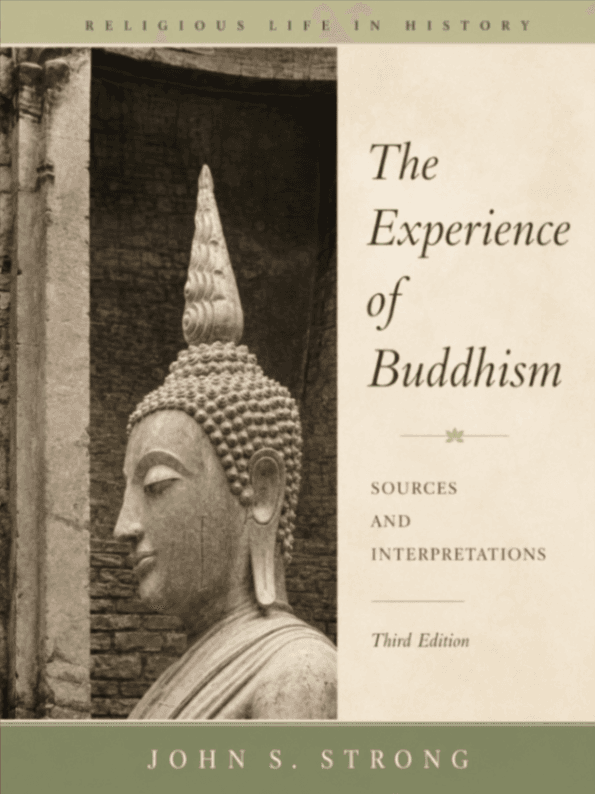
The Experience of Buddhism: Sources and Interpretations
John S. Strong.
English
Book
Thomson Learning, Belmont, California, United States
2002
375 pages
34.3 MB
Introduction
The book opens with maps of the Buddhist world and then presents Buddhism through a carefully organized structure that moves from South Asian foundations to global development. Part One, “The Experience of Buddhism in South Asia,” begins with “The Life Story of the Buddha and Its Ramifications,” introducing the Buddha’s biography not merely as historical record but as sacred story, pilgrimage memory, and religious model; it includes the eight commemorative shrines, Aśoka’s pilgrimage, the Great Departure, enlightenment, past-life narratives, cosmology, karma, the Four Noble Truths, parinirvāṇa, Buddha images, and Maitreya. The next chapter, “The Experience of the Sangha,” studies conversion, ordination, monastic rules, community life, lay-monastic relations, merit-making, and the relationship between Buddhism and kingship. Chapters on mainstream Buddhist Dharma explain suffering, impermanence, no-self, dependent origination, nirvāṇa, morality, meditation, mindfulness, and doctrinal debates among early schools. The Mahāyāna chapters introduce the Lotus Sutra, Prajñāpāramitā, Nāgārjuna, Vasubandhu, Buddha bodies, tathāgatagarbha, the Bodhisattva path, compassion, perfections, and Vimalakīrti’s skillful means. The section on “Saviors and Siddhas” expands into Avalokiteśvara, Tārā, Amitābha, Akṣobhya, Medicine Buddha, Pure Lands, Vajrayāna, tantric worship, maṇḍala offering, and siddha traditions. Part Two, “The Development of Buddhism outside India,” then surveys Sri Lanka and Southeast Asia, the Tibetan cultural area, China, Japan, and the West through parallel themes: mythic histories, interaction with local traditions, doctrinal and institutional disputes, reform movements, rituals and festivals, meditation, women in Buddhism, and the relationship between Saṅgha and society. Through this structure, the book presents Buddhism not as one fixed system, but as a living tradition shaped by texts, institutions, devotion, philosophy, ritual practice, cultural exchange, and historical transformation.
Copyright Notice
This material is provided solely for academic research, study, and religious practice purposes under Article 25 of Vietnam's Intellectual Property Law. Reproduction, distribution, or commercial use is strictly prohibited.
If you are the author, translator, publisher, or rights holder and believe this content has been posted without proper authorization, please contact us and we will promptly review and remove or restrict access.
Documents
The Experience of Buddhism: Sources and Interpretations
34.3 MB
Keywords
Buddhist ExperienceBuddhist SourcesSaṅghaDharmaMahāyānaVajrayānaGlobal Buddhism
Sách đọc nhiều nhất
The Buddha’s Ancient Path
Piyadassi Thera
Book·10.7 MB
229 pages1979223
The Questions of King Milinda, Part II
F. Max Müller (Editor)
Book·20.8 MB
427 pages1894208

A Taste of Freedom
Venerable Ajahn Chah / Phra Bodhinyana Thera
Book·1.2 MB
104 pages1980207
Buddhist Meditation: An Anthology of Texts from the Pāli Canon
Sarah Shaw (General Editors: Charles S. Prebish and Damien Keown)
Book·17.5 MB
253 pages2006204