
English
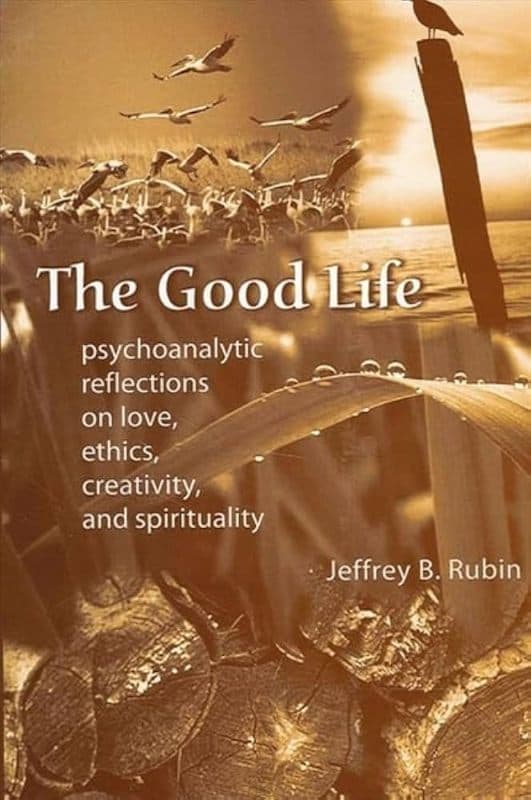
The Good Life: Psychoanalytic Reflections on Love, Ethics, Creativity, and Spirituality
Jeffrey B. Rubin
English
Book
State University of New York Press
2004
142 pages
1.4 MB
Introduction
The volume opens with a Preface, where Rubin explains that psychoanalysis has been a major source of insight in his life and clinical work. He argues that psychoanalysis remains deeply relevant in the contemporary world, especially because modern culture is marked by egocentricity, hedonism, addictive behavior, spiritual hunger, alienation, and the loss of moral direction. The book continues themes from his earlier work by focusing on neglected psychoanalytic topics such as love, creativity, ethics, spirituality, and the good life.
Introduction
The introduction establishes the book’s central problem: psychoanalysis has developed sophisticated tools for understanding psychic suffering, but has often neglected the positive and life-enriching dimensions of human existence. Rubin argues that analysts are often experts in hatred, envy, perversion, depression, and pathology, but less developed in their understanding of love, ethics, creativity, spirituality, and the good life.
Rubin criticizes two interpretive extremes. On one side, secular and self-help approaches often underestimate the unconscious and offer shallow formulas for happiness. On the other side, spiritual traditions may idealize love, morality, and spirituality without sufficient attention to unconscious conflict, aggression, narcissism, and self-deception. Psychoanalysis, when expanded beyond its own narrowness, can provide a more balanced approach: it can examine what wounds human beings while also clarifying what sustains and transforms them.
The introduction also previews the five chapters. Rubin presents psychoanalysis as a discipline that must become more cosmopolitan and less insular, engaging questions of meaning, moral life, intimacy, spirituality, and creative existence.
Chapter 1: Psychoanalysis and Creative Living
This chapter examines creativity as a way of living, not merely as artistic production. Rubin begins by contrasting perversity and creativity. In a perverse scenario, one person controls, scripts, and objectifies another; in a creative relationship, there is openness, feedback, surprise, vitality, and mutual transformation.
Rubin argues that psychoanalysis has had an ambivalent relationship with creativity. Freud and later analysts often interpreted artistic creation through neurosis, fantasy, compensation, trauma, or sublimation. While such interpretations can illuminate some dimensions of creativity, Rubin criticizes psychoanalysis when it becomes reductive and treats art merely as evidence of pathology.
The chapter then develops a broader account of creative living. Drawing on Freud, Jung, Winnicott, and other psychoanalytic thinkers, Rubin argues that creativity requires psychic space, openness to the unconscious, play, imagination, receptivity, and the ability to integrate apparent opposites. Psychoanalysis can support creativity when it helps people dream into life, decode the symbolic richness of ordinary experience, and loosen rigid patterns of thought and relationship.
Chapter 2: Values and Ethics in Psychoanalysis
This chapter addresses the moral dimensions of psychoanalysis. Rubin challenges the classical ideal of the analyst as a neutral scientist who simply provides objective insight. He argues that even when analysts claim neutrality, they inevitably carry explicit or implicit values about health, maturity, freedom, relationship, responsibility, and human flourishing.
Rubin examines several psychoanalytic approaches to ethics. Some analysts are phobic about moral issues and avoid them in the name of neutrality. Others take a Platonic stance, assuming that if the patient discovers reality or the true self, ethical life will naturally follow. Rubin finds these positions inadequate for the complexity of contemporary moral life.
He proposes that analysts should function less as moral authorities and more as facilitators of phronesis, or practical moral wisdom. The analyst can help patients reflect on ethical dilemmas, understand unconscious motivations, recognize self-deception, and cultivate more responsible ways of living. The chapter therefore frames psychoanalysis as a practice that can deepen moral reflection without becoming authoritarian or dogmatic.
Chapter 3: Psychoanalysis at Play in the Garden of Love
This chapter studies love as a central condition of human flourishing. Rubin begins from Freud’s claim that human beings must love in order not to fall ill. Yet he argues that psychoanalysis has often focused more on falling in love, erotic desire, dependency, narcissistic need, and pathology than on what sustains mature love over time.
Rubin explores the psychological conditions of a loving relationship. Drawing especially on Winnicott’s concept of potential space and later psychoanalytic theories of romantic space, he argues that love requires playfulness, openness, mutual recognition, tolerance of difference, emotional risk, trust, passion, reflection, and the capacity to hold multiple perspectives.
The chapter also critiques popular culture’s cynical depictions of love, especially its emphasis on betrayal, infidelity, and disillusionment. Rubin does not idealize love; rather, he uses psychoanalytic insight to examine the unconscious obstacles to intimacy while also identifying the capacities that make a loving relationship possible.
Chapter 4: There’s More Than Meets the I: Psychoanalytic Reflections on Spirituality
This chapter examines spirituality from a psychoanalytic perspective. Rubin notes that spirituality has become increasingly important in contemporary culture and within psychoanalysis itself. He asks what authentic spirituality is, why people seek it, how it may enrich self-experience, and how psychoanalysis can help identify distortions or pathologies of spiritual life.
Rubin defines spirituality not as a possession, achievement, or rigid belief system, but as a self-transcending relationship between the individual and something larger than the ego. Spiritual experience may be enlivening, expanding, humbling, and transformative.
At the same time, Rubin warns that spirituality can become pathological when it is used defensively: to avoid suffering, deny aggression, escape ordinary responsibility, inflate the self, or bypass unresolved psychological conflicts. He therefore proposes a contemplative psychoanalysis capable of appreciating spirituality while also analyzing its distortions.
Chapter 5: Psychoanalysis and the Good Life
The final chapter brings together the book’s central themes by asking what psychoanalysis can contribute to the question of the good life. Rubin argues that psychoanalysis cannot avoid this question, because every theory of treatment already implies some vision of human flourishing, psychic health, freedom, relationship, and maturity.
The chapter examines implicit and explicit conceptions of the good life in different psychoanalytic schools, including classical psychoanalysis, object relations theory, self psychology, interpersonal psychoanalysis, and relational approaches. Rubin compares psychoanalytic models with secular materialistic ideals and spiritual ideals of selflessness, suggesting that both extremes are incomplete.
For Rubin, the good life involves more than symptom relief or adaptation. It includes creative living, love, ethical responsibility, spirituality, self-reflection, freedom, and vitality. Psychoanalysis contributes by helping people understand the unconscious obstacles to these possibilities and by opening psychic space for richer forms of being
Copyright Notice
This material is provided solely for academic research, study, and religious practice purposes under Article 25 of Vietnam's Intellectual Property Law. Reproduction, distribution, or commercial use is strictly prohibited.
If you are the author, translator, publisher, or rights holder and believe this content has been posted without proper authorization, please contact us and we will promptly review and remove or restrict access.
Documents
The Good Life: Psychoanalytic Reflections on Love, Ethics, Creativity, and Spirituality
1.4 MB
Keywords
PsychoanalysisGood LifeLoveEthicsSpirituality
Sách đọc nhiều nhất

The Buddha’s Ancient Path
Piyadassi Thera
Book·10.7 MB
229 pages1979223
The Questions of King Milinda, Part II
F. Max Müller (Editor)
Book·20.8 MB
427 pages1894208

A Taste of Freedom
Venerable Ajahn Chah / Phra Bodhinyana Thera
Book·1.2 MB
104 pages1980207
Buddhist Meditation: An Anthology of Texts from the Pāli Canon
Sarah Shaw (General Editors: Charles S. Prebish and Damien Keown)
Book·17.5 MB
253 pages2006204