English
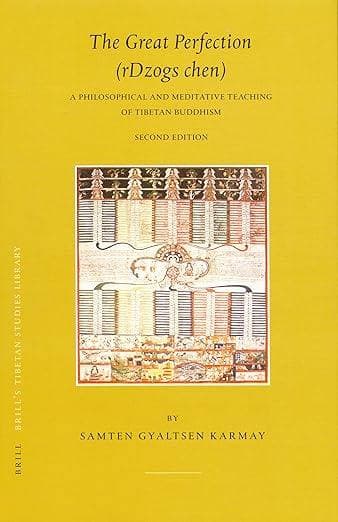
The Great Perfection (rDzogs chen): A Philosophical and Meditative Teaching of Tibetan Buddhism (2nd Edition)
Samten Gyaltsen Karmay
English
Book
Brill, Leiden; Boston.
2007
293 pages
4.2 MB
Introduction
The book begins with a Preface, where Karmay defines rDzogs chen, or the Great Perfection, as a philosophical and meditative teaching of Tibetan Buddhism. He notes that it has often been compared with Ch’an in Chinese Buddhism and Zen in Japanese Buddhism. However, he rejects the reduction of rDzogs chen to a simple survival of the “Sudden Path” associated with Ch’an. He emphasizes that rDzogs chen occupies the highest position in the rNying ma pa tradition and also plays a central role in the Bonpo tradition.
The Introduction places rDzogs chen within the larger historical formation of Tibetan Buddhism. Karmay begins with the establishment of bSam-yas, the first Buddhist monastery in Tibet, in 775 CE, and the official adoption of Buddhism by King Khri Srong-lde-btsan in 779 CE. He discusses the rise of Tibetan monastic culture, the Sino-Indian Buddhist controversy, the restriction of tantric teachings, the decline of the Tibetan Empire, and the later diffusion of tantric traditions after the collapse of royal and monastic authority. Within this setting, rDzogs chen emerges as a new philosophical doctrine shaped by tantric sources, meditative practice, and Tibetan religious creativity.
Part One
Chapter I: The Legend of Vairocana
This chapter examines the legendary figure of Vairocana, who is traditionally credited with introducing rDzogs chen into Tibet from India. Karmay studies later and earlier Tibetan Buddhist and Bonpo sources concerning Vairocana’s life, ordination, translation activities, exile, and association with Padmasambhava. Vairocana is presented as one of the early Tibetan monks ordained in the Mūlasarvāstivāda tradition and as a major translator.
The chapter also analyzes the Vairo ’dra ’bag, a later hagiographical source that narrates Vairocana’s role in the transmission of Atiyoga and rDzogs chen. Karmay treats these legends critically, distinguishing between historical evidence and retrospective religious construction. The chapter is foundational because Vairocana’s image becomes closely linked with the identity, prestige, and transmission history of rDzogs chen.
Part Two
Chapter II: The Ancient Documents of rDzogs chen from Tun-Huang
This chapter is one of the core sections of the book. It examines three early rDzogs chen documents from Dunhuang: IOL 647, IOL 594, and IOL 689/2. These materials are crucial because they provide evidence for early rDzogs chen thought before its later scholastic codification. The chapter studies their terminology, doctrinal structure, meditative language, and relationship with later rDzogs chen literature.
Karmay shows that these documents already contain key rDzogs chen ideas such as spontaneity, non-action, intrinsic purity, and the presence of awakened reality within the mind. The analysis demonstrates that rDzogs chen was not simply a late invention but had identifiable early textual foundations.
Chapter III: The Cig car ba Tradition in Tibet
This chapter studies the Cig car ba, or “sudden” tradition, in Tibet. Karmay situates it in relation to Chinese Ch’an, Tibetan debates over gradual and sudden approaches, and the meditative currents that influenced early rDzogs chen. The chapter is important because it clarifies how rDzogs chen interacted with sudden enlightenment discourse while developing its own distinctive philosophical identity.
Rather than accepting the orthodox Tibetan accusation that rDzogs chen was simply Ch’an in disguise, Karmay shows that the relationship was more nuanced. The sudden tradition provided part of the intellectual and contemplative background, but rDzogs chen also drew heavily from tantric sources and Tibetan doctrinal innovation.
Chapter IV: The Development of the rDzogs chen Doctrine and its Literature in the Tenth Century
This chapter traces the consolidation of rDzogs chen in the tenth century. Karmay discusses important figures and texts, including gNubs Sangs-rgyas ye-shes and the bSam gtan mig sgron. He shows how rDzogs chen became a recognizable philosophical doctrine during this period, even while remaining closely connected with Mahāyoga tantric traditions.
The chapter identifies rDzogs chen as a system that emphasizes non-action, direct recognition, spontaneous presence, and the already perfected nature of reality. It also shows that by the tenth century rDzogs chen had begun to develop its own literary and interpretive identity.
Chapter V: rDzogs chen Thought and its Critics in the Eleventh Century
This chapter examines the criticisms directed against rDzogs chen in the eleventh century, especially as new Buddhist reform movements sought to distinguish orthodox Indian Buddhism from earlier Tibetan tantric practices. Karmay discusses the attacks on rDzogs chen as inauthentic or unorthodox and the efforts of rNying ma pa masters to defend the tradition.
A major concern of the chapter is the tension between rDzogs chen and the emerging Tibetan Buddhist scholastic environment. The chapter shows how rDzogs chen was forced to define itself more sharply in response to criticism from other traditions.
Part Three
Chapter VI: The Provenance of the Fusion of Tantric and Pure Meditational Teachings
This chapter investigates the fusion between tantric doctrines and pure meditative teachings, especially through the role of Man ngag lta ba’i phreng ba. Karmay examines how rDzogs chen integrated tantric categories while also articulating a contemplative vision centered on immediacy, non-effort, and direct recognition.
The chapter is significant because it explains how rDzogs chen became neither purely tantric ritualism nor purely quietist meditation. It is presented as a synthesis that transformed tantric material through a distinctive philosophical and meditative orientation.
Chapter VII: rDzogs chen Theories and their Origins
This chapter presents the major theoretical foundations of rDzogs chen. Karmay explains that rDzogs chen begins with reflection on sems, or mind, which is central to Buddhist thought. The mind creates the world of illusion and obscures its own real nature. The real nature of mind is described as immaculate, luminous, and originally pure.
The chapter discusses the Primordial Basis (gdod ma’i gzhi), which is always already complete and perfect. Because nothing needs to be added to it, the tradition is called rdzogs pa chen po, the Great Perfection. Karmay also examines related concepts such as spontaneity, purity, awareness, and the rejection of effort-based meditative fabrication.
Chapter VIII: rDzogs chen in the Bonpo Tradition
This chapter studies the presence of rDzogs chen in the Bonpo tradition. Karmay shows that rDzogs chen was not limited to rNying ma pa Buddhism but also became central to Bon religious thought. The chapter explores Bonpo classifications, doctrinal parallels, and distinctive formulations of rDzogs chen.
This section is important because it shows that rDzogs chen functioned as a shared philosophical and meditative language across Buddhist and non-Buddhist Tibetan traditions. It also prepares the argument that rDzogs chen became a bridge between rNying ma pa Buddhism and Bon.
Chapter IX: The Three Trends of the rDzogs chen Tradition
This chapter analyzes three major trends within the rDzogs chen tradition. Karmay distinguishes different streams of development and shows how rDzogs chen was not a single uniform system from the beginning. Instead, it developed through multiple textual, doctrinal, and contemplative lines.
The chapter helps clarify the internal diversity of rDzogs chen and shows how later classifications emerged from earlier historical and doctrinal processes.
Chapter X: The rDzogs chen Tradition as a Link between the rNying ma pa and the Bonpo
The final chapter examines rDzogs chen as a connecting tradition between rNying ma pa Buddhism and Bonpo religion. Karmay argues that rDzogs chen became one of the major shared doctrinal spaces through which Buddhist and Bonpo thinkers could engage common philosophical and meditative themes.
The chapter concludes the book’s broader historical argument: rDzogs chen should be understood not only as a doctrine within one Tibetan Buddhist school, but as a formative current in Tibetan religious history as a whole.
Supplementary Materials
The volume includes a Bibliography, Chronological Table, Glossary, Indices, and Facsimiles of Texts IOL 594 and IOL 647, followed by plates. These materials support the book’s philological and historical orientation and make it useful for detailed research on early rDzogs chen sources.
Copyright Notice
This material is provided solely for academic research, study, and religious practice purposes under Article 25 of Vietnam's Intellectual Property Law. Reproduction, distribution, or commercial use is strictly prohibited.
If you are the author, translator, publisher, or rights holder and believe this content has been posted without proper authorization, please contact us and we will promptly review and remove or restrict access.
Documents
The Great Perfection: A Philosophical and Meditative Teaching of Tibetan Buddhism
4.2 MB
Keywords
rDzogs chenGreat PerfectionSamten Gyaltsen KarmayTibetan BuddhismBonpo Tradition.
Sách đọc nhiều nhất
The Buddha’s Ancient Path
Piyadassi Thera
Book·10.7 MB
229 pages1979223
The Questions of King Milinda, Part II
F. Max Müller (Editor)
Book·20.8 MB
427 pages1894208

A Taste of Freedom
Venerable Ajahn Chah / Phra Bodhinyana Thera
Book·1.2 MB
104 pages1980207
Buddhist Meditation: An Anthology of Texts from the Pāli Canon
Sarah Shaw (General Editors: Charles S. Prebish and Damien Keown)
Book·17.5 MB
253 pages2006204