
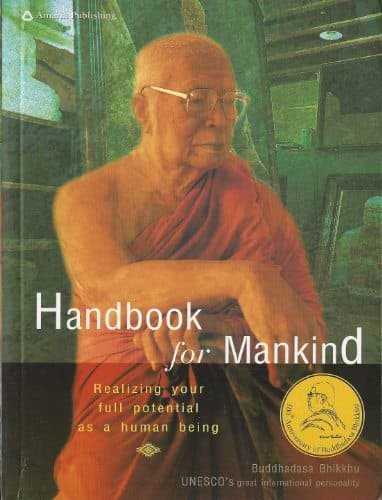
English
The Handbook for Mankind
Buddhadāsa Bhikkhu
English
Book
Dhammadana Foundation
1996
135 pages
389 KB
Introduction
The book is organized as a systematic guide to the core of Buddhist practice, beginning with a clarification of what Buddhism is and is not. Buddhadāsa first distinguishes authentic Buddhism from rites, ceremonies, superstition, and institutional accretions, then turns to the true nature of things through the Four Noble Truths and dependent causality. The text then develops the three universal characteristics—impermanence, suffering, and not-self—as the central framework for insight, showing that suffering arises because the mind grasps at things as worth getting, having, or being. Subsequent chapters examine clinging, the threefold training, the objects to which people attach themselves, and the cultivation of insight through both natural observation and organized training. The work culminates in the theme of emancipation from the world, understood not as physical withdrawal from life but as inner freedom from craving, attachment, and delusion.
Copyright Notice
This material is provided solely for academic research, study, and religious practice purposes under Article 25 of Vietnam's Intellectual Property Law. Reproduction, distribution, or commercial use is strictly prohibited.
If you are the author, translator, publisher, or rights holder and believe this content has been posted without proper authorization, please contact us and we will promptly review and remove or restrict access.
Documents
The Handbook for Mankind
389 KB
Keywords
Buddhadāsa BhikkhuThe Handbook for MankindFour Noble Truthsthree characteristicsnon-selfinsightclingingliberation.
Sách đọc nhiều nhất
The Buddha’s Ancient Path
Piyadassi Thera
Book·10.7 MB
229 pages1979223
The Questions of King Milinda, Part II
F. Max Müller (Editor)
Book·20.8 MB
427 pages1894208

A Taste of Freedom
Venerable Ajahn Chah / Phra Bodhinyana Thera
Book·1.2 MB
104 pages1980207
Buddhist Meditation: An Anthology of Texts from the Pāli Canon
Sarah Shaw (General Editors: Charles S. Prebish and Damien Keown)
Book·17.5 MB
253 pages2006204