English
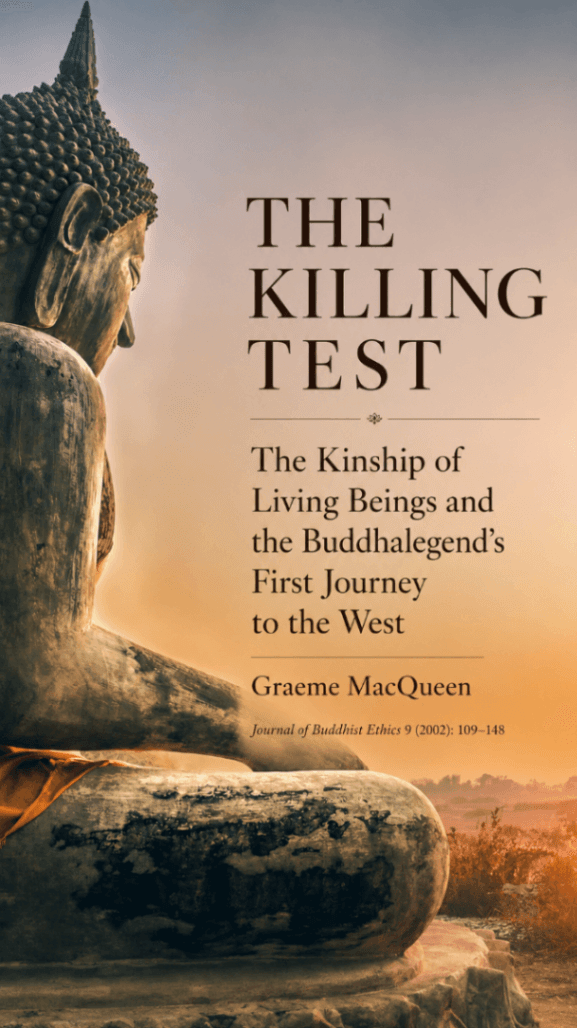
The Killing Test: The Kinship of Living Beings and the Buddhalegend’s First Journey to the West
Graeme MacQueen
English
Journal
Journal of Buddhist Ethics, Vol. 9, pp. 109-148
2002
40 pages
188 KB
Introduction
This article studies the westward transmission of the Buddhalegend by focusing on one ethical theme: the kinship of living beings. MacQueen begins by arguing that Indian Buddhist narrative traditions place human suffering within a wider field of sentient suffering, where animals and other beings are not morally irrelevant but deeply connected to human destiny. He identifies five dimensions of this kinship: metaphysical relatedness through rebirth, affective compassion for nonhuman suffering, epistemic insight into the shared condition of sentient life, moral responsibility toward animals and other beings, and the soteriological significance of nonviolence for liberation. The article then examines how this theme appears in Buddhist materials such as the Buddhacarita, the ploughed-field episode, and stories of animal protection, before tracing its partial survival in the Ismaili Arabic version of Barlaam and Josaphat. The central case is the sheep episode, in which Prince Josaphat’s refusal to kill an animal marks his spiritual sensitivity and renunciatory orientation. MacQueen then compares this with the Christian Balavariani, where the episode and the broader idea of kinship with nonhuman beings are absent. The article proposes that this erasure was not accidental but connected to Christian anxieties about heresy, especially Manichaeism, and to historical practices such as sacrifice tests, food tests, and killing tests. In this way, the article presents the transformation of the Buddhalegend as a case study in how Buddhist ethical values were constrained, censored, and reshaped during cross-cultural transmission.
Copyright Notice
This material is provided solely for academic research, study, and religious practice purposes under Article 25 of Vietnam's Intellectual Property Law. Reproduction, distribution, or commercial use is strictly prohibited.
If you are the author, translator, publisher, or rights holder and believe this content has been posted without proper authorization, please contact us and we will promptly review and remove or restrict access.
Documents
The Killing Test: The Kinship of Living Beings and the Buddhalegend’s First Journey to the West
188 KB
Keywords
BuddhalegendBarlaam and JosaphatKinship of Living BeingsKilling TestBuddhist EthicsManichaeismNonviolence.
Sách đọc nhiều nhất
The Buddha’s Ancient Path
Piyadassi Thera
Book·10.7 MB
229 pages1979223
The Questions of King Milinda, Part II
F. Max Müller (Editor)
Book·20.8 MB
427 pages1894208

A Taste of Freedom
Venerable Ajahn Chah / Phra Bodhinyana Thera
Book·1.2 MB
104 pages1980207
Buddhist Meditation: An Anthology of Texts from the Pāli Canon
Sarah Shaw (General Editors: Charles S. Prebish and Damien Keown)
Book·17.5 MB
253 pages2006204