
English
The Lotus Unleashed: The Buddhist Peace Movement in South Vietnam, 1964–1966
Robert J. Topmiller
English
Book
The University Press of Kentucky
2002
227 pages
1.6 MB
Introduction
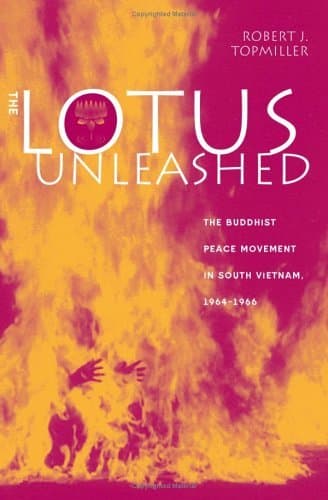
The front matter identifies the book as a study of the Buddhist peace movement in South Vietnam from 1964 to 1966. The cover visually links the lotus symbol with fire, protest, and sacrifice, evoking Buddhist self-immolation and the moral intensity of the antiwar movement. A map of South Vietnam appears early in the volume, marking key regions such as I Corps, II Corps, III Corps, IV Corps, Saigon, Huế, Đà Nẵng, Pleiku, Nha Trang, and the demarcation line, which is important because the 1966 Buddhist crisis centered heavily on I Corps and central Vietnam.
Preface
The preface presents the book’s core thesis: the United States failed in Vietnam partly because it did not understand the political aspirations of South Vietnamese citizens. Topmiller argues that the lack of legitimacy of the South Vietnamese government generated the Buddhist Movement, since most citizens had no effective legal channel to challenge the state. He emphasizes that the Buddhist Movement and the National Liberation Front were the two major internal challengers to the South Vietnamese government.
The preface also clarifies the author’s usage of “Buddhists.” In this book, the term primarily refers to those who followed Thích Trí Quang and the Viện Hóa Đạo, rather than all Buddhists in South Vietnam. Topmiller notes the internal division between moderates led by Thích Tâm Châu and radicals associated with Thích Trí Quang, as well as regional differences between central Vietnam, Saigon, and the Mekong Delta.
Introduction: Vietnamese Buddhism as a Political Force, 1963–1965
The introduction traces the political rise of Vietnamese Buddhism beginning with the 1963 Buddhist crisis under President Ngô Đình Diệm. It opens with the Huế flag incident in May 1963, when Buddhist students protested restrictions on Buddhist flags and government forces fired on demonstrators. The episode transformed Buddhist dissatisfaction into a national protest movement.
Topmiller presents Thích Quảng Đức’s self-immolation on June 11, 1963, as the defining image of the crisis. The introduction then follows the attack on pagodas, the role of U.S. Ambassador Henry Cabot Lodge, the fall of Diệm, and the emergence of Buddhists as the major non-Communist political force in South Vietnam.
The introduction also explains the formation of the Unified Buddhist Church (UBC) in 1964, which attempted to unite different Buddhist sects and traditions. However, internal conflict soon emerged over neutralism, anti-Communism, relations with the United States, and the proper political role of Buddhism.
Topmiller also contrasts three major Buddhist figures: Thích Nhất Hạnh, who articulated Engaged Buddhism and peace activism; Thích Trí Quang, who led the radical antiwar and nationalist faction; and Thích Tâm Châu, who represented a more conservative and anti-Communist position.
Chapter 1: Origins of the Buddhist Crisis of 1966
This chapter examines the political background that led to the 1966 Buddhist crisis. The key issue was the conflict between the South Vietnamese military government and Buddhist forces demanding civilian rule, elections, and a political path toward ending the war.
The chapter focuses on the growing opposition to the government of Nguyễn Cao Kỳ and the dismissal of General Nguyễn Chánh Thi, a popular figure in I Corps. Thi’s removal intensified Buddhist and regional resentment in central Vietnam. For many Buddhists, the issue was not only one military appointment, but the larger question of whether South Vietnam would remain under military rule supported by the United States or move toward a civilian government capable of negotiating peace.
Chapter 2: Conservative Backlash
This chapter analyzes the counterreaction against the Buddhist Movement. Topmiller shows how Buddhist calls for democracy and elections alarmed conservative forces, including the South Vietnamese military leadership, Catholic groups, right-wing political factions, and U.S. officials. These groups feared that an elected civilian government might negotiate with the National Liberation Front and end the war.
The chapter argues that U.S. and South Vietnamese government interests converged around stopping the Buddhist democracy movement. The Buddhist hierarchy continued to pursue three central goals: freedom from American domination, peace for South Vietnam, and an end to the killing. However, the movement’s near success also produced a coalition determined to destroy it.
Chapter 3: Confrontation in Danang: U.S. Marines and the Buddhist Struggle Movement
This chapter examines the crisis in Đà Nẵng, where the Buddhist-dominated Struggle Movement confronted the South Vietnamese government and where U.S. Marines found themselves caught between opposing allied Vietnamese forces. The chapter is especially important because it reveals the complex military and political contradictions of the war.
Topmiller describes how General Kỳ moved loyal ARVN Marines and paratroopers into Đà Nẵng in May 1966 to suppress the movement. U.S. Marine commanders attempted to prevent fighting between government forces and dissident ARVN units, while also protecting American bases and personnel. In one extraordinary episode, U.S. forces were positioned to block dissident South Vietnamese troops, meaning that Americans nearly confronted an allied army in order to prevent attacks on American installations.
The chapter also argues that the crisis damaged pacification efforts. As U.S. and ARVN forces focused on urban disorder, insurgent forces gained opportunities in the countryside. Topmiller concludes that even though the Struggle Movement was not controlled by the NLF, government repression pushed some dissidents toward the insurgency.
Chapter 4: American Reassessment of Its Role in South Vietnam
This chapter studies how the 1966 Buddhist crisis forced American officials to reassess their position in South Vietnam. The upheaval revealed that the United States could not easily control political developments inside the country it was trying to defend. It also raised doubts about the legitimacy of the South Vietnamese government and the wisdom of backing military leaders who lacked broad popular support.
Topmiller shows that the crisis exposed tensions within the American command structure, particularly between U.S. Marine commanders in I Corps and higher-level U.S. military and diplomatic authorities. The Buddhist challenge also raised uncomfortable questions in Washington about whether America was defending a viable government or sustaining a regime opposed by significant sections of its own population.
Chapter 5: Resolution
This chapter follows the suppression of the Buddhist Movement and the consolidation of Nguyễn Cao Kỳ’s position. With support from U.S. officials, loyal ARVN forces, conservative religious and political groups, and anti-Buddhist factions, the government moved to eliminate the Struggle Movement as an organized political threat.
The chapter shows that the “resolution” of the crisis was not a peaceful settlement but a political and military defeat of the Buddhist peace movement. Buddhist demands for civilian rule, elections, neutralism, and negotiations were crushed by a coalition committed to continuing the war.
Conclusion: The Movement Defeated?
The conclusion evaluates the failure and significance of the Buddhist peace movement. Topmiller argues that the movement was weakened by internal divisions between moderates and radicals, especially between supporters of Thích Tâm Châu and followers of Thích Trí Quang. Both factions feared Communism, but they disagreed over how to prevent a Communist victory: moderates leaned toward cooperation with the government and the United States, while radicals believed that American intervention itself would ultimately lead to disaster.
Topmiller emphasizes that students, monks, and nuns formed the critical core of the Struggle Movement. Monks and nuns acted from Buddhist commitments to compassion and peace; students resisted a war that threatened their future and could lead to military conscription. The conclusion presents the movement as politically defeated but morally significant: it represented a major South Vietnamese effort to stop the killing and reclaim national self-determination.
Copyright Notice
This material is provided solely for academic research, study, and religious practice purposes under Article 25 of Vietnam's Intellectual Property Law. Reproduction, distribution, or commercial use is strictly prohibited.
If you are the author, translator, publisher, or rights holder and believe this content has been posted without proper authorization, please contact us and we will promptly review and remove or restrict access.
Documents
The Lotus Unleashed: The Buddhist Peace Movement in South Vietnam, 1964–1966
1.6 MB
Keywords
Vietnamese BuddhismBuddhist Peace MovementThích Trí QuangSouth VietnamVietnam War.
Sách đọc nhiều nhất
The Buddha’s Ancient Path
Piyadassi Thera
Book·10.7 MB
229 pages1979223
The Questions of King Milinda, Part II
F. Max Müller (Editor)
Book·20.8 MB
427 pages1894208
A Taste of Freedom
Venerable Ajahn Chah / Phra Bodhinyana Thera
Book·1.2 MB
104 pages1980207
Buddhist Meditation: An Anthology of Texts from the Pāli Canon
Sarah Shaw (General Editors: Charles S. Prebish and Damien Keown)
Book·17.5 MB
253 pages2006204