
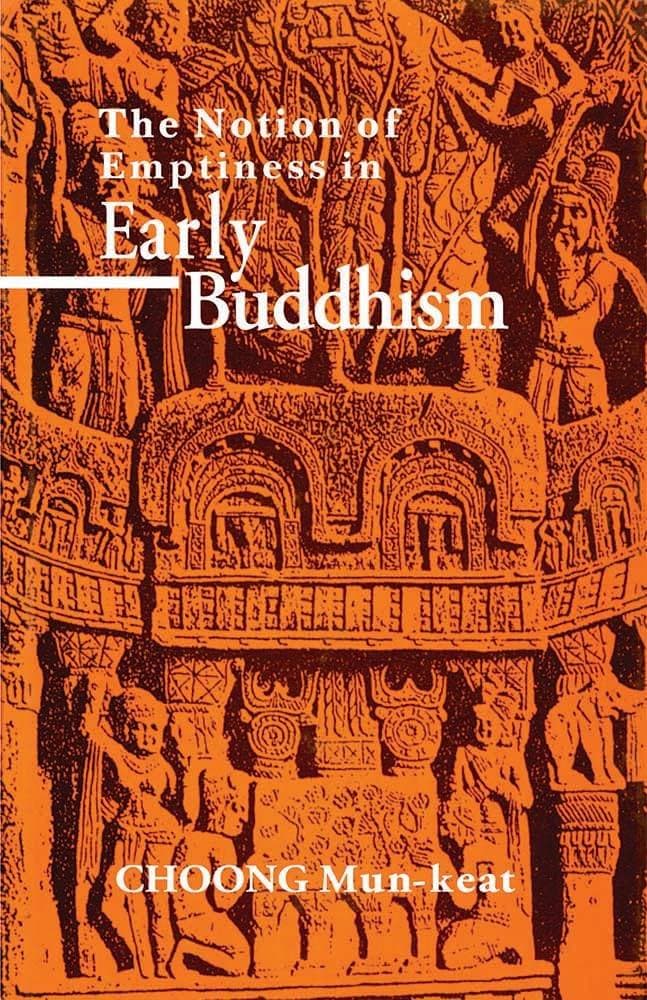
English
The Notion of Emptiness in Early Buddhism
CHOONG Mun-keat (Wei-keat)
English
Book
Motilal Banarsidass Publishers Private Limited, Delhi
1999
128 pages
64.8 MB
Introduction
The main body of the book is structured around two major chapters. The first chapter, “The Meaning of ‘Emptiness’ in Early Buddhism,” examines emptiness as a place of meditative seclusion, as kong-sanmei / suññatā-vihāra, as the “empty world,” and as a concept linked to conditioned genesis, nirvana, impermanence, not-self, and the middle way. It clarifies that early Buddhist emptiness does not usually mean that phenomena are absolutely non-existent, but that they are empty of self and of anything belonging to self. The second chapter, “The Practice of ‘Emptiness’ in Early Buddhism,” analyzes the practical dimension of emptiness through samatha-vipassanā, concentration, wisdom, mind-liberation, the three concentrations, three kinds of contact, and the discourses on small and great emptiness. Across these chapters, the book presents emptiness as a path-oriented concept: it begins with meditative seclusion, matures through insight into not-self and conditioned arising, and culminates in liberation, where the mind is empty of craving and afflictive attachments.
Copyright Notice
This material is provided solely for academic research, study, and religious practice purposes under Article 25 of Vietnam's Intellectual Property Law. Reproduction, distribution, or commercial use is strictly prohibited.
If you are the author, translator, publisher, or rights holder and believe this content has been posted without proper authorization, please contact us and we will promptly review and remove or restrict access.
Documents
The Notion of Emptiness in Early Buddhism
64.8 MB
Keywords
EmptinessEarly BuddhismSuññatāNot-selfConditioned GenesisNirvanaPāli NikāyasChinese Āgamas
Sách đọc nhiều nhất
The Buddha’s Ancient Path
Piyadassi Thera
Book·10.7 MB
229 pages1979223
The Questions of King Milinda, Part II
F. Max Müller (Editor)
Book·20.8 MB
427 pages1894208

A Taste of Freedom
Venerable Ajahn Chah / Phra Bodhinyana Thera
Book·1.2 MB
104 pages1980207
Buddhist Meditation: An Anthology of Texts from the Pāli Canon
Sarah Shaw (General Editors: Charles S. Prebish and Damien Keown)
Book·17.5 MB
253 pages2006204