
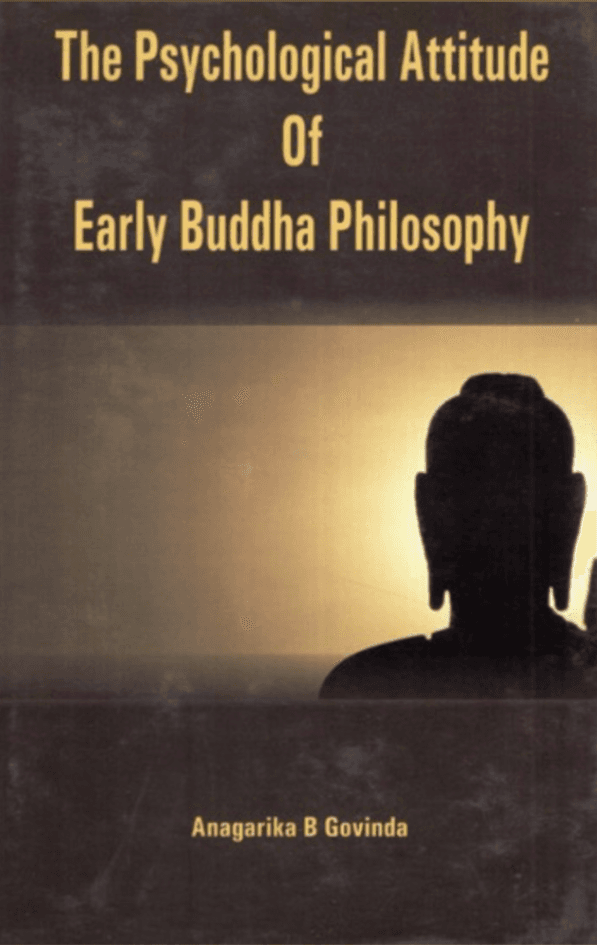
English
The Psychological Attitude of Early Buddhist Philosophy and Its Systematic Representation According to Abhidhamma Tradition
Anagarika B. Govinda
English
Book
Nag Publishers, Delhi
1975
258 pages
188.5 MB
Introduction
The book develops its main argument through a structured analysis of Indian religious development, Buddhist psychology, and Abhidhamma classification. The first part studies early Indian thought through the age of magic, the rise of anthropomorphic polytheism, the problem of God, and the problem of man, positioning Buddhism as a movement away from metaphysical absolutism toward experiential self-understanding. The second part explains psychology and metaphysics in light of the Abhidhamma, contrasting theoretical psychology with Buddhist practical psychology and emphasizing the Abhidhamma’s importance as a disciplined analysis of experience. The third part takes the Four Noble Truths as the starting point and logical frame of Buddhist philosophy, discussing suffering, the cause of suffering, cessation, happiness, the Eightfold Path, and dependent origination. The fourth part examines the fundamental principles of consciousness, including its objects, realms, structure, classification, and relation to different types of spiritually developed persons. The fifth part analyzes the factors of consciousness, including primary, secondary, neutral, and morally decisive mental factors. The sixth part studies the functions of consciousness and the process of perception, including the dynamic nature of consciousness, the problem of matter, and the stages of perceptual cognition. The appendix gives a systematic representation of Abhidhamma psychology through classifications of consciousness, mental factors, roots, objects, concepts, and the psycho-cosmic structure of Buddhism.
Copyright Notice
This material is provided solely for academic research, study, and religious practice purposes under Article 25 of Vietnam's Intellectual Property Law. Reproduction, distribution, or commercial use is strictly prohibited.
If you are the author, translator, publisher, or rights holder and believe this content has been posted without proper authorization, please contact us and we will promptly review and remove or restrict access.
Documents
The Psychological Attitude of Early Buddhist Philosophy and Its Systematic Representation According to Abhidhamma Tradition
188.5 MB
Keywords
Early Buddhist PhilosophyAbhidhammaBuddhist PsychologyConsciousnessFour Noble TruthsDependent OriginationCetasika
Sách đọc nhiều nhất
The Buddha’s Ancient Path
Piyadassi Thera
Book·10.7 MB
229 pages1979223
The Questions of King Milinda, Part II
F. Max Müller (Editor)
Book·20.8 MB
427 pages1894208

A Taste of Freedom
Venerable Ajahn Chah / Phra Bodhinyana Thera
Book·1.2 MB
104 pages1980207
Buddhist Meditation: An Anthology of Texts from the Pāli Canon
Sarah Shaw (General Editors: Charles S. Prebish and Damien Keown)
Book·17.5 MB
253 pages2006204