
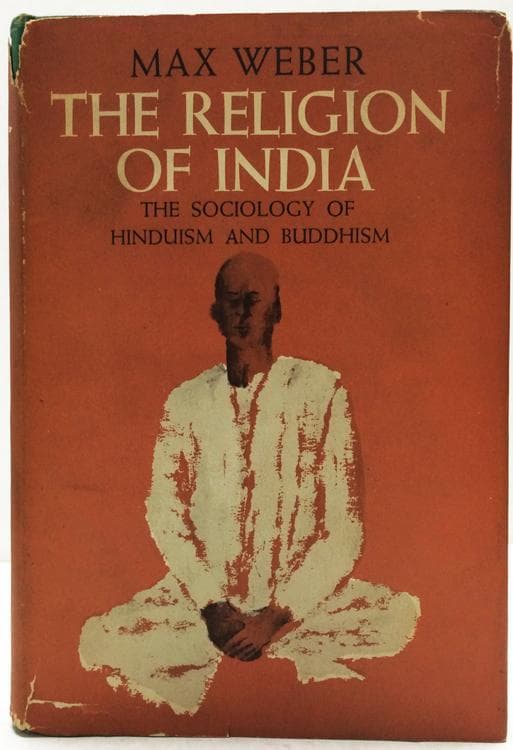
English
The Religion of India: The Sociology of Hinduism and Buddhism
Max Weber
English
Book
Munshiram Manoharlal Publishers Pvt. Ltd., New Delhi
1957
392 pages
75.6 MB
Introduction
The book is organized around three major thematic movements. The first examines the Hindu social system, beginning with India and Hinduism, then moving into the main grouping of castes, caste forms, caste schisms, ritual hierarchy, social rank, and the relationship between caste, tribe, guild, and status group. The second explores the orthodox and heterodox teachings of Indian intellectual life, including Brahmanical religiosity, ascetic discipline, yoga, the Bhagavadgītā, Jainism, and ancient Buddhism as alternative paths of salvation. The third follows the development of Asiatic sects and redemption religions, focusing on the transformation of ancient Buddhism, Buddhist missions across Asia, the restoration of Hindu orthodoxy in India, and the general character of Asiatic religion. Through these chapters, Weber constructs a sociological framework for understanding Hinduism and Buddhism as religious systems deeply embedded in social stratification, ritual authority, intellectual discipline, and historical change.
Copyright Notice
This material is provided solely for academic research, study, and religious practice purposes under Article 25 of Vietnam's Intellectual Property Law. Reproduction, distribution, or commercial use is strictly prohibited.
If you are the author, translator, publisher, or rights holder and believe this content has been posted without proper authorization, please contact us and we will promptly review and remove or restrict access.
Documents
The Religion of India: The Sociology of Hinduism and Buddhism
75.6 MB
Keywords
HinduismBuddhismcaste systemBrahmanismIndian sociologyasceticismsalvation religions.
Sách đọc nhiều nhất
The Buddha’s Ancient Path
Piyadassi Thera
Book·10.7 MB
229 pages1979223
The Questions of King Milinda, Part II
F. Max Müller (Editor)
Book·20.8 MB
427 pages1894208

A Taste of Freedom
Venerable Ajahn Chah / Phra Bodhinyana Thera
Book·1.2 MB
104 pages1980207
Buddhist Meditation: An Anthology of Texts from the Pāli Canon
Sarah Shaw (General Editors: Charles S. Prebish and Damien Keown)
Book·17.5 MB
253 pages2006204