
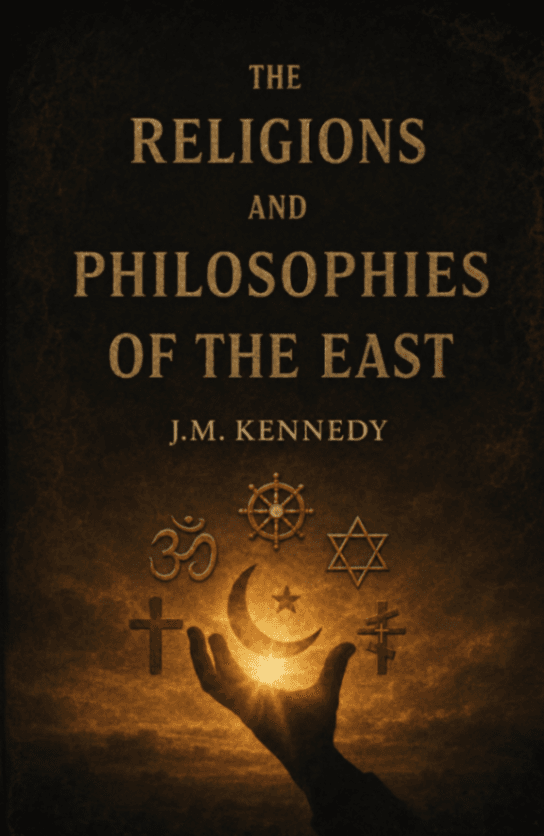
English
The Religions and Philosophies of the East
J. M. Kennedy
English
Book
John Lane Company, New York
1911
272 pages
4.3 MB
Introduction
The book is organized into eleven chapters. Chapter I discusses primitive civilization, the origin of religion, political influence on religion, and definitions of religion. Chapter II examines the Aryans, Brahmanism, caste, the Vedas, early Brahmanical literature, law codes, and gods. Chapter III treats later Brahmanism, Krishna, Krishnaism, the Bhagavad-Gītā, and marginalized social groups. Chapters IV and V focus on Buddhism, covering the Buddha’s life, teaching, illness and death, nirvāṇa, transmigration, Buddhist ethics, relics, Aśoka, edicts, and Buddhist writings. Chapters VI and VII present Islam, including the early Arabs, Mohammed, the Koran, Islamic ethics, fatalism, Sunnites, Shiites, Babism, and Behaism. Chapter VIII studies Judaism, Moses, monotheism, the Ten Commandments, Jewish morality, kingship, exile, and toleration. Chapter IX surveys Indian philosophy, Jainism, China, Confucius, Lao-Tze, Taoism, Mencius, Japan, Shintoism, Buddhism, Bushido, and the Samurai. Chapter X introduces minor Asiatic religions, including Babylonian religion, Zoroaster, Parsees, Hittites, and Mithraism. Chapter XI concludes by comparing East and West and emphasizing Asia’s influence on Europe.
Copyright Notice
This material is provided solely for academic research, study, and religious practice purposes under Article 25 of Vietnam's Intellectual Property Law. Reproduction, distribution, or commercial use is strictly prohibited.
If you are the author, translator, publisher, or rights holder and believe this content has been posted without proper authorization, please contact us and we will promptly review and remove or restrict access.
Documents
The Religions and Philosophies of the East
4.3 MB
Keywords
Eastern religionscomparative religionNietzschean philosophyBuddhismBrahmanismIslamConfucianism.
Sách đọc nhiều nhất
The Buddha’s Ancient Path
Piyadassi Thera
Book·10.7 MB
229 pages1979223
The Questions of King Milinda, Part II
F. Max Müller (Editor)
Book·20.8 MB
427 pages1894208

A Taste of Freedom
Venerable Ajahn Chah / Phra Bodhinyana Thera
Book·1.2 MB
104 pages1980207
Buddhist Meditation: An Anthology of Texts from the Pāli Canon
Sarah Shaw (General Editors: Charles S. Prebish and Damien Keown)
Book·17.5 MB
253 pages2006204