English
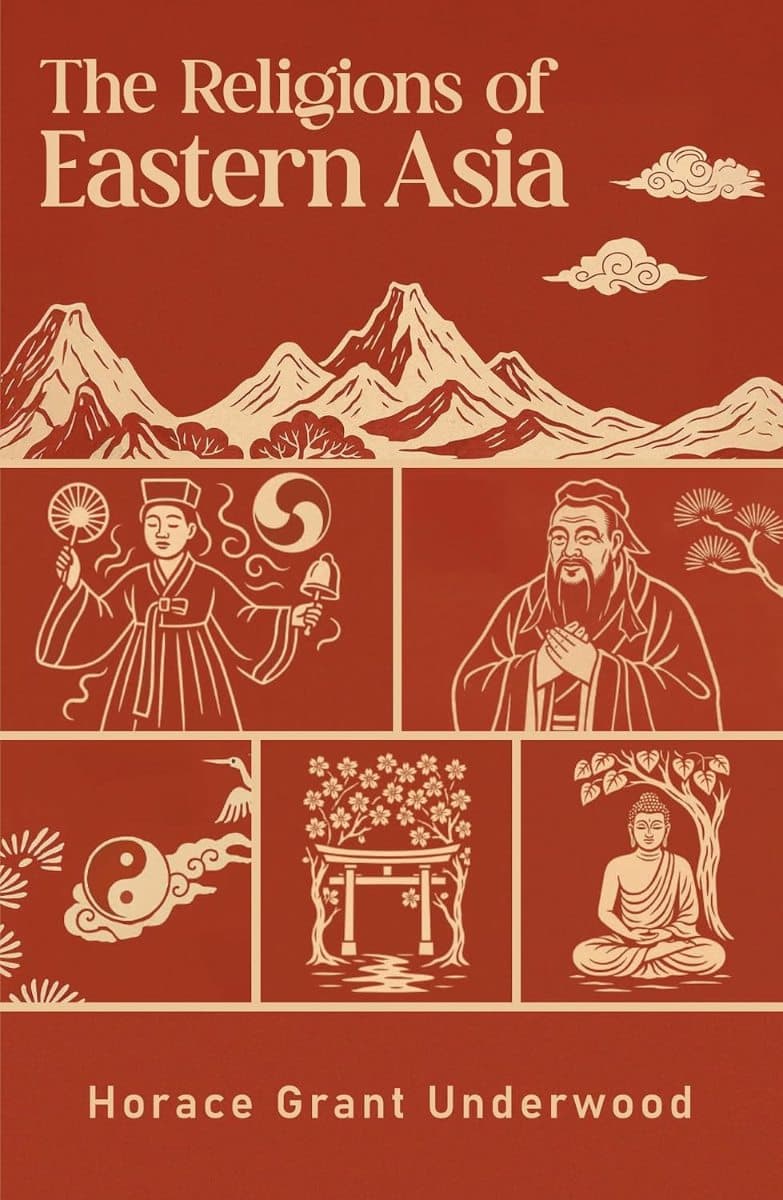
The Religions of Eastern Asia
Horace Grant Underwood, D.D.
English
Book
The Macmillan Company, New York
1910
267 pages
4.8 MB
Introduction
The book is arranged into six lectures. Lecture I, “Taoism,” examines Chinese religious origins, the idea of Tao, Lao-tzu, the distinction between Taoist philosophy and popular Taoist religion, and the movement from early theistic ideas toward spiritism and ritual practice. Lecture II, “Shintoism,” presents Japan’s indigenous religious tradition through mythology, kami worship, imperial symbolism, ritual purity, ancestor reverence, and national identity. Lecture III, “The Shamanism of Korea,” studies Korean folk religion through shamans, spirits, household worship, protective rites, fear of demons, and the religious psychology of Korean popular practice. Lecture IV, “Confucianism,” analyzes Confucius, Mencius, moral cultivation, filial piety, ancestral rites, Heaven, social order, and the question of whether Confucianism is properly religious. Lecture V, “Buddhism,” discusses the Buddha, Buddhist doctrine, nirvāṇa, karma, rebirth, monastic life, devotional Buddhism, and the transformation of Buddhism in East Asia. Lecture VI, “A Comparison of the Foregoing Theisms with that of the Old and New Testaments,” synthesizes the preceding material and contrasts East Asian religious conceptions with biblical monotheism.
Copyright Notice
This material is provided solely for academic research, study, and religious practice purposes under Article 25 of Vietnam's Intellectual Property Law. Reproduction, distribution, or commercial use is strictly prohibited.
If you are the author, translator, publisher, or rights holder and believe this content has been posted without proper authorization, please contact us and we will promptly review and remove or restrict access.
Documents
The Religions of Eastern Asia
4.8 MB
Keywords
East Asian religionsTaoismShintoismKorean shamanismConfucianismBuddhismbiblical theism
Sách đọc nhiều nhất
The Buddha’s Ancient Path
Piyadassi Thera
Book·10.7 MB
229 pages1979223
The Questions of King Milinda, Part II
F. Max Müller (Editor)
Book·20.8 MB
427 pages1894208

A Taste of Freedom
Venerable Ajahn Chah / Phra Bodhinyana Thera
Book·1.2 MB
104 pages1980207
Buddhist Meditation: An Anthology of Texts from the Pāli Canon
Sarah Shaw (General Editors: Charles S. Prebish and Damien Keown)
Book·17.5 MB
253 pages2006204