
English
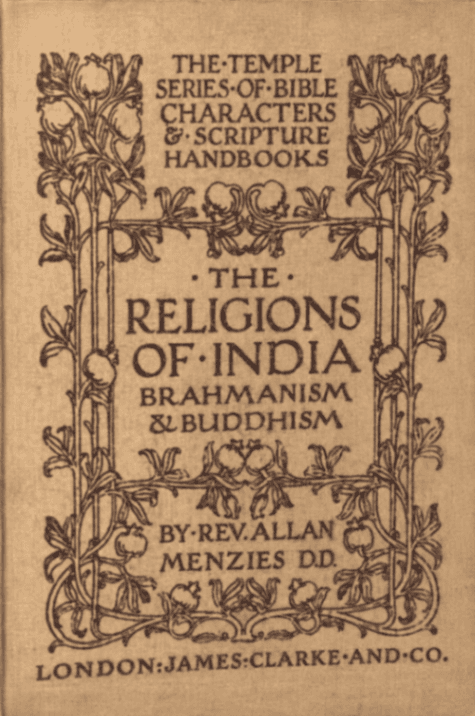
The Religions of India: Brahmanism and Buddhism
Rev. Allan Menzies, D.D
English
Book
J. M. Dent & Co., London
101 pages
4.5 MB
Introduction
The main content of the book is organized around the historical evolution of Indian religion. The first section, “The Religion of the Vedas,” introduces the early Aryan religion through the Vedic hymns, sacrificial ritual, priest-poets, Indo-Iranian background, and the worship of natural and moralized deities, showing how Vedic religion moved from nature worship toward more universal religious reflection. The second section, “Brahmanism,” examines the later development of priestly ritual, the Brahmanas, sacrificial symbolism, the rise of speculative thought, the Upanishadic search for ultimate reality, the doctrine of the Self, asceticism, karma, rebirth, and the path of liberation. The third section, “Buddhism,” presents Gautama Buddha as a religious founder who responded to the limitations of Brahmanical ritualism by teaching a practical path centered on suffering, desire, ethical discipline, meditation, renunciation, and personal effort. The final section, “Summary and Conclusion,” compares the historical relationship between Vedism, Brahmanism, Buddhism, and later Hinduism, emphasizing both continuity and conflict within Indian religious history.
Copyright Notice
This material is provided solely for academic research, study, and religious practice purposes under Article 25 of Vietnam's Intellectual Property Law. Reproduction, distribution, or commercial use is strictly prohibited.
If you are the author, translator, publisher, or rights holder and believe this content has been posted without proper authorization, please contact us and we will promptly review and remove or restrict access.
Documents
The Religions of India: Brahmanism and Buddhism
4.5 MB
Keywords
Indian religionsVedismBrahmanismBuddhismVedasUpanishadsGautama Buddha
Sách đọc nhiều nhất
The Buddha’s Ancient Path
Piyadassi Thera
Book·10.7 MB
229 pages1979223
The Questions of King Milinda, Part II
F. Max Müller (Editor)
Book·20.8 MB
427 pages1894208

A Taste of Freedom
Venerable Ajahn Chah / Phra Bodhinyana Thera
Book·1.2 MB
104 pages1980207
Buddhist Meditation: An Anthology of Texts from the Pāli Canon
Sarah Shaw (General Editors: Charles S. Prebish and Damien Keown)
Book·17.5 MB
253 pages2006204