
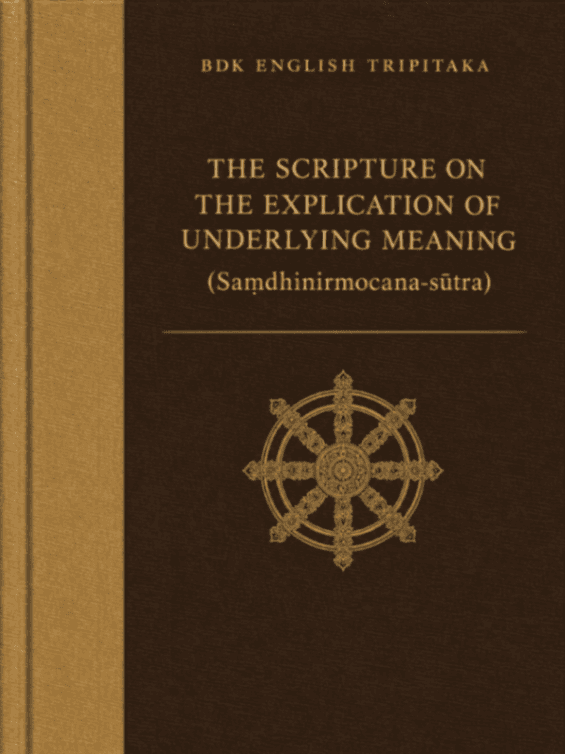
The Scripture on the Explication of Underlying Meaning (Saṃdhinirmocana-sūtra)
Introduction
The Saṃdhinirmocana-sūtra occupies a central position in the intellectual history of Mahāyāna Buddhism. According to John P. Keenan’s introduction, the scripture was apparently composed around the second century C.E. and represents an important formative stage in the emergence of Yogācāra thought. Its distinctive contribution lies in its effort to explain the “underlying meaning” or intention of earlier Buddhist teachings, particularly the Prajñāpāramitā tradition.
Rather than rejecting theoretical analysis in favor of emptiness, the scripture seeks to reconcile contemplative realization with a critical account of consciousness. It investigates how meaning, conceptual construction, perception, and awakening arise within consciousness and thereby provides a doctrinal framework for interpreting both conventional discourse and ultimate truth. This approach became especially influential in subsequent Yogācāra philosophy.
The central doctrinal chapters analyze consciousness and introduce concepts that became fundamental to Yogācāra philosophy. These include the storehouse consciousness (ālaya-vijñāna), the relation between consciousness, thought, and perception, and the three characteristic patterns or natures: the imagined (parikalpita), the dependent (paratantra), and the perfected (pariniṣpanna). Through this framework, the scripture explains emptiness and the absence of inherent essence without abandoning a systematic analysis of experience.
The later chapters apply these philosophical insights to Buddhist practice, discussing meditative centering, quietude and insight, the bodhisattva stages, the six perfections, and the enlightened activity of a Tathāgata. The text therefore combines Buddhist hermeneutics, philosophy of consciousness, meditation theory, and the bodhisattva path into an integrated doctrinal system.
The text is organized around three broad themes: the nature of ultimate meaning; the analysis of consciousness through doctrines such as ālaya-vijñāna and the three natures; and the practical implications of these teachings for meditation, the bodhisattva path, the perfections, and Buddhahood. The translator explicitly identifies the scripture as a foundational hermeneutical source for the later thought of Asaṅga and Vasubandhu.
Copyright Notice
This material is provided solely for academic research, study, and religious practice purposes under Article 25 of Vietnam's Intellectual Property Law. Reproduction, distribution, or commercial use is strictly prohibited.
If you are the author, translator, publisher, or rights holder and believe this content has been posted without proper authorization, please contact us and we will promptly review and remove or restrict access.
Documents
The Scripture on the Explication of Underlying Meaning (Saṃdhinirmocana-sūtra)
3.9 MB
Sách đọc nhiều nhất
The Buddha’s Ancient Path
Piyadassi Thera
The Questions of King Milinda, Part II
F. Max Müller (Editor)

A Taste of Freedom
Venerable Ajahn Chah / Phra Bodhinyana Thera
Buddhist Meditation: An Anthology of Texts from the Pāli Canon
Sarah Shaw (General Editors: Charles S. Prebish and Damien Keown)