
English
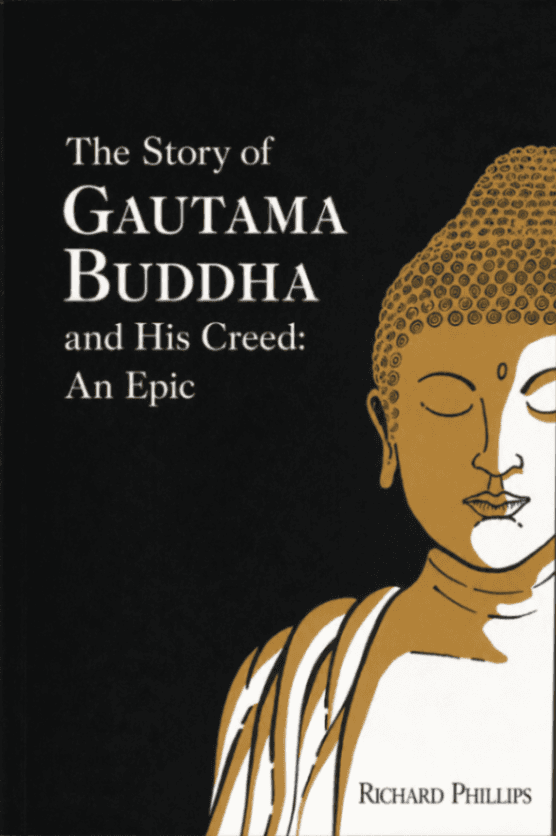
The Story of Gaútama Buddha and His Creed: An Epic
Richard Phillips
English
Book
Longmans, Green, and Co., London
1871
220 pages
4.3 MB
Introduction
The main body of the poem is arranged in an introductory poetic frame followed by thirteen cantos. The opening establishes the Buddha as a nonviolent conqueror whose influence surpasses that of kings and warriors. Canto I recounts the birth of Gautama, the joy of King Suddhodana, the death of Māyā, and the child’s early life under royal protection. Canto II describes the king’s efforts to keep the prince away from ascetic thought and surround him with pleasure. Canto III introduces marriage and worldly beauty, while the following cantos develop Gautama’s confrontation with impermanence, suffering, renunciation, ascetic discipline, and the search for truth. The middle cantos trace his withdrawal from palace life, encounter with religious teachers, severe austerities, awakening, and beginning of his mission. Later cantos present his preaching, the growth of his community, his death, the veneration of relics, and the expansion of Buddhism under Aśoka. The final cantos broaden the poem into a reflective assessment of Buddhism’s moral power, its appeal to Asia, its contrast with Christianity, and the enduring significance of the Buddha as a compassionate teacher and founder of a vast religious tradition.
Copyright Notice
This material is provided solely for academic research, study, and religious practice purposes under Article 25 of Vietnam's Intellectual Property Law. Reproduction, distribution, or commercial use is strictly prohibited.
If you are the author, translator, publisher, or rights holder and believe this content has been posted without proper authorization, please contact us and we will promptly review and remove or restrict access.
Documents
The Story of Gaútama Buddha and His Creed: An Epic
4.3 MB
Keywords
Gautama BuddhaBuddhist epicBuddha biographyrenunciationenlightenmentBuddhist creedAśoka.
Sách đọc nhiều nhất
The Buddha’s Ancient Path
Piyadassi Thera
Book·10.7 MB
229 pages1979223
The Questions of King Milinda, Part II
F. Max Müller (Editor)
Book·20.8 MB
427 pages1894208

A Taste of Freedom
Venerable Ajahn Chah / Phra Bodhinyana Thera
Book·1.2 MB
104 pages1980207
Buddhist Meditation: An Anthology of Texts from the Pāli Canon
Sarah Shaw (General Editors: Charles S. Prebish and Damien Keown)
Book·17.5 MB
253 pages2006204