English
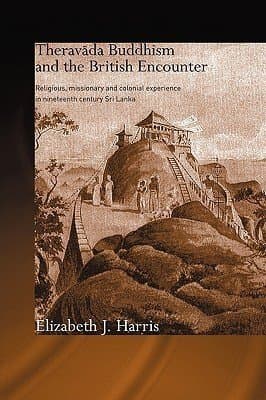
Theravāda Buddhism and the British Encounter: Religious, Missionary and Colonial Experience in Nineteenth-Century Sri Lanka
Elizabeth J. Harris
English
Book
Taylor & Francis Group
2006
289 pages
1.1 MB
Introduction
The book opens with an Introduction, where Harris explains the intellectual and personal background of the study. She began her inquiry while living in Sri Lanka between 1986 and 1993, where she encountered multiple forms of Buddhism: public Buddhism, devotional and ritual Buddhism, meditation-oriented Buddhism, philosophic Buddhism, militant Buddhism, and anti-Christian Buddhist discourse. This complexity led her to investigate how colonial encounters, especially the interaction between Buddhists and evangelical British missionaries, shaped modern Sri Lankan Buddhism and Buddhist–Christian relations.
Harris positions her work in relation to Edward Said’s Orientalism and Philip Almond’s The British Discovery of Buddhism. However, she argues that a study of British representations alone is insufficient. The Sri Lankan Buddhist side of the encounter must also be taken seriously. Her method emphasizes dialogue, reciprocity, contingency, and multiplicity rather than a one-sided model of Western construction.
Part I: 1796–1830
Chapter 1: Introduction
This chapter sets the first historical phase. British rule began in coastal Sri Lanka in 1796 after the fall of Dutch power and was consolidated when Sri Lanka became a British dependency in 1802. The British did not initially control the whole island; the Kandyan Kingdom remained independent until 1815.
The chapter examines early British attitudes toward Sri Lanka, including paternalistic governance, commercial interest, cultural superiority, and stereotypes about Sinhala society. It also explains the arrival of Protestant missionary societies, especially the London Missionary Society, Baptist Missionary Society, Wesleyan Methodist Missionary Society, American Mission Board, and Church Missionary Society. Missionary interpretations of Buddhism were shaped by evangelical theology, the desire to convert, and the conviction that Buddhism had to be confronted as religious error.
Chapter 2: The Early British Visitors: Mapping the Ground
This chapter studies the first wave of British observers, including Joseph Joinville, Robert Percival, James Cordiner, John Davy, William Harvard, Methodist missionaries, and Edward Upham.
Harris shows that these writers encountered Buddhism in different ways. Some relied on hearsay and earlier European sources; some observed ritual practice; some spoke with Buddhist monks; some used textual materials; and some approached Buddhism primarily as missionaries. Their descriptions were inconsistent and often contradictory. Buddhism could appear as idolatry, moral philosophy, metaphysics, superstition, or an ancient religious system. The chapter establishes the book’s central pattern: British interpretations of Buddhism were diverse from the beginning.
Part II: 1830–1870
Chapter 3: Introduction
This chapter introduces the second phase of the encounter. By this period, British colonial rule had become more secure, missionary activity had expanded, and Buddhist institutions were increasingly pressured by Christian education, printing, debate, and conversion campaigns.
Chapter 4: The Arrogance of Power: The Memoir Writers
This chapter examines memoir writers who described Buddhism from within the confidence of colonial authority. Their accounts often reflected assumptions of British superiority and interpreted Sri Lankan Buddhism through categories of decline, passivity, superstition, or civilizational inferiority.
Chapter 5: Christian Exclusivism: The Protestant Missionaries and Their Friends
This chapter studies Protestant missionary writings and their polemical interpretation of Buddhism. Missionaries often presented Buddhism as false, morally inadequate, nihilistic, pessimistic, or incapable of salvation. Their purpose was not neutral description but religious contestation. This chapter is central for understanding how anti-Buddhist missionary discourse provoked later Buddhist reform and apologetic response.
Chapter 6: Missionary Scholars: Daniel Gogerly and Robert Spence Hardy
This chapter analyzes two major missionary scholars: Daniel Gogerly and Robert Spence Hardy. Both studied Buddhism more seriously than many earlier missionaries, using texts and monastic sources, yet their scholarship remained tied to missionary objectives.
Harris shows the complexity of such figures: they contributed to Western knowledge of Buddhism, but they also used that knowledge to critique and undermine Buddhist belief. Hardy, in particular, became a major reference point in later Buddhist–Christian mistrust.
Chapter 7: Buddhism’s Glorious Core: Turnour’s Allies
This chapter considers British and colonial scholars who were more sympathetic to Buddhism, especially those associated with the recovery and appreciation of Sri Lankan Buddhist textual history. The chapter highlights the growing importance of Pāli studies, historical chronicles, and the recognition that Buddhism possessed an ancient, sophisticated, and ethically serious tradition.
Part III: 1870–1900
Chapter 8: Introduction
This chapter introduces the third phase, when Buddhism became a more prominent subject in Victorian intellectual culture. By the late nineteenth century, Western interest in Buddhism had moved beyond missionary polemic and colonial description into literature, comparative religion, Theosophy, conversion, and public debate.
Chapter 9: The Buddha as Hero: Arnold’s The Light of Asia
This chapter examines Edwin Arnold’s The Light of Asia, one of the most influential Western literary representations of the Buddha. Arnold presented the Buddha as a heroic, compassionate, noble spiritual figure. This image contrasted sharply with missionary depictions of Buddhism as nihilistic or morally deficient.
Chapter 10: Buddhism as Nihilism: The Missionary Perspective
This chapter returns to missionary critiques of Buddhism, especially the claim that Buddhism was nihilistic because of its doctrine of nibbāna. Harris shows how this interpretation became one of the most persistent missionary attacks. Buddhism was often represented as life-denying, pessimistic, and spiritually empty.
Chapter 11: Romantic Other, Negative Spin: Constance Gordon Cumming
This chapter studies Constance Gordon Cumming’s representation of Sri Lankan Buddhism. Her writing combined romantic fascination with negative judgment. Harris uses this material to show how admiration and condescension could coexist within Victorian representations of Buddhism.
Chapter 12: Buddhism as Life-Affirming: Contesting the Missionaries
This chapter presents British and other voices that challenged missionary claims that Buddhism was nihilistic. These writers argued that Buddhism could be understood as ethical, rational, compassionate, disciplined, and life-affirming. The chapter shows that British discourse on Buddhism was internally contested.
Chapter 13: Contrasting Scholars: R. S. Copleston and T. W. Rhys Davids
This chapter compares Reginald Stephen Copleston, Anglican Bishop of Colombo, with T. W. Rhys Davids, the pioneering Pāli scholar. Copleston’s interpretation remained shaped by Christian theological commitments, while Rhys Davids helped establish Buddhism as a serious object of academic study in the West. Their contrast reveals the tension between missionary theology and emerging scholarly Buddhology.
Chapter 14: Balancing the Exoteric and the Esoteric: Theosophists in Sri Lanka
This chapter examines Theosophical engagement with Sri Lankan Buddhism. Theosophists played a significant role in Buddhist revival and education, but their interpretation of Buddhism often combined Buddhist themes with esoteric and universalist religious ideas. Harris shows that Theosophy both supported and reshaped Buddhist self-presentation.
Chapter 15: Convert to Compassion: Allan Bennett
This chapter focuses on Allan Bennett, later known as Ananda Metteyya, one of the first British Buddhist monks and an important early Western Buddhist figure. His conversion represents a significant shift: Buddhism was no longer merely an object of British observation, criticism, or scholarship; it became a path that some Westerners adopted.
Part IV: Remodelling Buddhist Belief and Practice: The Dynamics of Protestant Buddhism
Chapter 16: The British as Witnesses to the Tradition: Continuity and Ruption
This chapter examines the British as witnesses to Sri Lankan Buddhist tradition. Harris studies both continuity and rupture, showing that British accounts preserved information about Buddhism while also filtering it through colonial, missionary, and Orientalist frameworks.
Chapter 17: The Roots of Buddhist Modernism
This chapter investigates the emergence of Buddhist modernism in Sri Lanka. Harris connects Buddhist reform to missionary pressure, print culture, debate, education, colonial critique, and Buddhist efforts to defend the Dhamma in modern terms.
Chapter 18: One Tradition, Differing Voices
This chapter emphasizes internal diversity within Sri Lankan Buddhism. Harris rejects the idea of a single Buddhist response to colonialism. Different monks, lay leaders, reformers, traditionalists, and educated Buddhists interpreted the tradition in different ways.
Chapter 19: Threat to the Dhamma, a Dhamma Renewed
This chapter argues that missionary criticism and colonial pressure were perceived as threats to the Dhamma, but they also stimulated renewal. Buddhist reformers rearticulated Buddhism as rational, ethical, textual, disciplined, and compatible with modernity. Harris treats Protestant Buddhism not as a simple imitation of Christianity, but as a complex Buddhist response to colonial and missionary challenge.
Part V: Discourses of Contempt: The Encounter Between Buddhists and Christian Missionaries
Chapter 20: Co-existence and Dual Belonging
This chapter examines everyday religious coexistence, porous boundaries, and cases of dual religious belonging. Harris complicates the idea that Buddhist–Christian relations were always defined by hostility.
Chapter 21: World Views in Collision
This chapter studies deeper theological and philosophical conflict between Buddhist and Christian worldviews. Missionary exclusivism, Buddhist defense, and competing understandings of salvation, morality, ritual, and truth created a field of sustained confrontation.
Chapter 22: Betrayal and Retaliation
This chapter explores how conversion, polemic, and missionary critique produced feelings of betrayal and retaliation among Buddhists. Harris shows that religious encounter under colonial conditions could intensify communal mistrust and sharpen boundaries.
Chapter 23: The Twentieth Century
This chapter moves beyond the nineteenth century to consider later consequences. Harris asks whether colonial-era Buddhist–Christian conflict contributed to twentieth-century Buddhist suspicion of Christianity and possibly to broader patterns of religious and ethnic tension in Sri Lanka.
Epilogue
The Epilogue returns to Western constructions of Buddhism in the early twentieth century. Harris discusses how romantic travellers, Christian missionaries, textual scholars, and converts inherited nineteenth-century representations and helped prepare the way for Buddhism to become not only an Asian religion but also a Western religious and intellectual presence.
Copyright Notice
This material is provided solely for academic research, study, and religious practice purposes under Article 25 of Vietnam's Intellectual Property Law. Reproduction, distribution, or commercial use is strictly prohibited.
If you are the author, translator, publisher, or rights holder and believe this content has been posted without proper authorization, please contact us and we will promptly review and remove or restrict access.
Documents
Theravāda Buddhism and the British Encounter
1.1 MB
Keywords
Theravāda BuddhismBritish EncounterSri LankaProtestant BuddhismBuddhist–Christian Relations.
Sách cùng tác giả
Sách đọc nhiều nhất
The Buddha’s Ancient Path
Piyadassi Thera
Book·10.7 MB
229 pages1979223
The Questions of King Milinda, Part II
F. Max Müller (Editor)
Book·20.8 MB
427 pages1894208
A Taste of Freedom
Venerable Ajahn Chah / Phra Bodhinyana Thera
Book·1.2 MB
104 pages1980207
Buddhist Meditation: An Anthology of Texts from the Pāli Canon
Sarah Shaw (General Editors: Charles S. Prebish and Damien Keown)
Book·17.5 MB
253 pages2006204