
English
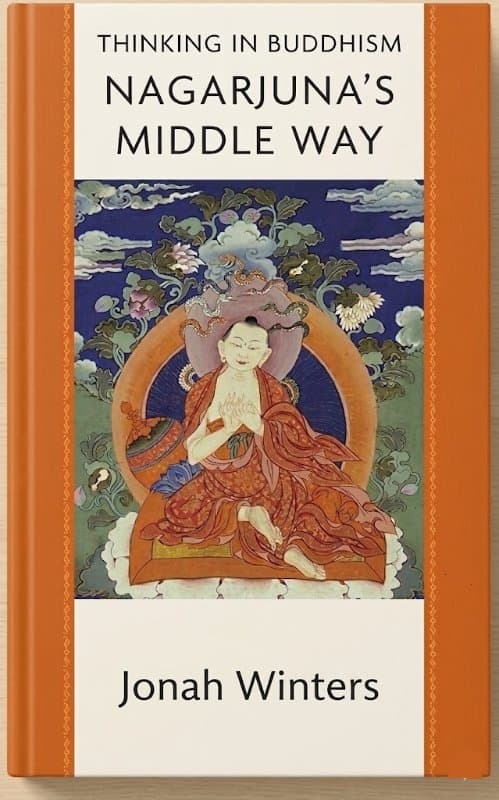
Thinking in Buddhism: Nagarjuna’s Middle Way
Jonah Winters
English
Book
1994
154 pages
533 KB
Introduction
The document opens with an “About this Book” section explaining the author’s terminology and translation policy. Winters states that most early Buddhist texts are in Pāli, while Madhyamaka texts are generally in Sanskrit or Buddhist Hybrid Sanskrit. For consistency, Sanskrit forms are generally preferred. Terms such as karma, nirvana, Buddha, and Tathagata are left untranslated, while other technical terms are translated where possible for accessibility.
Chapter 1: Introduction
The introduction situates Buddhism within Western intellectual reception. Winters notes that Buddhism has attracted Western interest because it appears to offer a path based on personal understanding rather than divine revelation or priestly authority. He also warns against reducing Buddhism to Zen or conflating it with vague modern spiritual movements.
The chapter introduces the distinctive character of Buddhist thought: Buddhism does not posit a fixed ultimate substance in the way many Western, Abrahamic, Hindu, or metaphysical systems do. Instead, it avoids rigid assertions about ultimate reality. Winters identifies Madhyamaka as the school most suitable for examining this distinctive Buddhist method because it gives conceptual expression to the Buddha’s non-affirming and non-negating approach.
1.1 Notes on the Methodology of this Thesis
This section explains that the thesis focuses almost exclusively on Nāgārjuna’s Mūlamadhyamakakārikā. Winters deliberately avoids extensive use of other Nāgārjuna texts, later commentators, or Western philosophical comparisons in order to keep the study centered on the foundational Madhyamaka treatise itself. The intended audience is the educated lay reader rather than only specialist scholars.
Chapter 2: The Buddha and His Teachings
2.1 The Life of the Buddha
This section presents the traditional life of Siddhartha Gautama: his princely upbringing, the Four Sights, renunciation, ascetic practice, rejection of extremes, awakening under the Bodhi tree, and teaching career. Winters emphasizes that the Buddha claimed no divine authority, but taught from direct realization.
2.2 The Thought of the Buddha
This section presents the core of Buddhist teaching. Winters identifies impermanence as the key philosophical insight and the path as the key religious or soteriological framework. He explains the Four Noble Truths, the Noble Eightfold Path, suffering, craving, nirvāṇa, non-self, and dependent arising. The Buddha is presented as a “spiritual doctor” who diagnoses suffering, identifies its cause, declares its cure, and prescribes the path.
Chapter 3: Early Buddhism and the Historical Context of Nagarjuna
3.1 The Person of Nagarjuna
This section introduces traditional legends about Nāgārjuna, including his association with the Nāgas and the recovery of the Prajñāpāramitā scriptures. Winters notes that while such legends are not historically secure, they demonstrate Nāgārjuna’s importance in Buddhist tradition as a major restorer and interpreter of the Dharma.
3.2 Some Early Controversies
This section explains early Buddhist doctrinal disputes after the Buddha’s death. Winters discusses the rise of debates over the nature of the person, the reality of dharmas, the status of the Buddha, and the interpretation of no-self. Three major tendencies are highlighted: Personalism, Realism, and Transcendentalism.
3.3 Abhidharma and the Perfection of Wisdom Writings
This section contrasts Abhidharma systematization with the Prajñāpāramitā literature. Abhidharma sought to analyze experience into dharmic categories, while Perfection of Wisdom texts emphasized emptiness and the inadequacy of fixed conceptual categories.
3.4 The Main Figures of Madhyamika
This section introduces the principal figures associated with the Madhyamaka school, especially Nāgārjuna and later interpreters. It prepares the reader for the close reading of the Mūlamadhyamakakārikā.
Chapter 4: Nagarjuna’s Mulamadhyamakakarika
This is the central chapter of the thesis.
4.1 Structure of the Karika
Winters explains the organization of Nāgārjuna’s root verses and the philosophical progression of the text.
4.2 Methodology of this Examination of the Karika
This section explains how Winters will approach the text: not by translating every verse in exhaustive philological detail, but by presenting the main arguments and doctrinal movement of each section.
4.3 A Presentation of the Treatise
This long section follows the structure of the Mūlamadhyamakakārikā:
Section 1 — Causation and Initial Problems
Nāgārjuna begins by rejecting causation from self, other, both, or no cause. The aim is not to deny conventional causality, but to undermine metaphysical theories of intrinsic causation.
Section 2 — Nominal and Verbal Subjects
This section examines linguistic and conceptual relations, especially how naming and conceptual designation shape our understanding of phenomena.
Sections 3–6 — Factors of Personal Existence: Elements and Passions
Nāgārjuna analyzes the components of personal existence and shows that neither elements nor passions possess self-nature.
Section 7 — Cohesion of Disparate Elements
This section discusses conditioned formations and the problem of how apparently separate elements are taken to form coherent entities.
Sections 8–11 — The Ontological Status of the Individual
Nāgārjuna examines the person, agent, action, and individuality, rejecting the idea of an inherently existing self.
Sections 12–13 — Suffering and Its Cause
These sections connect Madhyamaka analysis with the Buddhist diagnosis of suffering. Suffering cannot be understood through fixed entities, but through dependent processes.
Sections 14–15 — Identity and Difference
Nāgārjuna critiques the binary of identity and difference, showing that phenomena cannot be coherently understood as either absolutely identical or absolutely distinct.
Sections 16–17 — Bondage and Its Cause
This part analyzes bondage, karma, and the mechanisms by which beings remain trapped in saṃsāra.
Section 18 — Selfhood and Its Consequences
This section directly addresses the problem of selfhood and shows how clinging to self produces philosophical confusion and existential bondage.
Sections 19–21 — Time and Phenomena
Nāgārjuna examines past, present, future, arising, duration, and destruction. He denies that time can be established as an inherently existing entity.
Section 22 — The Enlightened One
This section analyzes the ontological status of the Tathāgata. Nāgārjuna rejects attempts to define the Buddha as existent, nonexistent, both, or neither in ultimate terms.
Sections 23–24 — Error and Truth
These sections discuss wrong views, the Four Noble Truths, and the two levels of truth. Section 24 is especially important because it explains that emptiness makes conventional truth and liberation possible.
Section 25 — Enlightenment
Nāgārjuna examines nirvāṇa and rejects the view that it is an independently existing metaphysical state separate from saṃsāra.
Section 26 — Dependent Arising
This section returns to dependent arising as the positive framework of Madhyamaka. Dependent arising explains both bondage and liberation without requiring self-nature.
Section 27 — Right and Wrong Views
The final section critiques speculative views and concludes the text by reaffirming the Middle Way beyond metaphysical extremes.
Chapter 5: The Philosophy of Madhyamika
This chapter synthesizes the philosophical orientation of Madhyamaka. Winters presents Madhyamaka as a system that does not establish a new metaphysical doctrine, but dismantles attachment to all views that assume fixed essence or self-nature.
Chapter 6: Nagarjuna’s Motivation and Mission
6.1 The Dedicatory Verses
This section examines Nāgārjuna’s opening homage and its philosophical significance.
6.2 Self-Nature Theories
Winters explains the central target of Nāgārjuna’s critique: svabhāva, or self-nature.
6.3 Non-Buddhist Notions of Self-Nature and the Soul
This section discusses Indian theories of essence, soul, and metaphysical substratum outside Buddhism.
6.4 The Buddha’s Theory of Soul-lessness
Winters returns to the Buddha’s doctrine of non-self as the foundation for Nāgārjuna’s critique.
6.5 Nagarjuna’s Response
Nāgārjuna’s mission is presented as a defense and radical clarification of the Buddha’s teaching against substantialist interpretations.
Chapter 7: Dependent Arising, the Foundation of Madhyamika
7.1 Dependent Arising as a Central Notion in Buddhism
This section explains dependent arising as the core Buddhist doctrine of conditionality.
7.2 The Meaning of Dependent Arising
Winters explains that phenomena arise in dependence on causes, conditions, conceptual designation, and relational structures.
7.3 Madhyamika Interpretation and Reinterpretation
This section shows how Nāgārjuna reinterprets dependent arising as inseparable from emptiness. Because things arise dependently, they cannot possess self-nature.
Chapter 8: Emptiness, the Ultimate Cosmology
8.1 Pre-Madhyamika Use of the Concept
This section traces emptiness before Nāgārjuna, especially in early Buddhism and Prajñāpāramitā literature.
8.2 Emptiness as a Via Negativa
Winters presents emptiness as a way of negation: it removes false views rather than establishing a new metaphysical substance.
8.3 Emptiness Is Perceived, Not Invented
This section argues that emptiness is not a speculative invention, but the insight into how things actually exist dependently.
8.4 Dependent Arising + No Self-Nature = Emptiness
This is the conceptual heart of the thesis. Emptiness is the conclusion that follows when dependent arising is combined with the absence of self-nature.
8.5 Emptiness Is a Theory of No-Theory
Winters explains that emptiness should not become another dogmatic theory. Its function is therapeutic: to release attachment to all fixed views.
8.6 Emptiness Is Freedom Itself
The chapter concludes by connecting emptiness with liberation. Realizing emptiness frees the mind from clinging, conceptual fixation, and existential bondage.
Chapter 9: Conclusion
The conclusion gathers the main argument: Nāgārjuna’s Madhyamaka is not nihilism, skepticism, or metaphysical absolutism. It is a Middle Way that clarifies the Buddha’s teachings on dependent arising, non-self, and liberation.
Chapter 10: Epilogue
The epilogue provides closing reflections on the meaning and continuing significance of Madhyamaka thought.
Chapter 11: Bibliography and Index
The work concludes with a bibliography and index, supporting further study of Nāgārjuna, Madhyamaka, early Buddhism, and Buddhist philosophy.
Copyright Notice
This material is provided solely for academic research, study, and religious practice purposes under Article 25 of Vietnam's Intellectual Property Law. Reproduction, distribution, or commercial use is strictly prohibited.
If you are the author, translator, publisher, or rights holder and believe this content has been posted without proper authorization, please contact us and we will promptly review and remove or restrict access.
Documents
Thinking in Buddhism Nagarjuna’s Middle Way
533 KB
Keywords
NāgārjunaMadhyamakaMiddle WayDependent ArisingEmptiness.
Sách đọc nhiều nhất
The Buddha’s Ancient Path
Piyadassi Thera
Book·10.7 MB
229 pages1979223
The Questions of King Milinda, Part II
F. Max Müller (Editor)
Book·20.8 MB
427 pages1894208

A Taste of Freedom
Venerable Ajahn Chah / Phra Bodhinyana Thera
Book·1.2 MB
104 pages1980207
Buddhist Meditation: An Anthology of Texts from the Pāli Canon
Sarah Shaw (General Editors: Charles S. Prebish and Damien Keown)
Book·17.5 MB
253 pages2006204