
English
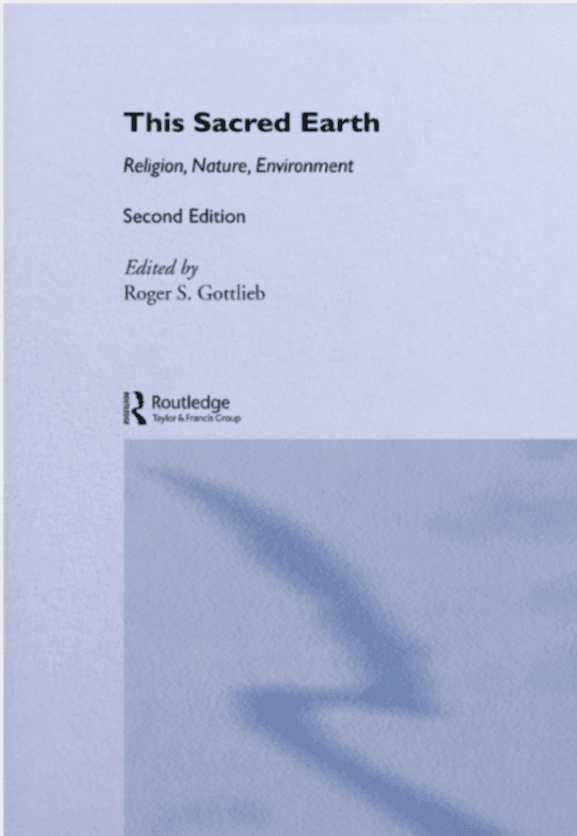
This Sacred Earth: Religion, Nature, Environment
Roger S. Gottlieb
English
Book
Routledge
2004
699 pages
6.1 MB
Introduction
The book opens with Preface and Acknowledgments, where Gottlieb explains that the anthology surveys traditional religious perspectives on nature and contemporary religious responses to environmental devastation. The editor states that the selections were chosen for historical importance, insight, literary quality, and representation of particular religious or spiritual traditions.
The Introduction: “Religion in an Age of Environmental Crisis” frames the ecological crisis as both an external and internal crisis. Gottlieb argues that environmental destruction produces fear, grief, anger, despair, and moral disorientation. He identifies major areas of concern: climate change, toxic waste, loss of land, loss of species, loss of wilderness, devastation of indigenous peoples, overconsumption, and genetic engineering. The introduction also explains why religion matters: religious traditions shape values, rituals, visions of the good life, and attitudes toward human obligations to the natural world.
The Introduction to the Second Edition: “Good News/Bad News” updates the first edition by noting that environmental problems have worsened, yet religious environmentalism has expanded significantly. Gottlieb highlights the growth of scholarship, institutional commitment, interfaith activism, climate campaigns, environmental justice movements, and religious participation in ecological politics.
Part I: The Moment of Seeing — Selections from Nature Writers Linking Nature and Spirit
This part gathers literary and contemplative writings that present nature as a source of spiritual awakening. The emphasis is not formal doctrine, but direct perception: the moment when the natural world becomes charged with meaning.
Major selections include:
Matsuo Bashō, from the Haibun
Bashō represents a poetic and contemplative perception of nature rooted in Japanese literary and spiritual sensitivity.
William Hazlitt, “On the Lure of the Country”
Hazlitt reflects on the attraction of rural life and the restorative power of the countryside.
Henry David Thoreau, from “Walking”
Thoreau presents walking in wild nature as a form of spiritual and existential renewal.
Ralph Waldo Emerson, “Nature”
Emerson’s text represents Transcendentalist spirituality, where nature becomes a medium for self-knowledge and contact with the divine.
John Muir, from Thousand-Mile Walk to the Gulf
Muir gives a deeply reverent vision of wilderness, later foundational for American conservation consciousness.
Aldo Leopold, from A Sand County Almanac
Leopold introduces an ecological ethic that challenges purely human-centered value systems.
Luther Standing Bear, “Nature”
This selection gives an Indigenous perspective on the human relationship with the natural world.
Linda Hogan, “The Kill Hole”
Hogan’s writing links ecology, memory, violence, and Indigenous spiritual perception.
Part II: How Have Traditional Religions Viewed Nature?
This part surveys religious and cultural traditions before the rise of modern environmentalism. It shows that traditional religions have held diverse views of nature: sometimes reverential, sometimes hierarchical, sometimes anthropocentric, sometimes deeply ecological.
Key selections include:
Fanetorens / Ray Fadden, “The Creation”
An Indigenous creation account emphasizing the sacred structure of the world.
Hindu selections: “Death and Rebirth of the Universe” and “The Parade of Ants”
These selections present cosmic cycles, humility before vast time, and the place of human beings within a larger universe.
“The Five Suns” — Aztec tradition
A mythic account of cosmic ages and the fragility of world order.
“Persephone” — Greek tradition
A classical myth connecting seasonal rhythms, death, fertility, and renewal.
Lao Tzu, from the Tao Te Ching
This selection represents Taoist harmony with the natural order, non-domination, and the wisdom of yielding.
Selections from the Hebrew Bible
These passages introduce creation, covenant, land, dominion, stewardship, Sabbath, and moral responsibility.
Selections from the Qur’an
The Qur’anic passages present creation as signs of divine wisdom and place humanity within a moral order of accountability.
Daniel Swartz, “Jews, Jewish Texts, and Nature: A Brief History”
This essay surveys Jewish approaches to nature, environmental responsibility, and textual interpretation.
Anna Peterson, “In and of the World: Christian Theological Anthropology and Environmental Ethics”
Peterson examines Christian anthropology and asks how human beings can be understood as both spiritually distinctive and ecologically embedded.
Michael Kioni Dudley, “Traditional Native Hawaiian Environmental Philosophy”
This essay presents Hawaiian environmental thought, emphasizing land, kinship, spirit, and responsibility.
Chatsumarn Kabilsingh, “Early Buddhist Views on Nature”
This selection presents Buddhist reflections on nature, non-harming, compassion, simplicity, and the interdependence of life.
Leslie E. Sponsel and Poranee Natadecha-Sponsel, “Illuminating Darkness”
This essay studies the monk-cave-bat-ecosystem complex in Thailand, showing how Buddhist practice can interact with ecological systems.
O. P. Dwivedi, “Satyagraha for Conservation”
Dwivedi connects Hindu spirituality, Gandhian nonviolence, and conservation.
Mawil Y. Izzi Deen, “Islamic Environmental Ethics, Law, and Society”
This essay explores Islamic teachings on creation, trusteeship, moderation, justice, and ecological responsibility.
Part III: Ecotheology in an Age of Environmental Crisis — Transforming Tradition
This part examines how religious traditions reinterpret themselves in response to ecological crisis. It includes institutional statements, theological essays, and activist reflections.
Key selections include:
Lynn White, “The Historical Roots of Our Ecological Crisis”
A landmark essay arguing that Western Christianity contributed to ecological domination through its interpretation of human mastery over nature.
Pope John Paul II, “The Ecological Crisis: A Common Responsibility”
A Catholic statement linking ecological responsibility with moral duty and global solidarity.
American Baptist Churches USA, “Creation and the Covenant of Caring”
A Christian institutional response emphasizing creation care and covenantal responsibility.
Evangelical Environmental Network, “Evangelical Declaration on the Environment”
An evangelical Christian statement affirming environmental stewardship as part of faithfulness to God.
Ecumenical Patriarch Bartholomew, “Address of His All Holiness”
A major Orthodox Christian environmental statement emphasizing spiritual accountability for ecological harm.
John F. Haught, “Christianity and Ecology”
Haught offers a theological rethinking of Christianity in relation to ecological science and environmental crisis.
John B. Cobb, Jr., “Protestant Theology and Deep Ecology”
Cobb places Protestant theology in dialogue with deep ecology.
Sallie McFague, “The Scope of the Body: The Cosmic Christ”
McFague proposes a theological vision of the world as God’s body, expanding Christian ecological imagination.
Arthur Waskow, “What Is Eco-Kosher?”
Waskow reinterprets Jewish dietary and ethical practice in ecological terms.
Nawal H. Ammar, “An Islamic Response to the Manifest Ecological Crisis”
Ammar links Islamic ecological ethics with justice, responsibility, and social order.
Christopher Key Chapple, “Hinduism and Deep Ecology”
Chapple explores points of contact between Hindu traditions and deep ecological thought.
Tu Weiming, “Beyond the Enlightenment Mentality”
Tu Weiming presents a Confucian and post-Enlightenment critique of modernity’s domination of nature.
Stephanie Kaza, “To Save All Beings: Buddhist Environmental Activism”
Kaza connects Buddhist compassion, interdependence, non-harming, and activism for ecological protection.
Gary A. Kowalski, “Somebody, Not Something: Do Animals Have Souls?”
Kowalski challenges reductionist views of animals and argues for their moral and spiritual significance.
Andrew Linzey, “The Theological Basis of Animal Rights”
Linzey provides a Christian theological argument for animal rights.
Roger S. Gottlieb, “No Place to Hide: Spirituality, Avoidance, and Denial”
Gottlieb examines how spirituality can either confront or avoid ecological crisis.
Part IV: Ecotheology in an Age of Environmental Crisis — Ecofeminist Spirituality
This section focuses on ecofeminism, which links the domination of women and the domination of nature.
Key selections include:
Rosemary Radford Ruether, “Ecofeminism”
Ruether analyzes symbolic and social connections between patriarchy, oppression of women, and exploitation of nature.
Ivone Gebara, “The Trinity and Human Experience”
Gebara presents an ecofeminist approach to Christian theology.
Shamara Shantu Riley, “Ecology Is a Sistah’s Issue Too”
Riley develops an Afrocentric ecowomanist perspective on ecology and social justice.
Karen Baker-Fletcher, “Something or Nothing”
This essay examines God, creation, and indispensability from an eco-womanist perspective.
Irene Diamond and David Seidenberg, “Sensuous Minds”
This selection develops a Jewish ecofeminist practice grounded in embodiment, nature, and relationality.
Riane Eisler, “Messages from the Past”
Eisler explores goddess traditions and alternative models of culture.
Brooke Medicine Eagle, “The Rainbow Bridge”
A spiritually oriented Indigenous and ecofeminist reflection.
Vandana Shiva, “The Chipko Women’s Concept of Freedom”
Shiva analyzes women-led environmental resistance in India and connects ecology with freedom, community, and survival.
Part V: Ecotheology in an Age of Environmental Crisis — Spiritual Deep Ecology
This part explores spiritual deep ecology, emphasizing transformation of human identity and a deeper sense of belonging within the Earth community.
Key selections include:
Edna St. Vincent Millay, “The Fawn”
A poetic entry into vulnerability, beauty, and human response to nonhuman life.
David Abram, “The Ecology of Magic”
Abram explores perception, language, animism, and the more-than-human world.
Thomas Berry, “Into the Future”
Berry presents an ecological and cosmological vision of humanity’s future.
Joanna Macy, “Faith, Power, and Ecology”
Macy links Buddhist-inspired systems thinking, ecological activism, grief work, and empowerment.
Paul Shepard, from The Others: How Animals Made Us Human
Shepard reflects on the formative role of animals in human identity, culture, and consciousness.
Part VI: Religious Practice for a Sacred Earth
This part presents rituals, prayers, meditations, and liturgical resources designed for ecological awareness and healing.
Key selections include:
Dee Smith, “Dance to Heal the Earth”
A ritual practice linking embodied movement and ecological healing.
Thich Nhat Hanh, “Earth Gathas”
Short Buddhist verses for mindfulness of the Earth in daily life.
Ellen Bernstein and Dan Fink, “Blessings and Praise” and “Bal Tashchit”
Jewish ecological prayers and teachings rooted in the prohibition against wasteful destruction.
Black Elk, “Wiwanyag Wachipi: The Sun Dance”
A Native American ritual text emphasizing sacrifice, renewal, and sacred relationship.
National Council of Churches, “Worship Resources, Earth Day Sunday”
Christian liturgical materials for ecological worship.
John Seed, “Invocation”
A deep ecology ritual invocation.
John Seed and Joanna Macy, “Gaia Meditations”
Meditative practices designed to awaken planetary consciousness.
John Seed and Pat Fleming, “Evolutionary Remembering”
A ritual practice for reconnecting human identity with evolutionary history.
Marina Lachecki, “The Blessing of the Water”
A ritual honoring water as sacred and life-giving.
Part VII: Ecology, Religion, and Society
The final part examines the intersection of religion, ecology, politics, activism, justice, race, globalization, indigenous rights, and social transformation.
Key selections include:
Roger S. Gottlieb, “Saving the World: Religion and Politics in the Environmental Movement”
Gottlieb analyzes the political role of religious environmentalism.
Mark I. Wallace, “Environmental Justice, Neopreservationism, and Sustainable Spirituality”
Wallace links ecological preservation with justice-oriented spirituality.
Sarah McFarland Taylor, “Reinhabiting Religion”
Taylor studies “Green Sisters,” ecological renewal, and religious landscapes.
Catherine Ingram, “Interview with Cesar Chavez”
This selection connects labor justice, spirituality, agriculture, and ecological concern.
Seth Zuckerman, “Redwood Rabbis”
An example of Jewish environmental activism.
Evelyn Martin, “Of Telescopes, Squirrels, and Prayers”
This essay discusses the Mt. Graham controversy, where science, indigenous sacred land, and environmental protection collide.
Bruce Byers, “Mhondoro: Spirit Lions and Sacred Forests”
A study of African sacred forests and spirit ecology.
Ernst Conradie and others, “Seeking Eco-Justice in the South African Context”
This essay brings environmental concern into dialogue with South African social justice.
B. D. Sharma, “On Sustainability”
A reflection on sustainability, development, and ethical responsibility.
Mary John Mananzan, “Globalization and the Perennial Question of Justice”
Mananzan critiques globalization through justice-oriented religious reflection.
William F. Fisher, “Sacred Rivers, Sacred Dams”
This essay examines competing visions of justice and sustainability along the Narmada River.
United Church of Christ, “Statements on Environmental Racism in St. Louis”
A religious response to environmental racism.
Coordinadora de Defensa del Agua y de la Vida, “The Cochabamba Declaration on Water”
A political and ethical statement against water privatization.
Principles of Environmental Justice
A foundational document from the First National People of Color Environmental Leadership Summit.
Religious Leaders at the Summit on Environment and Joint Appeal by Religion and Science for the Environment
These statements show interfaith and religion-science collaboration on ecological responsibility.
Copyright Notice
This material is provided solely for academic research, study, and religious practice purposes under Article 25 of Vietnam's Intellectual Property Law. Reproduction, distribution, or commercial use is strictly prohibited.
If you are the author, translator, publisher, or rights holder and believe this content has been posted without proper authorization, please contact us and we will promptly review and remove or restrict access.
Documents
This Sacred Earth: Religion, Nature, Environment
6.1 MB
Keywords
Religion and EcologyEcotheologyEnvironmental EthicsEcofeminismDeep Ecology.
Sách đọc nhiều nhất
The Buddha’s Ancient Path
Piyadassi Thera
Book·10.7 MB
229 pages1979223
The Questions of King Milinda, Part II
F. Max Müller (Editor)
Book·20.8 MB
427 pages1894208
A Taste of Freedom
Venerable Ajahn Chah / Phra Bodhinyana Thera
Book·1.2 MB
104 pages1980207
Buddhist Meditation: An Anthology of Texts from the Pāli Canon
Sarah Shaw (General Editors: Charles S. Prebish and Damien Keown)
Book·17.5 MB
253 pages2006204